
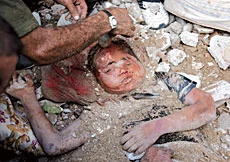
BEIRUT, 14 August 2006 — After a stormy debate yesterday, Israel’s Cabinet approved a Mideast cease-fire, agreeing to silence the army’s guns in less than 24 hours amid a last-minute push by the military to deliver a devastating blow to Hezbollah. The 24-0 vote, with one abstention, came a day after the Lebanese government approved the agreement. The truce was to take effect today morning, but the potential for new flare-ups remained high.
A heated debate erupted during the Israeli Cabinet session, with minister Ofir Pines-Paz criticizing the government’s decision to order an expanded ground offensive in the days before the cease-fire is to take effect.
Prime Minister Ehud Olmert said the cease-fire agreement would ensure that “Hezbollah won’t continue to exist as a state within a state.”
The Cabinet session came as some 30,000 Israeli troops fought heavy battles with Hezbollah a day after 24 soldiers were killed in the highest Israeli toll of the monthlong war.
The cease-fire was to go into effect at 8 a.m. today, three days after the UN Security Council passed a resolution laying out a blueprint to end the fighting. After the halt in fighting, some 15,000 Lebanese troops and an equal number of UN forces were to deploy in the coming days in south Lebanon and create a Hezbollah-free zone, from the Israel-Lebanon border to Lebanon’s Litani River.
The Israeli Army “will withdraw as the Lebanese Army and the international force deploys,” Foreign Minister Tzipi Livni said. “The Security Council decision is good for Israel, and if it’s implemented, it will lead to a significant change in the rules of the game in Lebanon,” Livni said. “I’m not naive. ... I live in the Middle East, and I know that sometimes not every decision is implemented. I’m aware of the difficulties, yet with this I say with full confidence that the Security Council decision is good for Israel.”
Meanwhile, Saudi Foreign Minister Prince Saud Al-Faisal said yesterday that the UN resolution fell short of expectations, but said the Kingdom stands by the Lebanese government that has approved it.
“UN (Security Council) Resolution 1701 did not include all that we wanted, but we stand by the Lebanese government in all its demands,” Prince Saud told reporters in Sanaa.
Yesterday, Hezbollah fired more than 200 rockets at northern Israel, killing an Israeli man in a direct hit on a house, police said. Israeli jets ranged across the skies above Lebanon from north to south, hitting a Hezbollah stronghold in south Beirut with at least 20 missiles in a two-minute period yesterday.
The jets also attacked gas stations in the southern port city of Tyre. The strikes killed at least 12 people, Lebanese officials said.
The potential for more clashes after a cease-fire was high, with Israeli troops remaining in south Lebanon until Lebanese and international troops take their place.
Livni said the fighting brought “a change in the rules of the game” between Israel and Lebanon and the cease-fire should “lead in the end to the disarming of Hezbollah.” Livni said Israel would not stop trying to win the soldiers’ release, but would not accept a link between the release of the captives and Hezbollah’s initial demand that Israel release Lebanese prisoners.
“The prime minister will personally appoint a person who would take care of the issue,” she said. “We will have to enter a process which means negotiations.”
The Cabinet session was overshadowed by rising Israeli casualties. Twenty-four soldiers were killed Saturday and at least 73 wounded as Hezbollah shot down an Israeli helicopter, a first in the war, and killed five crew members. Other troops were killed by Hezbollah anti-tank missiles. The army said it killed more than 50 Hezbollah fighters.

