
JEDDAH, 23 August 2006 — The recent Israeli invasion of Lebanon and its aftermath has gripped the attention of people around the world, especially in the Middle East. Political analysts have turned to the Arab street to gauge the opinions of ordinary people which often vary greatly from the views of their governments.
“The views of this street will shape the destiny of Arab countries,” wrote Riz Khan in a recent article in this newspaper. “It was, after all, the Arab street that elected Hezbollah members to government positions in Lebanon. It was the Arab street that elected Hamas to lead the Palestinians.”
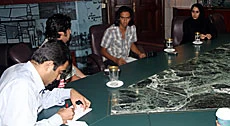
Although 60 percent of the Arab population is below 25, their views are seldom heard. Arab News recently organized a roundtable discussion about the conflict in Lebanon with four young Saudis and also to learn their views on its ramifications for the future of the Middle East. The discussion was moderated by National Desk Editor Mahmoud Ahmad. Three of the young Saudis were Jeddah students, Ahmad Sabri and Mohammad Jastaniah from King Abdul Aziz University along with Dima Ikhwan from Effat College. The fourth, Salem Bajnaid, had recently returned from studies in the UK.
Although the four agreed on certain points, they also differed on others — from whether Hezbollah’s stand against the Israelis really constituted a victory to differing views on a peaceful resolution to the differences in the region or eventually driving the Israelis into the sea.
When asked to define terrorism, their differences became apparent. “I guess killing civilians constitutes terrorism,” said Ikhwan. “In Lebanon, it was war — open war. During wars all kinds of terrible things happen. That is a given. What happened in Qana was terrible. It was terrible carnage. But I think it was the consequence of war. I make a difference between ordinary circumstances and war. As to what is terrorism? It is the media that gives an act a label. And when something gets a label, it is very difficult to undo it. Whoever controls the media gets to define what terrorism is. The most powerful media is the American media, so they decide what is terrorism and what is not.”
“We all agree that Sept. 11, 2001, was an act of terrorism,” said Sabri. “What happened on that day? Two hijacked airplanes rammed into the Twin Towers in New York killing nearly 3,000 innocent people. What just happened in Lebanon, and has been happening in Palestine for many years, is far worse. Innocent people were killed in cold blood by the Israelis. They destroyed civilian infrastructure in Lebanon. They bombarded the airport in Beirut. In Lebanon, innocent children were targeted in civilian buildings. We heard on American television about the children being killed ... So going by the American definition of terrorism, Israel is a terrorist state. I define terrorism as intentionally killing or hurting civilians by a group whether that group is a government or a militia.”
“So you don’t differentiate between war and normal circumstances?” Ikhwan queried. “What about Hiroshima?”
“I think that Hiroshima was a terrorist attack,” Sabri replied. “It was a direct attack on civilians. It intentionally targeted civilians. War or no war, hitting civilians is an act of terror. What happened in Qana during the Israeli war on Lebanon was that US-supplied precision-guided missiles were fired into a building full of unarmed civilians, including many children. If that is not terrorism, then what is? The children were killed intentionally. We have in Palestine, F-16 fighter jets repeatedly targeting schools. Are those attacks not acts of terror? There are nearly 100 documented cases of Israelis targeting civilians.”
“Israel is a terrorist state,” Bajnaid said. “They are striking terror in the hearts of civilians. They are supported by the American administration. This Republican administration has the full support of the fundamentalist neocons. They will never condemn any Israeli terror acts. To me, these neocons are no better than the Bin Ladens and the Al-Zawahiris.”
When asked if Hezbollah’s crudely aimed rocket attacks against Israeli population centers constituted terrorism, the young people had some interesting ideas.
“First of all, the majority of Israelis are serving in the army,” Sabri said. “They are all reservists. They are not in uniform. But most of them are part of the military. Secondly, Israel is an occupying nation. It was created merely 50 years ago. It occupied Arab land. The Israelis are the occupiers. There is not even one single meter that is owned by the Israelis. It is all our land. We have the right to fight against the occupiers. They are on our land. And we fight to get our land back.”
Sabri said some allowances for Hezbollah were justified. “They (the Israelis) claim that Hezbollah hides in civilian areas,” he said. “Hezbollah is the people. Do the Israelis expect them to stand on open ground for the F-16s and Apache helicopters to fire at? They are guerrillas.”
“Let me make it very clear. I am, or rather we are, not against the Jews. Let us make that absolutely clear,” said Jastaniah. “We don’t hate the Jews — never. We are against Israel and its terrorist policies. We hate the Zionists. It is a historic fact that Jews enjoyed protection under Muslim rule. They were persecuted by the Europeans. They were hounded out of Europe. So let me make it clear, we don’t hate Jews.”
Jastaniah also said Israel’s policies amount to state terrorism. “Yes, Israel is a terrorist state,” Jastaniah said. “There was an article in The Guardian of London recently that said we are still debating whether what happened in Qana was a war crime. According to the writer, the same thing was debated 10 years ago when Qana was attacked. And, according to him, they will debate the same thing in 10 more years when Qana is attacked again. This is ridiculous. Innocent people were bombed for no crime. It was murder on an unimaginable scale. Just this one act qualifies Israel to be branded as a terrorist state.”
As for Hezbollah’s raid that resulted in the deaths of several Israeli soldiers and the capture of two, the young Saudis’ opinions ranged from its being justifiable to its being folly. “First of all, Israel is occupying Shebaa Farms,” Jastaniah said. “It is Lebanese territory. According to international opinion, the Lebanese people have the right to resist. And they are resisting. For me, the raid was justified. Hezbollah was prepared for the consequences. Israel is a very small country, well-supported by the US. It has nuclear weapons. Hezbollah is just a militia. Still Israel couldn’t win. We have won.”
“Whether Hezbollah captured the soldiers or not, Israel would still have gone to war,” Sabri said. “There is near unanimity among military analysts that they (the Israelis) were waiting for an excuse. They were itching for war. Hezbollah was expecting this reaction from the Israelis.”
“No. Hezbollah didn’t do the right thing,” Ikhwan said. “It resulted in death and destruction. Lebanon had just come out of the civil war. It was in the process of rebuilding itself. And now it has been set back by another 20 years. Hezbollah was wrong.”
“Why don’t you talk about the Arab prisoners? Hezbollah asked for their release,” Sabri countered. “And the Israeli soldiers were captured in order to get them released. There are more than 10,000 Palestinian and Lebanese prisoners in Israeli jails. And remember, that number includes women and children.”
“There are only four Lebanese prisoners,” Ikhwan responded. “One is convicted of killing four Israelis. One the Israelis claim they don’t have. One is an Israeli himself. He is a Lebanese Israeli. Yes, there are Palestinian prisoners. But I don’t see why Hezbollah should be concerned about them. We didn’t gain anything from this war.”
As for a lasting peace in the region, there was a range of opinion. “I have always believed that we have the power to win against Israel,” Bajnaid said. “Just cut oil supplies for one day and see how the world reacts. They will put all pressure on Israel and it will immediately come to its senses. Even the United States will come to its senses. Just a one-day cut in oil supplies. There is no will to win. We don’t want to. No Arab country is ready to take on America. But it is worth remembering that America has betrayed its friends in the past.”
“Those who have fought against colonialism and occupation understand the reasoning behind the intifada and resistance,” Jastaniah said. “The Irish, for example, are sympathetic to our cause because they know what it means to be under occupation. The most important thing is to know how to use the media. We need to make ourselves very clear. We are the victims, not the aggressors. We are defending our land — not usurping the land of someone else.”
“I always believed that we can win,” Sabri said. “And we won. Israel will not last as a state. It is just a question of another 50 years.”
“I think we should adopt Gandhi’s way to expel the occupiers — that of pacifist resistance,” Ikhwan said. “We have to win over world opinion. It is important. Ultimately, it is world pressure that will force Israel to give up. Suicide bombings and killing innocent civilians will always turn the tide of world opinion against us. Gandhian principles are the only option.
“As to whether Israel is defeatable or invincible, I think we’ve got to accept that Israel is here to stay. The sooner we realize this the better it will be for all of us. Israel is going to exist. You cannot wish it away. If we accept this fact we will be able to solve a lot of problems affecting our region.”