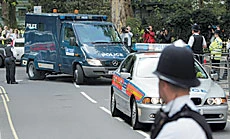
LONDON, 23 August 2006 — Amid tight security in central London yesterday afternoon, 11 people appeared before the City of Westminster Magistrates Court charged with conspiracy to murder and a new offense of preparing acts of terrorism under the 2006 Anti-terrorism Act, which came into effect in April this year. All the 11 people were remanded in custody. They all deny the charges.
The 11 accused arrived separately at the court in vans with blacked-out windows, having been ferried from the high security Paddington Green police station in Edgware Road.
The charges were in connection with an alleged terror plot to blow up nine trans-Atlantic airliners, using liquid explosives disguised in soft drink bottles and smuggled on to the planes in hand luggage.
The proceedings were dragged out because Westminster Magistrate Court is very small and compact. The demeanor of the suspects was described by one observer as “unexceptional”. Some of them glanced and waved to family members and friends who had packed the public gallery in the court.
Eight of the suspects — Tanvir Hussain, 25, from Leyton, east London; Umar Islam (born Brian Young), 28, from Stratford, east London; Arafat Waheed Khan, 25, from Walthamstow, east London; Ahmed Abdullah Ali, 25, from Walthamstow; Ibrahim Savant (born Oliver Savant), 25, of north London; Waheed Zaman, 22, from Walthamstow; Assad Ali Sarwar, 26, from High Wycombe and 19-year-old Adam Khatib, from Walthamstow —were all remanded in custody until Sept. 4 when they will appear at the Old Bailey. They were charged with conspiracy to murder and with preparing acts of terrorism under Section 5 of the 2006 Anti-Terrorism Act. No applications for bail were made.
Two others — Mehran Hussain, and Cossar Ali, a 23-year old mother of an eight-month-old baby and wife of accused Ahmed Abdullah Ali — were charged with failing to disclose information which might be of material assistance in preventing others from the commission of a terrorist act.
The eleventh person charged was a 17-year-old boy who cannot be named under the law because of his age and who is accused of possessing information of use to someone preparing a terrorist act including a book on bombs, suicide notes and the wills of people prepared to commit terrorist acts.
The three were remanded in custody until Aug. 29 with no bail applied for on their behalf.
British police have until today to question 11 other people suspected of being involved in the alleged plot which, according to Scotland Yard, intended to “commit mass murder on an unimaginable scale.”
Yesterday, Scotland Yard’s anti-terror chief, Peter Clarke, the deputy assistant commissioner, for the first time released information about the progress of the investigation.
“First, there is evidence from surveillance carried out before Aug. 10. This includes important, indeed, highly significant video and audio recordings. I can also tell you that since Aug. 10 we have found bombmaking equipment. There are chemicals, including hydrogen peroxide, electrical components, documents and other items. We have also found a number of video recordings — these are sometimes referred to as martyrdom videos. This has all given us a clearer picture of the alleged plot,” he said.
The investigation, however, because of its enormity and size, may take months to complete.
Police conducted 69 searches of houses, businesses and vehicles; they seized 400 computers; they have examined 200 mobile telephones; they removed 8,000 removable storage media devices such as CDs, DVDs, memory sticks; and they have removed in total 6,000 gigabytes of data.
“The meticulous investigation of all this material will take many months. All the data will be analyzed. There will be thousands of forensic examinations and comparisons.
Fingerprints, DNA, electronic data, handwriting comparisons, chemical analysis, and indeed the full range of forensic disciplines will be used,” explained Clarke.
Civil liberties and human rights lawyers are wary that such a detailed disclosure of the evidence could jeopardize a fair trial for the defendants.
Geoffrey Byman, a human rights lawyer, expressed concern that potential jurors in the trial may be influenced by what they are reading in the papers especially about information “brought out in such a one-sided way”.
After all, the accused have only been charged, and have not stood trial as yet. There is a real risk that potential jurors may not forget what they have read about such a high profile case.