
The Chinese take their religious duty to appease the spirits of their dead ancestors quite seriously, and nowhere more so than on the northern tip of Taiwan just 23 kilometers from the capital, Taipei.
The Mid-Summer Ghost Festival takes place every year in the seventh month of the Chinese lunar calendar; it has been celebrated for thousands of years in China. In Keelung, the festival has been held regularly since the August 1851 war called the “Changchow and Chuanchow Clash” in which many people died. Luckily, after wise people of high esteem stepped in and mediated a peaceful settlement, further clashes were avoided. Instead, the families of Keelung decided to offer sacrifices to the souls of the dead.
Every year a different family, from an association of 15 leading families in Keelung, sponsors the Ghost Festival, paying for the many floats that appear in a parade on the 14th day of the Ghost month, and which are later released into the sea on the 15th and burned on the water as a way of attracting the lost souls of ghosts who are wandering the Earth.
But I am getting ahead of myself here. The Chinese are mostly Taoists and Buddhists and so believe that the souls of departed loved ones must be appeased every year with prayers and offerings of food and paper money at temples. They also believe that on the seventh month of the Chinese calendar, the gates of Hell are opened and its ghosts are allowed to roam the Earth freely. Therefore, the Chinese find this month a bad luck one, and as such, refrain from getting married during the month, embarking on a new project or making a major purchase such as a new car or house.
I witnessed Keelung’s Ghost Festival parade this year as a guest of the Taiwanese government along with a group of 11 international journalists. Keelung takes the Ghost Festival especially seriously because of the fact that in the early days of the settlement of Taiwan by Chinese from the mainland, there were a large number of immigrants who died on the island in shipwrecks, military disasters, inter-group fights and disease. Most of them were bachelors without any offspring or family members to provide for them, so that when they died, they became restless, wandering ghosts. Thus the Ghost Festival turned into a major event for Keelung in an attempt to appease the ghosts by offering them food and money so that they wouldn’t haunt those who are still alive.
Keelung being so close to Taipei meant that we were able to arrive on the actual day of the parade, which this year fell on Aug. 7. We checked into the comfortable Evergreen Laurel Hotel (62-1, Chung Chen Road, Keelung 202, Tel. 02-2427-9988), which is located at the harbor, just a few blocks away from the start of the parade, and were able to walk to the festivities. Approaching the grandstand where we would be seated next to the local VIPs, we saw row upon row of satellite dish vans from all the leading Taiwanese television networks which were going to broadcast the parade live.
The parade began at 7 p.m. with a speech by the mayor of Keelung and the city council speaker. Taiwan is very hot and sticky in the summer, so everyone crowding the streets was madly fanning themselves with the free, paper fans given out by the Ghost Festival organizers.
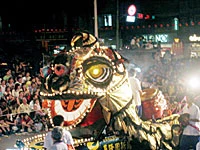
The first float had yellow and pink lanterns, while others were decorated with fresh flowers. All of them came by in a cacophony of music blaring forth from speakers mounted on each float. Acrobatic orange and yellow dragons, a whole orchestra on horse back, cartoon characters for the kids, a giant gong and a giant gold fish, and a whole group of young men walking high above the crowd on stilts were just some of the floats that I saw.
Each float had several people on it waving to the crowd and obviously enjoying themselves. The whole event had a carnival-like atmosphere, and hardly seemed like something you would expect to celebrate the visit of ghosts on Earth.
After two hours of this non-stop glitz and music, I had had enough and walked back to my hotel. The parade lasted until 10 p.m., winding through the major streets of Keelung. Later that night, we took a bus to a beach in the city where all the parade’s participants had gathered to put the finishing touches on their individual lanterns built to resemble mini-temples. Made of paper, plastic and wood, these lanterns can take from 2-3 months to build, according to Mr. Teng, whom I met there.
A riot of color, the temples were covered in drawings of orange, pink, yellow, light blue and green dragons. “It cost us NT$8,000 (around SR920) to build this temple,” he told me as he stuffed fake paper money into the temple to give the ghosts some money to spend.
Laid out on long tables near the beach, food and paper money were being placed into the lanterns in preparation for their launch into the sea shortly after midnight. Hundreds of residents turned up to watch the festivities, and hawkers sold everything from cheap watches to grilled sausages to the crowds.
Liz, an English journalist in our group, and I bought a bright red paper lantern around four feet high. We both inscribed our names on it and let the vendor light the flame that would propel it skyward with our wishes for good fortune. We watched the lantern rise into the night sky, its light blinking faithfully for several minutes until it disappeared into the inky darkness.
A fire truck and several firemen were present in case a major fire broke out. On the beach, several people were burning large amounts of fake, paper money, which sent clouds of stinging smoke and ashes into the eyes of the bystanders.
At midnight, the 50 lantern-temples were carefully carried down the rocky slope to the beach, and with the candles within them lit, pushed into the sea. Not surprisingly, the lanterns didn’t get very far before burning down in a blaze of orange flames. Some of them, packed beforehand with fireworks, let out loud noses as the fireworks exploded in the sky above us. Everyone seemed to have a digital or video camera out to record the event. By 12:15 a.m. it was all over and the crowd began to disperse.
The next day we looked for the small tables of offerings for the ghosts that individual families put out in front of their homes. Piles of packaged food, fresh fruit, candy and even face powder, a comb and a mirror were laid out on these tables. The food was to feed the hungry ghosts, while the makeup was there to beautify them as they are allegedly ugly because they live in Hell. Hopefully, all of this bounty was enough to appease and please the ghosts until they return again next year for their annual vacation on Earth, a welcome break for them from the horrors of Hell.
Getting There: Cathay Pacific (www.cathaypacific.com) has flights three times a week from Riyadh to Taipei via Hong Kong. Fares for a roundtrip in mid-September cost from SR4,183 in economy and SR13,192 in business class per person. Cathay also has packages from SR3,778 per person (excluding taxes) in economy class with 3-nights accommodation in Taipei and an optional stopover in Hong Kong. For reservations and more information call Cathay Pacific in Riyadh at 01-479-3232.
Entry Requirements: Saudis need a visa to enter Taiwan as tourists. Contact the Taipei Economic and Cultural Representative Office in Riyadh (Tel. 01-488-1900, ext. 208) or Jeddah (Tel. 02-660-02264) for more information. A single entry visit visa costs SR135 and applicants will need a letter of introduction from their company or government department where they work. Saudis do not need visas for Hong Kong.
Accomodation: In Taipei I stayed at the Evergreen Laurel Taipei Hotel (No. 63 Sung Chiang Rd., Tel. 02-25019988), a luxury boutique hotel where rooms cost around $138 a night per person, breakfast included. My room included a double bed, DSL Internet access, a flat-screen TV, mini-bar and gold-plated sinks and toilet in the bathroom.
Currency and Time Zone: It may be impossible to exchange Saudi riyals for New Taiwanese dollars in Taiwan so bring US dollars with you. The exchange rate is roughly $1=NT$32.60. Taiwan is five hours ahead of the Kingdom (GMT+8).
Language: English is not widely spoken, so make sure that you master a few words of basic Mandarin and ask that your hotel write down all of your destinations clearly in Chinese, so that you can just show the card to a taxi driver or passerby when asking for directions.