
ALKHOBAR, 5 September 2006 — When I write this column every week, I am surrounded by my birds. Their twittering and chirping keep me company throughout the long workdays. In fact, as I write this column, Ivanovich is sitting beside me. Ivan is an African Grey parrot, who is casually drinking cola through a straw while I share with him the main points I want to make in today’s column.
What does Ivan have to do with information technology? Nothing. The truth is that telling you about Ivan is a bribe. Today, I want to convince all of you to pay attention for a short while and learn some important stuff about information security. In exchange for reading a little bit about information security, I’ll tell you a few secrets about the feathered friends who keep me company while I’m at my keyboard.
We include articles about information security on the pages of Arab News nearly every week. Unfortunately, lots of people don’t read them. Folks tell me that information security is a very boring topic. I’m a very security conscious person, so respectfully, I disagree. Firewalls, anti-virus and encrypted data are all essential elements in the quest to keep my data safe. So why isn’t everyone equally conscious of the seriousness of paying attention to information security? After much investigation, I believe the real reason people don’t read about information security is that they are afraid.
For the average person just keeping a PC up and running is a major feat. Nobody wants to even consider everything that could go wrong with that stupid machine. It’s not very comfortable either to think overly much about all the evil doers lurking online, just waiting to reach out and attack our data. Everybody has heard of someone somewhere who has suffered some sort of IT fraud or PC hack, but we all are certain it will never happen to us. When it comes to information security, I see lots of ostriches behind the keyboards out there and they’ve all got their heads in the Saudi sand.
Speaking of ostriches, my office is populated with other birds besides Ivan, the parrot. I have six lovebirds — Blue Masked Lovebirds, Masked Lovebirds and Peach Faced Lovebirds. Recently one of the Blue Masked Lovebirds got together with one of the Peach Faced Lovebirds and they are now raising four chicks. What color are the chicks? Only time will tell. What I do know is that their excited baby “cheeps” are punctuating all the sentences in this article.
If it were only “cheeps” punctuating the Internet, too, the virtual world would be a happy place. Instead, criminals have interrupted the smooth functioning of online applications such as e-mail and Net banking. The coming year is going to be the most challenging yet for information security protection in the Kingdom. Every Saudi bank already has warnings concerning “phishing” frauds posted before log-in at their Internet banking sites. “Nigerian Scams” with a Middle Eastern flavor are proliferating. “Technical subterfuge” schemes are planting crimeware onto unprotected PCs to steal credentials directly, often using key logging systems to intercept consumers’ online account user names and passwords.
People believe that if they don’t use Internet banking or make purchases online, that they are safe from the Net thieves. This illusion is quickly dissipating. PCs are packed with lots of important data. How much would you pay to obtain a password to be able to access your applications, your address book or your family’s photos again? Nasty computer code called “Ransom Trojan horses” were found a few months ago and it is expected that such “malware” will become more common and sophisticated in the future.
All right, all right, it’s time for a break from the security sermon. Ivan the parrot is loudly advising me to stop horsing around and peel him a grape. Yes, of course, Ivan can talk. He has a vocabulary of about two dozen words and is well able to make his requirements known. One of Ivan’s favorite snacks are juicy red grapes. He enjoys apples and green chillies, too, but he draws the line at carrots. Put a carrot near him and Ivan flings it across the room.
That’s exactly the strategy we should use with the criminals that want to access our PCs — keep them as far away as possible. So please do a small favor for me. Paste the following address into your browser: http://www.techweb.com/showArticle.jhtml?articleID=161100001. An article will appear titled, “10 Free Ways To Keep Your PC Safe,” by Preston Gralla. This is a superb feature that just was posted on the Internet in August. It gives clear guidance including excellent illustrations and screen shots concerning firewalls, anti-virus, anti-spyware and much more. All the downloads suggested are FREE and from reputable sources. That means all you need to invest to secure your PC is your time. Try to implement one suggested security upgrade each week and in a couple of months you’ll officially have a black belt in personal information security.
Once you’ve enhanced your own information security, it’s time to reach out to others. The most optimistic statistics put Home PC Penetration in Saudi Arabia at about 30 percent. Consequently, even without available data, it can be extrapolated that in the Kingdom, knowledge about information security is very low. Just by reading this article on information security, you probably know more about the topic than most people around you. So be a force for good.
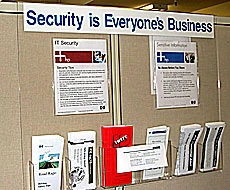
The photo accompanying this article was taken at the HP Labs in Palo Alto, California. HP is one of the largest IT companies in the world and they have a great, low tech, low cost way of helping their staff learn about all areas of security — including information security — and even enabling them to share that knowledge with others. Throughout the offices at the HP Labs are wall mounted displays that bear the slogan “Security is Everyone’s Business.” On the displays are posted fliers with tips and policies about network security and information security in the workplace. At the bottom of the displays are pockets holding leaflets that provide information about various security issues. HP encourages its staff to read the material and then pass on the leaflets to family and friends who could benefit from the knowledge as well.
Some of the leaflets available during my visit to HP were “Preventing Computer and Information Theft,” “ID Theft: What’s It All About,” “Road Rage” and “The Nigerian Scam: Costly Compassion.” Ivan, the parrot, thinks the ID Theft leaflet is the most attractive — perhaps due to the bright red color of its cover, but all the leaflets were quite informative.
It would be very simple for anyone to make such a security display for their workplace, school, mosque, housing compound, supermarket or social center. Companies such as electronics super stores could do the same at their retail locations. The material for the display is available from many sources over the Internet. Download the security information and print it on plain paper using any printer or photocopier. Then fold the sheets in thirds to create leaflets, place the leaflets in the pockets on the display, make sure instructions on the display read: “Please take one,” and regularly keep the display stocked with items of interest.
Such an effort wouldn’t cost much but the impact on our society could be enormous. Social scientists estimate that one leaflet could be passed around to at least five people. Those five people would then each verbally spread at least a portion of that knowledge on to ten more people. In no time at all the level of information security awareness in this society would rise to new heights. That would go a long way to reducing the success of information theft and technology crimes targeting citizens and residents in the Kingdom.
Need help getting started? Send me a request by e-mail and I’ll send you by e-mail the first four information bulletins for your security display. Need help convincing someone to put up a security display? First, show them this article. If that’s not enough, send me their e-mail or postal address and I’ll send them a personal note requesting their support for your security project. If you send me a photo of your security display, I’ll send you a photo of Ivan the parrot with his security message, “I’m not a birdbrain. I take security seriously.”
Contact me through: [email protected].