
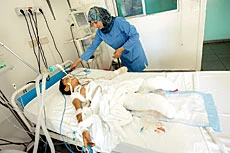
BEIRUT, 13 August 2006 — An avalanche of Israeli troops and armor roared into southern Lebanon yesterday, reaching the Litani River and igniting some of the heaviest ground combat of the monthlong war. Hezbollah shot down an Israeli helicopter late in the night with a new missile called “Waad”.
Hezbollah leader Hassan Nasrallah joined the government in backing a UN cease-fire plan but vowed to fight on until Israeli forces withdrew. “We will not be an obstacle to any (government) decision that it finds appropriate, but our ministers will express reservations about articles that we consider unjust and unfair,” Nasrallah said in a taped television address shortly before the Lebanese Cabinet met four hours and agreed unanimously to accept the UN plan.
“It was a unanimous decision, with some reservations,” Prime Minister Fuad Siniora said. “We will deal with the requirements of the resolution with realism in a way that serves the national interest.” While all sides had accepted the truce proposal in principle at least, there remained a real possibility that momentum to stop the bloodshed could collapse.
Israel’s determination to get in its last punishing licks against Hezbollah and the fighters’ continued fierce resistance have put enormous pressure on the international community to quickly insert a muscular peacekeeping force between the antagonists.
Meanwhile, Custodian of the Two Holy Mosques King Abdullah yesterday reiterated Saudi Arabia’s full support for Lebanon. Speaking to Prime Minister Siniora by telephone, the king said he believed that Lebanon would be able to achieve full economic recovery with the support of Arab countries.
Siniora thanked the king for his support and his efforts to achieve peace. The premier briefed King Abdullah on the latest developments in his country.
After a month of punishing Israeli air, artillery and ground assaults, Hezbollah appeared to be fighting as fiercely as ever. Israel said seven of its soldiers were killed and dozens wounded in the expanded offensive, which has tripled the Israeli troop strength in southern Lebanon to 30,000.
Both sides claimed battlefield successes — Israel saying it killed more than 40 Hezbollah fighters. Hezbollah issued a statement saying three of its fighters were killed but gave no date. Nineteen Lebanese civilians were killed. The 32-day struggle has claimed nearly 900 lives — including at least 763 in Lebanon and 123 Israelis.
In the deadliest single strike, Israeli missiles slammed into the southern Lebanon village of Rachaf killing at least 15 civilians, security officials said.
Four other Lebanese were killed in strikes elsewhere.
The big expansion of Israel troop strength prompted Nasrallah to declare the fight far from finished and likely to get worse.
Israeli police said 64 rockets fell on the north, wounding eight people. That compared with an average 200 that had been pounding Israel daily for the last two weeks.
The cease-fire, unanimously adopted by the UN Security Council on Friday, calls for a contingent of as many as 30,000 soldiers — half UN, half Lebanese — to enforce the truce.
But with Israel intent on its offensive and Hezbollah vowing to resist, there was a danger that the peacekeepers would have to fight their way between the foes — seen as an unacceptable prospect for most nations that would contribute to the force.

