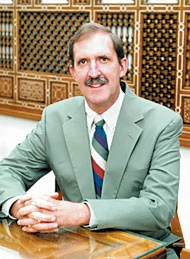
JEDDAH, 17 April 2006 — During his visit to Saudi Arabia last week, David Arnold, the president of the American University of Cairo (AUC), spoke to Arab News about the institution’s achievements, plans and activities. He also spoke about the challenges faced by higher education institutions, especially in this region. According to him, they must raise the standard of the education system and of society as a whole.
There is a large number of AUC alumni in the Kingdom and the president meets them annually in order to bring them up to date on the latest developments at AUC. He also meets sponsors, friends and donors as well as with the university’s trustee here, Suad Al-Juffali.
“AUC is at a dynamic phase in its history and development. We want our friends, alumni and supporters to feel part of the transformation process as we develop in a relatively short time from a very good regional institution into a world class university,” said Arnold. “We are also very eager to provide more opportunities for students from Saudi Arabia to study at AUC. The quality we offer is unmatched in the region,” he added.
AUC’s nearness to the Kingdom is one advantage; it also offers high-quality American education in a number of subjects. “The demand for quality higher education is growing and that is a positive development for the region,” said Arnold.
AUC is distinct in being a relatively small institution — about 5,000 students, with 4,000 undergraduates and 1,000 postgraduates. It aims at the very top of the pyramid in terms of the quality of the students it seeks. “We are concentrating on making sure that everything we do is at the highest level of excellence and that all our professional degree programs are fully US-accredited,” he explained.
Arnold cautioned against new universities in the region that are profit-driven rather than committed to quality education. AUC is now building a new $300 million campus with state-of-the-art facilities “that will be without doubt the finest educational institution in the region.”
The university will have moved to this new 260-acre campus by early 2008. It will keep a downtown presence that will be used for its adult education programs and as a cultural center.
AUC enjoys tremendous comparative advantage in a number of fields, according to Arnold. He said that the university’s historic strength has been in the humanities and social sciences, its strong liberal arts education including areas such as Islamic studies and Middle East studies. Its Arabic language institute is probably the finest in the world, and its Egyptology program is unequaled anywhere in the world. Over the years, it has added programs in engineering, computer science (the only accredited CS program outside the US), business (just completed the accreditation process for AACSB, the US accrediting body for collegiate schools of business), as well as journalism and mass communications program. “In all these areas, AUC strives to have focused programs that enable us to attract the finest faculty that we can,” said Arnold. “We also put a great deal of emphasis on building up and strengthening our research programs.”
On the role of the university in society, he talked about AUC being a historic part of Egyptian society with deep roots in the country. “It is an institution with a wonderfully international hybrid quality. We are a place where cultures meet, where ideas from different parts of the world can be shared and discussed in a free space, and that has been an important asset for Egypt and the region.”
Arnold emphasized the university’s basic philosophy of liberal arts education. “We are committed to academic freedom, to freedom of speech on the campus, and we believe that ideas and knowledge are best pursued in an environment that is characterized by a respect and tolerance for different points of view and an understanding of different cultures.”
He described AUC as an American institution that had grown in Egyptian soil, and therefore had deep and strong ties to Egypt along with enormous respect for the culture and traditions of the Arab world.
Asked if maintaining that balance posed a challenge to AUC, he answered: “I think academic institutions around the world face this challenge, whether Oxford or Harvard or AUC. There are always tensions and debates about the political dimension of academic activity. That’s why the struggle for academic freedom is not a struggle limited to a single country or university; it is a universal struggle. In order for universities and institutions of higher learning to play the role they need to play, there has to be a space created within that permits them to function in the kind of free environment that we cherish.”
Arnold said that through its 87-year history, AUC had managed to preserve and protect that space and to have the understanding and support and respect of both the Egyptian and US governments. AUC did, though, go through a difficult period immediately after the 1967 war.
“I think in the current environment, people seem to understand and respect that AUC has an independent academic quality to it without its own agenda in political or foreign policy terms. We have enjoyed support from both the US and Egyptian governments, but we are fiercely private and a totally committed nonprofit educational institution; we are nongovernmental.”
AUC maintains good relations with Egypt’s national universities and its student conferences are open to other students. “I think Egyptian universities face enormous challenges. The problems that higher education in the region faces are the challenges of trying to balance the demands for education with the numbers of students and the commitment to quality.”
AUC has no direct links or connections with any Saudi universities although it has been in touch with some of the new private institutions in Jeddah. Both Dar Al-Hekma and Effat College sent teams to AUC to benefit from its experience and curriculum development. Arnold visited both campuses as well as King Abdul Aziz University. He was impressed by its enormous campus and facilities but there was no discussion of collaboration or exchange programs.
Refuting accusations of being elitist, Arnold said that AUC works very hard to combat that image. “AUC should not apologize for being elite in an academic sense. There is a difference between being an elite university and an elitist university. AUC is doing much to make sure that we are not an elitist university.”
More than 60 percent of AUC students, according to Arnold, receive some form of scholarship or financial aid. In the early 1990s, it began a program of providing full scholarships for the top students coming out of Egypt’s public schools. Two years ago, it started a program which brings in two of the top students — one male and one female — from each of Egypt’s 27 governorates and provides them a full undergraduate program in addition to leadership training experiences, workshops and exposure to social and development needs in Egypt.
“Over the next few years,” Arnold said, “we aim to have 10 percent of each entering class at AUC on full scholarships based on academic ability and need.” He hopes to see the development of scholarship programs and funds to support Saudi students who could not afford on their own to come to AUC.
Speaking of AUC’s public service programs, he said that they had been part of its values since its establishment. The university has a wide variety of community service activities and programs that involve students and faculty in volunteer service. Last month, it launched a new center for philanthropy and public service, the Gerhard Center for Philanthropy and Civic Engagement, which will be an academic and outreach center to encourage and develop Arab philanthropy.