
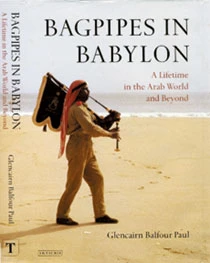
IT was the British Ambassador to Iraq, Glencairn Balfour Paul, who in December 1969 became one of the first Westerners to meet and assess the rising new Baathist strongman, Saddam Hussein. Famously, the veteran Arabist wrote to the Foreign Office that Saddam was hard-headed, but had an “engaging smile” and was a man with whom “it would be possible to do business.”
Balfour Paul has now written an intriguing memoir, “Bagpipes in Babylon: a Lifetime in the Arab World and Beyond.” Its first lines use a scene from this meeting to draw the reader in. We learn that Saddam actually seized the ambassador by the shoulders and lectured him while marching him up and down his office. But we hear nothing directly about what led to that famous ambassadorial judgment — or any thoughts on why everything subsequently went so wrong.
Mr. Balfour Paul never drops his diplomatic distance, and explicitly promises no sweeping new theories or secret revelations about the politics of the Arab world. The book may irritate those seeking policy prescriptions for the Middle East or those who are averse to high-handed judgements. Most Tunisians, he finds, combine “in a dubiously sophisticated way the less attractive aspects of both the Arab and French character.”
For those who relish occasional open opinions, however, there is a steady stream of insights from his four decades at the high table of Middle Eastern affairs. Balfour Paul’s dry wit will engage any ready to absorb eclectic tales from a life that started with an almost Edwardian childhood through an extraordinary range of experiences from Mali to Micronesia to Bengal. The atmospherics are elegantly recounted, amid plenty of wise observations about his postings in Sudan, Egypt, the Persian Gulf, Iraq, Jordan and Lebanon.
At the very least, readers may feel nostalgia for a rugged patrician character once more common among British diplomats. Balfour Paul is proud of a notable Scots lineage, a taste of desert campaigning in the Second World War, nine years experience as an administrator in the colonial Sudan, a sideline in archaeological publications and a wife with a passion for indigo.
He shows how the miracle of the British Empire worked in Sudan, making some sense of how a few hundred men ran the whole country on a diet of kippers, Coopers Oxford Marmalade and rations of rum. He is charmed by the Sudanese, polite and humorous with their British masters even while they opposed British rule. They must indeed have been forgiving. “Crocodiles were a nuisance … I was expected to slay them … with a rifle,” Balfour Paul writes. “Not far from where one croc escaped, a man was found dead with a bullet in his head. I persuaded myself that it couldn’t have been fired by me and that there was therefore no need to charge myself with culpable homicide.”
That last sentence could stand for a century of British policy-making in the Middle East. But this book doesn’t try to untangle the morality of it all, reveling instead in the Middle East’s colorful confusion of myth and reality. As a mid-ranking diplomat in Lebanon, Balfour Paul tells how his embassy suddenly found itself being fancifully accused by veteran Druze community leader Kemal Jumblatt of fomenting a coup — and how he successfully used Kim Philby, ultimately shown to be a Soviet spy, to lecture Lebanese journalists on why Britain couldn’t possibly have done this.
Balfour Paul’s next Mideast assignment was in the Persian Gulf, where he records the pre-oil charms and alarms of the Dubai and other emirates. He had no car, but did have an official bagpiper and claims that he was the last British envoy to award a “Freedom Certificate” to a runaway slave. Later in Jordan, he describes how King Hussein, Crown Prince Hassan, the American ambassador and himself cooked up a “dodge” to put Jordan into the 1973 war on the Arab side, but safe from destruction by Israel. As usual, the political content of the “dodge” isn’t analysed — but the jokey atmosphere is remarkable.
British imperialism was a “a mixture of good and bad,” says Balfour Paul, whose other more serious book is a history titled The End of Empire in the Middle East. Sometimes the good seems more to do with trouser creases and pavements than political stability. But there’s plenty to chew on in many of his asides, as in a friend’s advice as he set off to start his career in Sudan: “The Englishman who spends his life in the East returns changed himself but he leaves the East exactly as he found it.”
Overall, Balfour Paul’s memoir is meant for those who already know the story but want to relax over diplomatic digestifs. Even though he never says so outright, there seems to be an assumption that he strongly disapproves of pro-Israel British policies in the Middle East. Perhaps a horror of direct judgements about politics is an ingrained element in a diplomat’s make-up, the habit, as 1950s South African Foreign Minister Eric Louw put it, “to serve each succeeding government with equal loyalty and disdain.”
Possibly it is also a defence mechanism against conditions in the Middle East. When Saddam’s Iraqi Baathists stage a bloody purge after a coup attempt against them, he notes a “dispiriting aftermath.” He visits the leader of the secret opposition, only to hear the leader tell him that, if he were in power, he would have cracked down in exactly the same murderous way. At moments like this, I wanted to know more about the inner frustrations, hopes and fears of an ambassador at work.
Like many in his generation, Balfour Paul flinches from feelings, although they do trigger his weakness for breaking out in verse. He follows mention of a sublime moment looking at the Krak des Chevaliers with the off-hand “so there it is — the only spiritual experience of my life.” Balfour Paul instead takes refuge in a scrupulous impartiality. Even the trauma of his entire embassy’s expulsion from Baghdad is amusingly recounted almost as if it is happening to somebody else. Similarly, he recognizes Kim Philby’s deadly treachery to Britain. But he defends his relationship with “a most enjoyable friend” as well.
Balfour Paul is quite conscious of this. Indeed, he quotes Britain’s Prime Minister Margaret Thatcher scolding a diplomat colleague about his membership of Britain’s upper-middle classes, saying, “They see every one else’s point of view but have none of their own.” Luckily, Balfour Paul’s stories are well-enough told for the reader to feel as if he is hearing the epigram from the Iron Lady herself.
Hugh Pope is author of Sons of the Conquerors: the Rise of the Turkic World (Overlook Duckworth 2005) and was the Istanbul bureau chief of The Wall Street Journal for most of the past decade.