
ALKHOBAR, 20 October 2006 — Eid Al-Fitr comes around every year. While the spirit of joy and good will on Eid is the same now as ever, so much else about the observance of this occasion has changed.
Many still remember the small, temporary amusement parks that would spring up at Eid time in the 1960s in Saudi Arabia. Donkey and camel rides were a big hit with little kids. Sparklers were the most common fireworks back then and new shoes were so unusual that most folks can still lovingly describe their favorite Eid footwear. Dark burgundy seems to have been a popular shade for children’s sandals decades ago. In the 1960s, two or three riyals was the standard “eidia,” the money given to each child on the morning of Eid.
At the King Abdul Aziz Street branch of Banque Saudi Fransi on Wednesday night it was readily apparent how different things are now. Scores of customers were waiting for envelopes of new notes to hand out as “eidia.” Fifty riyals is the minimum that is now acceptable for a middle class Saudi man to offer to any child as an “eidia” and fathers typically give at least SR500 to each of their own sons and daughters.
“It isn’t only men who give “eidia” any more,” said Hania Othman, a Saudi who works in the banking sector. “Grandmothers give ‘eidia’ and women who work also give the kids money. In a family, fathers may give their children ‘eidia’ and then the mother will give ‘eidia’ separately from her salary. Women can get away with giving the kids less money then the men have to, but if the parents are divorced, then the kids expect ‘eidia’ from everyone.”
The increasing number of divorces in society has also changed Eid in unanticipated ways. For example, if your parents are divorced, where will you eat breakfast on Eid?
“Don’t talk to me about this” said Ali, “It is going to cause so much grief in my marriage.” Ali asked that his last name not be mentioned to keep him out of trouble. Ali’s parents are divorced and his wife’s parents are divorced. The couple got married this past summer and planning the wedding was awful. Since due to work obligations they didn’t go away on a honeymoon, Ali and his wife told everyone that they were going to Cairo for Eid. This allowed them to neatly sidestep the Eid breakfast venue problem, until next year.
Another young Saudi with divorced parents explained that he will have breakfast with his mother in the Eastern Province and then fly to Jeddah to have dinner with his father on the first day of Eid.
Even the basics about celebrating Eid have become cause for concern. Decades ago, Saudi towns were much smaller and closer knit. It was easy to know who was in need and paying Zakah Al-Fitr, which consists of food donations, was not a burden. More recently, on the night before Eid, supposedly poor women sit on sidewalks near supermarkets surrounded by growing mountains of rice donated to them as Zakah Al-Fitr. Much of that rice is then sold at a cheap price to restaurants or even recycled back to the markets where it was originally purchased. Believing that this is not the correct use of the Eid food donations, local charity organizations have stepped in to help manage the huge amount of food given to the needy at this time.
Mabbarat Al-Ehsan Al-Khariyah, a registered charity organization in Alkhobar, sells SR10 coupons for its Zakah Al-Fitr Project. The organization is distributing flyers that read, “We save you the trouble of searching for the poor people. We buy the Zakah Al-Fitr for you and give it to all the families in need in the Alkhobar area. This includes widows, orphans, divorcees, handicapped, families of prisoners and poor people — about 2,500 families total. If you prefer, actual food donations will be accepted from the 28th of Ramadan until 1 a.m. on the last day of Ramadan.” Last year, this charity went so far as to having its staff stationed at curbside outside its headquarters from the 28th of Ramadan so that people didn’t even have to leave their cars to make their donations.
This year Zakah Al-Fitr has become caught up in a new controversy. Due to misinformation, a brand of rice “Abu Cas” was claimed to be a sponsor of MBC’s television serial “Tash.” Based on that misinformation, certain conservatives advised people not to purchase that brand when paying Zakah Al-Fitr. Yesterday, mobile phones began beeping with text messages denying any link between the brand and the show and asserting that it was acceptable to purchase “Abu Cas” for use in Zakah Al-Fitr giving.
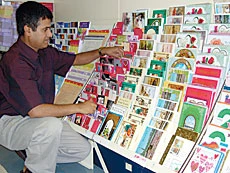
Text messaging has become an integral part of the modern Eid celebration, with millions of people across the Kingdom sending their Eid greetings by SMS. This trend has led to the unfortunate demise of another happy tradition — Eid greeting cards.
“Many stationery shops no longer sell greeting cards at all,” said Yar Mohammed Sarker, a Bangladeshi sales representative at the New National Bookshop in Alrashid Mall. “We do sell Eid cards, but they are slow moving items and their season is short. We try to have Eid cards in different languages, English, Arabic, Urdu, etc, so there is something for everyone.”
Post boxes used to be so full of greeting cards at Eid time, that it seemed like whole forests must have been chopped down to create them. But the cards did earn good money for organizations such as UNICEF and other charities. Thus far this year, I’ve received only one paper card. I placed it next to my computer as a reminder that what’s considered old fashioned is too often underrated.