
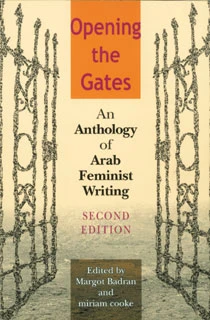
THIS book is a treasure trove for anyone interested in learning more about Arab women writers and in reading some of their work. Opening the Gates: An Anthology of Arab Feminist Writing, the second edition, is a collection of poems, essays, short stories and excerpts from memoirs by Arab women writers from almost every Arab country and going as far back as 1867. It features works by some well-known names and some lesser-known ones who are also certainly worth reading and discovering; the women write on a variety of issues reflecting their time and place but all under the theme of feminism. Some of the women, however, never even considered themselves feminists! It is edited by Margot Badran and Miriam Cooke, two respected scholars who specialize in Arabic literature and Arab feminism. The latest edition was published by Indiana University Press in 2004; the first edition was published in 1990.
The introduction is an informative, historical and analytical account of the writers, their work and the circumstances of their lives. The literary works presented cover a range of topics that concern feminist scholars such as segregation, oppression, circumcision, education and polygamy. The editors have categorized them into three sections: Awareness, Rejection and Activism in addition to a final section called Transitions that contains interviews and writings by contemporary figures presenting recent changes in feminist discourse and activism. Interviews with such leading women as Amat Al-Aleem Alsoswa, the first woman minister in Yemen, Tahani Al-Jibali, one of the first three Egyptian women appointed to be a judge, and with some Kuwaiti activists bring to light the struggles, the challenges and the opportunities that brought them to where they are.
The sections are in chronological order; neither are the texts within each section. Each section represents the writers’ general mode of thinking and objective in writing while the contents reflect their individual styles, perceptions and realities. Each section begins with a poem that sets the theme. The editors mention in the introduction that some of the selections in each section clearly fitted into it while others covered wider ground but were better suited for that particular section. This allows the reader to indulge in their own interpretations and debates over the issues discussed. It is interesting to realize how some of the issues and debates on the minds of Arab and Muslim women in the 19th century, hcontinued in the 20th century and are still going on today — women’s legal rights, women’s education and employment and interpretations of Islamic texts on women.
Not surprisingly, the majority of the texts are by writers from Egypt and Lebanon where the first signs of feminist writing and activism were recorded. However, there are a number of vivid and intriguing writings by women from Palestine, Syria, Iraq and countries of north Africa and a few writings by women from Yemen, Sudan, Jordan and some Gulf countries. From Saudi Arabia there are two short stories by Khairiya Saqqaf, a pioneer journalist, and two poems by the poets, Fawziya Abu Khalid and Thurayya Al-Urayyid. Despite some common themes threading the texts together and reflecting common struggles, especially regarding the family and marriage, there are also different concerns and issues that appear in the writings of these women who come from different backgrounds. Overall, this is a wonderful book and a joy to read. It opens the gate for some old voices to be heard again and some current voices to be heard louder. It certainly documents and presents the rich literary heritage of Arab women that goes back to earlier centuries as the editors mention in the introduction but here it focuses on the feminist side of those writings which by itself is an impressive revelation.