JEDDAH, 4 May 2006 — Crown Prince Sultan, deputy premier and minister of defense and aviation, has rejected an Iranian offer to provide the Kingdom and other Gulf states with nuclear technology. “We don’t need nuclear assistance from any country,” Asharq Al-Awsat Arabic daily quoted the crown prince as saying.
Speaking to reporters after attending the year-end ceremony at Kingdom Schools in Riyadh on Tuesday, Sultan urged both Iran and the Western powers, who are locked in a standoff over Tehran’s nuclear program, to cool down and cooperate with one another for the betterment of humanity.
Saudi Arabia seeks a diplomatic solution to the standoff. In a previous statement, the crown prince said Saudi Arabia was against nuclear weapons and nuclear proliferation. However, he said Riyadh would not take a position against Iran on the issue while Israel possessed nuclear weapons.
Asked about reports that a deal had been reached with the Boeing Company to purchase new planes for Saudi Arabian Airlines, Sultan said that there was a plan to replace the airline’s old planes. The Kingdom will not, however, revoke the deal with Airbus.
Sultan said the government was following up the case of Abdul Rahman Al-Atwi, a Saudi, being detained in an Israeli prison. His comments came amid reports that Al-Atwi has been sentenced to three months in jail by a military court.
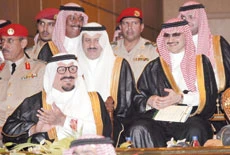
Prince Sultan hailed the tremendous progress achieved by Kingdom Schools. “I thank Alwaleed ibn Talal for this great work,” he said at the ceremony where students who achieved grades of excellence were honored.
In his welcome address, Prince Alwaleed, chairman of Kingdom Holding, said the school was honored by the crown prince’s presence. “Three years ago Kingdom Schools were honored with your patronage. ... At that time you said ‘If you love your children, take them to Kingdom Schools’.”
Prince Alwaleed underscored the government’s efforts to strengthen the country’s security and stability. “Our Islamic faith rejects terrorism and violence and brings together all people for peace,” he said.
He referred to the Saudi leadership’s efforts to expand popular participation in the decision-making process by conducting elections to municipal councils. “The Kingdom has also given women their rights to take decisions,” he pointed out. “There will not be any dispute over women’s rights to knowledge and work,” he stressed.
Prince Alwaleed also referred to a statement by Custodian of the Two Holy Mosques King Abdullah that he strongly believes in Saudi women’s rights.
“Islam has given women all rights and we’ll never dilute them,” Alwaleed said.
He noted the Kingdom’s efforts to establish strong relations with Asian countries, such as China, Japan, India, Pakistan, Malaysia and Singapore, apart from Western countries in order to promote bilateral cooperation.
“The visits of the heads of state of industrialized countries to Riyadh and their meetings with Saudi leadership affirms the peaceful coexistence of civilizations,” he pointed out.