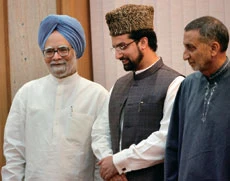
NEW DELHI, 4 May 2006 — Kashmiri separatist leaders and Indian Prime Minister Manmohan Singh held fresh peace talks on the future of Kashmir yesterday.
Manmohan and Hurriyat leaders said after the talks they had agreed to establish a system to discuss solutions to the dispute over the Himalayan region.
“To carry this decision forward, we have undertaken to evolve very shortly a mechanism to carry out a continuous dialogue,” Hurriyat chief Mirwaiz Umar Farooq told reporters.
Manmohan described the talks as a “meeting of minds”, his spokesman said. It was the second meeting between the two sides since Manmohan took power in 2004
“This augurs well for the future of Jammu and Kashmir, for the people of India and our region,” spokesman Sanjaya Baru quoted Manmohan as saying
The talks at the prime minister’s official residence with moderate leaders of the All Parties Hurriyat Conference or “Freedom” alliance were held after 35 Hindus were massacred in an apparent attempt to thwart negotiations.
On Sunday, suspected militants gunned down 35 Hindu villagers in Kashmir in the worst such massacre since 2000. Analysts warned against high expectations from the talks as troops combed densely forested areas of the Indian Kashmir hunting for the killers.
“It’s going to be a long haul — don’t expect dramatic results but the fact they have come with no set agenda is a good sign they want to talk,” said S. Chandrasekharan, of New Delhi’s South Asia Analysis Group.
New Delhi “is not going to be deflected” by the massacre,” he added. “If the government stopped talking it would give them (the killers) what they want.”
Hours before the talks were due to begin, four rebels and three security men died in gunbattles in Kashmir, the army said. Violence has risen in Kashmir despite two years of peace talks between nuclear-armed India and Pakistan. The talks have made progress on people-to-people contacts and trade but little on the disputed region.
Farooq told AFP earlier that India needed “to move beyond traditional stands and positions in order to find a solution to the dispute.”
“Pakistan is very serious to resolve the dispute over Kashmir,” he added, “and India should also show flexibility in its stand on Kashmir. The prime minister has said he cannot agree to boundary changes. But he is open to discussion on other subjects to resolve the feud over Kashmir where a separatist revolt has raged since 1989, claiming at least 44,000 lives by official count and double that according to separatists.
“The prime minister is willing to think ‘out of the box’,” said Chandrasekharan. Proposals by Pakistan for India to withdraw troops from three main cities in Kashmir should be “deliberated and discussed,” Farooq said. Farooq, who said he wants “specifics” to take home, said a withdrawal would be a huge confidence-building measure in the heavily militarized region where the military presence is a major irritant to locals.
He said the separatists would also focus on seeking an end to alleged human rights abuses and winning release of detainees.