
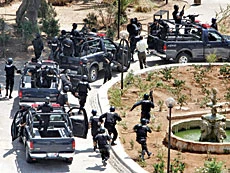
AMMAN, 5 September 2006 — A Briton was killed and five other Westerners were wounded yesterday when a gunman opened fire on a group of tourists at Hashemiyah Square in downtown Amman, the Interior Minister Eid Al-Fayez said. The gunman was captured.
Fayez branded the attack as a “terrorist operation,” but said he believed the onslaught was not part of a “systematic scheme.”
The minister said security authorities had started an immediate investigation into the incident.
The attacker, a Jordanian, opened fire at the group of tourists at the Roman Amphitheater near Hashemiyah Square. Among the injured was a Jordanian policeman who doubled as a tourist guide, Fayez said. “All of the injured are receiving intensive care treatment in hospitals,” he added.
Of the injured tourists, four are women — two British, one Australian and one from New Zealand — and the fifth a Dutchman, official sources said.
Fayez identified the gunman as Nabil Ahmed Jaourah of Palestinian descent. “He is in his 30s and resides in the city of Zarqa”, about 30 km east of the capital Amman, the minister said. Zarqa is the hometown of Jordan-born terrorist leader Abu Musab Al-Zarqawi, who was killed in a US airstrike in Iraq on June 7.
“Investigations are under way to know the reasons and motives behind his action,” Fayez said, adding that there were no indications so far that the culprit had a partner.
“The attacker surprised the tourists and opened fire on them after they disembarked from their bus and started a tour of the Roman Amphitheater,” he said.
Witness Mohammed Jawad said the assailant opened fire twice at the group before he was arrested by police, who have been deployed at the site since a string of suicide hotel bombings in the capital in November killed 60 people.
“The gunman fired around 14 rounds after climbing the steps of the amphitheater,” the witness said.
Another witness said two street cleaners who were in the area helped police arrest the assailant.
In London, a Foreign Office spokesman confirmed that a British national had been killed and two were injured but declined to identify the victims until their relatives had been informed.
The condition of the Dutch tourist was listed as stable.
The French Embassy issued an advisory to its nationals in Jordan urging them to observe caution. “Until we receive further information, we recommend prudence in your movements and invite you to avoid the city center where traffic is disrupted,” the message read.
This is the first fatal attack in the country since Nov. 9, when Iraqi suicide bombers blew themselves up at three five-star Amman hotels, killing 60 people and wounding more than 90. The blasts were claimed by an Al-Qaeda-affiliated group, Jihad and Tawhid Brigades of Zarqawi.
A suspected Iraqi terrorist woman, Sajeda Al-Rishawi, is currently standing trial before the country’s State Security Court in connection with the bombings.
Rishawi, who was arrested three days after the bombings, confessed on state-run Jordan Television of being part of the terrorist gang, but claimed her explosive belt failed to detonate at a wedding party that was in progress at Radisson SAS, one of the targeted hotels.
Zarqawi also claimed responsibility for a rocket attack on Aug. 19, 2005 that targeted a US warship that was docked at the Red Sea port of Aqaba. The attack missed the American warship but hit a Jordanian Army warehouse, killing one soldier and wounding another.
Following the November suicide blasts, the authorities tightened security around all tourists attractions and hotels across the kingdom. More metal detectors and police patrols were positioned outside these locations.
Israel’s offensive in the Gaza Strip and war against Hezbollah in Lebanon, which has killed over 1,200 fellow Arabs and drawn international criticism, has also raised passions in Jordan where anti-Israeli feelings are running high.
Many Jordanians are angry about what they see as Western indifference toward the plight of Palestinians.
Security sources say they have been worried as Israel’s war with Hezbollah has led to a surge in anti-Western sentiment among Jordanians. Jordan enjoys the warmest ties with Israel among its Arab neighbors and has close security cooperation since a peace treaty in 1994.
— Additional input from agencies

