
ALKHOBAR, 12 May 2006 — There’s no denying that this year business is booming in the Kingdom. The hotels are packed with company representatives. Every week there’s a report about another trade delegation traipsing through our major cities. Stock trading may be a topic of intense speculation, but for those interested more in long-term profitability, the good old fashioned sort of trading, with handshakes and contracts signed, is quite intense at the moment.
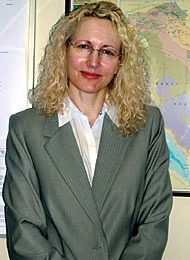
There have also been welcome changes with new sectors being represented in the trade delegations and women being included both in the delegations and on the local business side. In that spirit, in the Eastern Province, the stodgy business community of thobes and suits has been enhanced by a new addition. The able Mike Hurley, who headed the British Trade Office in Alkhobar, has come to the end of his term and been replaced by the equally capable Terry Evans.
Prior to this posting, Evans spent seven years as part of a team at the British Embassy in Beijing. While the scale of work there was considerably larger than that undertaken in her current post at the British Trade Office in Alkhobar, the nature of the work was quite similar.
“Both in Beijing and here in Alkhobar my job is basically to promote trade between two countries and helping companies develop trading options,” said Evans. “This can be trade or investment in both directions. I have considerable experience in this type of work. In Beijing, I was the head of the large industrial team in the Commercial Section at the embassy. The jargon is different and we are called a Trade Office here in Alkhobar, but we are really an extended arm of the British Embassy in Saudi Arabia, their outposted, outstationed commercial arm covering the Eastern Province.”
Evans has been in Kingdom just six weeks but she is already working to understand the local business environment and establish her own style and direction in the job.
“People say to me, ‘Wow, coming from Beijing, it must be much different here.’ They think it’s a huge culture shock,” explained Evans. “What I have noticed though is that there are many similarities. Both nations have dynamic, growing economies. Both are faced with the challenges of newly joining the World Trade Organization. They both have concerns about WTO and how it is going to affect local industry. There is a general fear initially that strong competition will come in under WTO and steal all the business away from local firms. It is only through time that all the opportunities become apparent.”
She continued, “Culturally there are other commonalties. For example, just as in Saudi Arabia, the Chinese like to get to know you as a person before they will feel encouraged to do business with you. This means there could be a long lead time before a contract is signed or results are seen. But of course relationships are important in business the world over. Understanding how to forge those relationships is one way the British Trade Office adds value both to British companies wanting to do business abroad and also for those companies interested in investing in the UK.”
While it is still quite unusual to find Saudi women in diplomatic and trade postings, for the British government, all applicants to available positions within its foreign service are considered only on the basis of merit. Evans emphasized that there is no “statement” in her role in Saudi Arabia and that numerous women have been appointed to the British Embassy’s Trade and Investment team in the Kingdom. However, Evans in the first women to head the Trade Office in Alkhobar and she intends to use that to her advantage.
“Part of the challenge in my position will be interfacing directly with Saudi business women and growing the UK’s trade relationship with them,” remarked Evans. “That said, I will still be promoting British involvement in major infrastructure projects, railways, mining, petrochemicals, oil and gas, and other traditional sectors where British companies have long been able to offer outstanding technologies, products and services. However, I want to grow our involvement in areas which have not been looked at closely before. In the small business sector which has the ability to provide so many jobs, and particularly in companies owned by women, we have hardly scratched the surface. I have discovered that in Dammam and Alkhobar alone there are over 1,000 what might be called “Beauty Centers” of different types. I believe there will be numerous opportunities for British companies in the areas of supply of equipment, products and professional training for these centers. In the past, we’ve never been able to effectively reach out to businesses owned by women, and more research and networking will be required to define the opportunities specifically, but this does seem to be a good area for growth, among others.”
Using technology to enable trade is also a priority for Evans. She mentioned the example of a British company that has set up a web-based directory.
“This directory would encourage Saudi companies to engage in trade via the Internet,” said Evans. “Look for instance at Saudi designers of women’s fashions. There are over 1.8 million Muslims in the UK and I am certain that some of them would have a taste for stylish top-end, perhaps even one of a kind designs, that would take their specific religious concerns in the area of attire into consideration. I do think that utilizing new technologies better is an important means of helping smaller firms both in the UK and Saudi Arabia tap a larger, broader audience.”
According to Evans, the business scene in the Kingdom has never been more vibrant and she’s pleased to be a part of it. She plans to use the resources of the British Trade Office to empower UK companies to compete in this place, which may appear quite different from afar, but that in reality is just another market in our global village.