
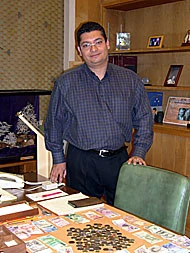
ALKHOBAR, 23 May 2006 — Hewlett-Packard (HP) announced its second-quarter earnings last Tuesday. The company has seen its net income grow by more than 50 percent over a year ago, while its revenues climbed 5 percent. HP continues to depend on its Imaging and Printing Group (IPG), which accounted for $1 billion in operating profit — almost 67 percent of the company’s total operating profit of $1.7 billion. This means that Amr Hassan, regional general manager, IPG, HP Middle East is playing an increasingly important role as HP works to grow emerging markets, such as the Middle East.
“HP is committed to the Middle East region. This is not just talk. Over the last six years, there have been many changes in the market,” Hassan said. “I am proud to say that we have contributed to this to a large extent. When it comes to consumer IT we were the first to start in so many areas because of our range of products and solutions. When I joined HP, I was leading the consumer business and I have seen the transformation happen in the market. Years ago it was mostly small, independent retailers in the market, but now we are seeing the emergence of large retailers. These are local companies who have put large investments in retail. We are also seeing Pan-Arabian and Pan-Asian retailers investing in the Middle East. This is good for the consumer because the consumer now has more choice.”
Hassan pointed out that HP has been aggressively working with its distributors and channel partners to make the transformation in the market a reality. Besides making the technology available, HP has consistently been encouraging and providing training to the retail channel.
“We realized from the beginning that the channel is the vehicle through which our products are made available to the consumers. If we educate our channel partners well, they will educate the consumers about the different solutions available to them and the new technologies,” he explained. “I want to emphasize that we have no compromises when it comes to the technology commitment to the Middle East. HP’s technologies are available in the Middle East at the same time they become available in Europe.”
For HP, the size of the Middle East with its diverse countries, regulations and logistical challenges, required increased investment as the markets have grown. Especially in Saudi Arabia, it has been necessary to invest heavily in the channels and distribution network to ensure that most of the Kingdom’s cities are well-served.
“Without a doubt, Saudi Arabia is the biggest market in the region today. It is growing very fast. Retail is booming. I can tell you too that across other segments, such as SMB and enterprise, we are seeing a strong level of development, especially in the last year,” remarked Hassan. “That’s why lately we have almost doubled the resources we have committed to the Kingdom. Doubling the resources within HP has two aspects. First, we make sure that we increase the number. Second, we increase the quality of the people there, especially in terms of giving them the right level of training and empowerment to make decisions. In addition to that there has been a lot of work with the channels. We’ve got more than 3,000 active resellers and retailers in Saudi Arabia in our database, which is the largest of any vendor by far. We monitor the movement of our products through the distributors to the resellers, plus we interact directly with our retailers and resellers in the Kingdom. The ultimate goal of this is customer satisfaction.”
Customer satisfaction can also be consistently improved, according to Hassan, by having people on the ground who know the market.
“When HP’s Middle East office started, the ratio of people from the Middle East versus the number of people from outside of the Middle East was to the advantage of the outsiders. Now we have a very diversified organization that has a lot of people from the Arab countries and many local hires. In the Middle East, HP IMG has a very good track record of hiring women and in fact we are in very good shape compared to the targets that Europe is trying to meet.”
Elaborating on the personnel situation here in Saudi Arabia, Hassan advised, “Specifically for Saudi Arabia, now we have the people who speak the language. Next, is to have the right number of Saudis working for HP. Finally, we are talking about women for Saudi Arabian operations. We are getting there by employing the right number of Saudis. It is a priority for us to include more Saudis in the organization and that will include women, as well. Right now in Saudi Arabia we see a lot of changes that encourages business and makes it simpler to find the right talents. This may not have always been the case in the past.”
HP is also very conscious of the need to be a good corporate citizen of the Kingdom. Hassan commented that HP’s making its technology available and providing good service was the first step. Now, technology know-how is being transferred to the Kingdom through HP’s local production facility in Riyadh and also by its education efforts with its channel partners. Additionally, the company is supporting charitable events and other good causes within Saudi society.
“We aren’t fond of making publicity out of our charity efforts,” Hassan said. “For example at one HP/Nokia event in Jeddah, more than a million riyals were donated to charity. Companies exist not only to make profit from society but to add value to the society. We cannot sustain our presence if we ignore either.”
Asked about HP’s plans in regards to supporting the Saudi environment through the responsible disposal or recycling of HP’s products, Hassan stated that as of yet, HP hadn’t seen a demand for such a service. It is true that due to a lack of consumer awareness coupled with a dearth of government regulations, no IT company is responsibly disposing of products sold in the Kingdom. This may be witnessed in the millions of mobile phone batteries that are tossed into local landfills annually, where they have the potential to cause serious pollution. Hassan did agree that in other geographies HP was working to protect the environment and that with its overwhelming presence in this market it must plan to do the same here.
“Ours are the products of choice, and I am talking about Imaging and Printing, for 80 percent of the buyers. And we are in a growth mode. The market has a low penetration rate. The need today from a customer point of view is to have those products available,” he said. “The next stage that we will reach is that there will be replacements for those products. This opens up opportunities for some local companies to have a recycling business. The public must demand the recycling service. Then it is the government who will put the rules and regulations in place. It will be local companies that do the recycling and the IT vendors who will put the logistics together. Yes, we do have the interest to engage with the government to ensure that we make this happen.”
Hassan reiterated that in every way, HP does take its leading corporate role in Saudi society seriously. Through its wins in various government education initiatives, HP products entered Saudi schools. Saudi businesses have depended on HP products and solutions to improve efficiency and enhance productivity. Now, Saudi consumers are introducing HP products into their homes. Hassan is certain that this latest move will drive technological innovation in Saudi society.
“When families purchase technological products you really have the opportunity to introduce children to technology at a very young age. In the Kingdom that is something new for many people,” he observed. “Until recently, Saudis never encountered information technology until they started school or even later. Today’s products are very easy to use which makes them fit well into a home environment. Look how things have changed. Two years back it was almost impossible to print a photo from a digital camera without going through a computer. Today, my children are using a digital camera. At home they take out the storage media, they put it in the printer and by a simple push of a button they print. In the past, technology required a lot of effort to make it work. Now, better, high quality, easy to use technology really encourages innovation, especially when people grow with these technologies from early in life.”
Of all HP IMG’s products, Hassan feels that the most important products for families to have at home are “All-in-One” devices that print, scan, copy, e-mail and fax, plus they should have a digital camera. He mentions too that families that bring technologies into their homes will demand more technology be used at school, in business and in every other aspect of life. It will no longer be acceptable to understand just the basics about technology. This is why Hassan believes that it is crucial that schools continue to enhance their education resources in regards to technology.
“Everyone is familiar with the mobile phone, but how many features do you use in your mobile handset?” he asked. “The phone has lots of features that could make you more productive but because they aren’t easy to use or perhaps because you aren’t educated on their functionalities you don’t use them. So even though students have the technology at home, schools have a big role to play in teaching students about the ideal uses of technology. Teachers must take students beyond the basics and encourage them to stretch their talents and imaginations. At HP we’d like to see more schools have technology education as a part of their course of study.”
Comments to: [email protected]