
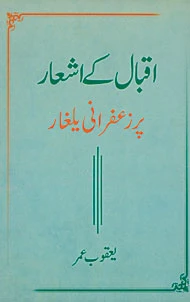
Professor Yakub Omer taught Persian at Osmania University of Hyderabad from 1964-2001. He earlier reviewed professor Gyan Chand Jain’s book, “Ibtedai Kalame-Iqbal Ba Tarteeb Mah-O-Saal”, which was published by Urdu Research Center Hyderabad (India) in 1988.
According to Yakub, his reason for reviewing this ‘hateful book’ was to reject the negative thinking of a class, which since India’s independence, has tried to undermine the very foundations of ‘National Integration’.
This class wants to give Indian culture, civilization, history and even literature its own color. It does not like Urdu, which is the greatest symbol of Hindu-Muslim compromise culture, and Iqbal’s patriotic poetry stands like a huge obstacle in its path. The class is trying to smash the obstacle through rumors, deceptions and lies.
Yakub’s 148-page book “Iqbal Ke Ashaar Per Zaafrani Yelghaar” from chapter one to five, has in a very profound, logical and convincing way, revealed and rejected the defamation campaign and blasphemy, which has raised its ugly head in the name of freedom of expression.
Iqbal’s love for the Holy Prophet (pbuh) is unbounded. In fact it is the color of his whole being. So one who tries to reject Iqbal’s thought would indulge in blasphemy. Unfortunately a famous literary figure such as Gyan Chand has stumbled upon this step and this was a watershed in his life’s work.
Yakub has enlisted and given the details of Gyan Chand’s objections and poems, which Iqbal canceled. Iqbal never gave them a place in his collection. Even some of them are fake. Yakub, as a skilled research scholar, checked the authenticity, period and value of the poems. He laments that the poems rejected by Iqbal himself were made a base and platform to damage Iqbal’s thoughts and even his image. He says that Gyan Chand even sometimes ridicules Shibli Nomani and Maulana Hali who are not only pivotal to Urdu language and literature but are also great advocates of Islamic civilization.
Yakub is successful in brushing off Gyan Chand’s criticism. In the last chapter of the book, he surveys Gyan Chand’s other literary works and, like James J. Kilpatrick, rounds up a good number of Gyan Chand’s grammatical and linguistic mistakes. Yakub’s style is aggressive; yet when I read his book a second time, I was impressed by his sincerity and depth of knowledge.
Yakub’s love for Urdu and Indian civilization compelled him to stand before a scholar like Gyan Chand and defend the values of compromise culture.
Though sometimes acerbic in style, the book is worth reading.