
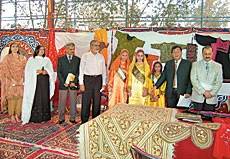
The Pakistan International School in Jeddah held an art and science exhibition last week that brought Kashmir into the spotlight of Jeddah society. Hundreds of visitors attended the exhibition, which was inaugurated by Shireen Masood, wife of the Pakistani Consul General. The exhibition featured the student’s art and science projects and included a special presentation on Kashmir.
The Kashmir exhibit aimed to show solidarity with Kashmiri Muslims and to create awareness among the students by highlighting the salient features of the sometimes-heated Kashmir issue. The Kashmiri food corner displayed delicious Kashmiri cuisine served to the guests and the visitors. The beautifully decorated Kashmir Pavilion showcased Kashmir’s culture and handicrafts.
Students exhibited their own crafts through pencil sketches, paintings, books and publications. A documentary was also prepared showing the beauty of Kashmir, the destruction brought about by October’s earthquake, the ensuing quake-relief activities, the suffering of Kashmiri Muslims and human rights information. Handmade greeting cards of second-graders moved the hearts of the visitors, including a drawing of a dove above the caption “peace is on the way” and a picture of an eye crying tears of blood above the words “bloodshed can melt hearts.” A banner depicting the destruction of the earthquake accompanying the words “Kashmir Cries for Help” reminded the visitors that over seven months since the devastating quake the region still needs assistance from abroad.
Girls dressed up in Kashmiri dresses briefed the visitors about the region. The UN Resolution on Kashmir was also displayed on the school notice board to educate students and create awareness.
Pakistan’s Consul General Shaukat Munir Kiyani and members of the Kashmir Committee visited the exhibition and commended the school’s efforts on educating students and adults about the Kashmir issue. Parents were also full of praises for the students’ artwork. Students not only displayed there skills in art and handicrafts; their science projects were also an endearing sight — volcanoes, magnetic fields, models of biological processes, space diagrams, planets and satellite models, solar systems and computer projects were marveled at by the visitors. Students confidently explained their projects to the parents and guests.
There were English projects, too, including newsletters, stories autored by the kids, models of famous characters and chart displays. An urdu-language project represented the four provinces of Pakistan, models of villages, monuments of Quaid-e-Azam and a model of a typical Kashmiri village. The so-called “Pakistan Studies Project” represented the history of Pakistan and its war of independence. There were also math & algebra presentations as well as recycling projects, botany, biology and trade and commerce. Products from Pakistan and Saudi Arabia were also presented in the form of models and charts. There were also Islamic studies projects, including the Pillars of Islam, models of the Holy Kaaba, Masjid-e-Nabvi, and Thawr Cave.