GAZA CITY, 6 June 2006 — The face-off between Palestinian President Mahmoud Abbas and the new Palestinian government headed by Hamas intensified yesterday with Abbas insisting he would accept no changes to a plan calling for compromise with Israel.
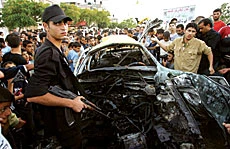
Also yesterday, Israeli aircraft fired missiles at a car in the Jabaliya refugee camp next to Gaza City, killing a Palestinian and wounding three others — a passenger in the car and two bystanders, according to Palestinian hospital officials.
Israel said it missed its target, Imad Assaliya, 27, a fighter from the Popular Resistance Committees involved in firing rockets at Israel. Hospital officials said he was wounded.
Abbas is set to call for a referendum after factions failed to agree on the document yesterday, a delegate to the talks said.
“The president informed us that he has no option but to call a referendum,” Khalida Jarar, a delegate from the Popular Front for the Liberation of Palestine, told reporters after factions held last-ditch talks with Abbas.
Abbas has given Hamas, whose charter calls for Israel’s destruction, until today to accept the proposal for a Palestinian state alongside Israel, or face a national referendum on the matter.
“If anyone wants to amend this document, then we will not reach any results,” Abbas told reporters after meeting with European Union foreign policy chief Javier Solana.
Abbas has endorsed the plan, put forth by politically powerful Hamas and Fatah prisoners held in Israeli jails, as a way to end crushing economic sanctions against the Palestinians and allow him to resume peace talks with Israel. Since Hamas trounced Abbas’ Fatah movement in legislative elections, the two sides have been locked in an increasingly bloody power struggle.
Late Sunday, five Palestinians — a Hamas fighter and four bystanders — were killed in two clashes between Fatah and Hamas forces, one in Gaza City and the other in the southern city of Khan Younis.
Yesterday, Hamas gunmen rampaged through a Palestinian TV transmitter site in Khan Younis, expelled employees, beat up a cameraman and fired their weapons at cameras and other equipment, witnesses said. They left after several minutes.
Hamas officials reacted angrily yesterday to Abbas’ threat to call a referendum. The sides have been holding occasional talks since Abbas announced his referendum plan late last month but have made little headway.
“We feel that the approach is to impose the document on us ... The approach is to treat this document as a sacred document, and that is something we don’t accept,” said Hamas spokesman Sami Abu Zuhri.
“We are against the referendum. We are not going to accept it, and we reject this referendum,” he said.
Abbas was meeting with election officials yesterday to discuss the logistics of holding such a vote, and planned to call the referendum in a decree today, aides said.
The Palestinians have never held a referendum before, and legal experts say the vote would not be binding. But with polls showing widespread support for the plan, a referendum could give Abbas an important boost in his standoff with Hamas.
“It would bolster his legitimacy and give him power to go ahead with negotiations with Israel,” said Azam Al-Ahmad, a top Fatah official. Al-Ahmad also said Abbas, who was elected separately last year and wields considerable powers, would consider calling elections for president and Parliament if Hamas did not abide by the results of a referendum.
Late Sunday, the Bank of Palestine, drawing on tax revenues deposited there, began releasing money to the lowest wage earners on its payrolls.
But yesterday, there was widespread confusion throughout the West Bank and Gaza after government money failed to reach local banks. Angry workers stormed one bank branch in Gaza, and tempers flared in many areas. Banks said the government hadn’t transferred funds, and some advanced cash to help calm the situation.
“These are people who don’t have money to buy milk,” said policeman Raed Abu Ghoneima, one of the protesters who stormed a Gaza City branch of The Arab Bank. “It has nothing to do with politics; it’s about wages.”
— With input from agencies