
The history of mankind is often defined by materials. Historians discuss the Copper Age, Bronze Age and the Iron Age as mankind progressively becomes more sophisticated in the materials used to fulfill its needs. Although we often refer to the here and now as the Information Age, we could just as easily called it the Plastic Age as these increasingly are the materials used to fill society’s needs.
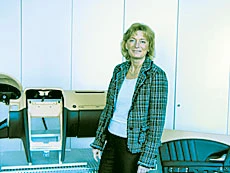
Plastics, however, are not always man made — they also are woman-made, and Bettina Blume of the German industrial giant Benecke-Kaliko is proof of that.
Blume works for the company’s Industrial Engineering Division and specializes in product and material development with an emphasis on the automotive industry. Blume is the holder of a long list of patents that create the materials that make car seats and steering wheels soft to the touch, enhance leather products to perform better and last longer in everyday use and alter the composition of plastics to bend them to the needs of manufacturers and consumers around the globe.
With Saudi Arabia emerging as a petrochemical leader when it comes to raw materials, Blume’s story may encourage some young Saudi women to gain the knowledge to turn those raw materials into export products that will transform both the Kingdom’s industrial base and developing economy.
Blume started out studying biology but found her niche in chemistry. For the last 15 years she’s been making her mark in a male-dominated industry and proving that a woman’s touch is sometimes exactly what’s needed to take a hard material and turn it into a soft one.
Polyvinyl Chloride, or PVC is one of the materials with which Blume works. PVC is the plastic tubing used in pipes for plumbing systems, but with the addition of plasticizers, this hard material can be made pliable and become anything from the hood of an automobile to the sun visors that shields its occupants or the seats they sit on or even a designer handbag. Sometimes, the plastics are used as coatings on other materials, such as leather, to create a longer-lasting, more usable product. The goal is not to create something cheaper but to create something better.
“You might wonder, since this material is not purely leather why is it so expensive? Well, simply because it is hand made,” she told Review during a recent interview. “This material helps us form as many shapes and colors as possible unlike the pure leather. By adding phthalates (plasticizers) to PVC, the hard plastic becomes softer and more flexible to work with.” Automotive applications account for more than 70 percent of Benecke-Kaliko’s business, but the company also makes composite material for athletic shoe uppers, furniture coverings and aircraft flooring.
With scholarships available to top students now available in basic sciences, including chemistry, and the domestic petrochemical industry expected to skyrocket in the next decade, young Saudi women may have the chance to develop meaningful careers through education, application and determination.
“I haven’t been to Saudi Arabia,” Blume said, “but I’m looking forward to visit there one day and meet with other women who are interested in this work.” She said her parents supported her career choices and that her husband plays an important role when she travels sometimes to learn of clients’ needs or to demonstrate new products to them.
“I admire my husband for being a good supporter,” said Blume, noting that he understands her job requirement and helps out around the house when she has to travel. “For sure, this makes life easier.”
Whether petrochemicals will simply be manufactured here and exported in bulk or they will become an engine of job creation and prosperity will be determined, in large part, by the numbers of Saudi chemists and engineers capable of turning feedstock into an array of products for export.
“Instead of producing the raw materials, such as aluminum and plastic, that now our being shipped abroad to undergo manufacturing processes and then sold again back here, it would be much better if we started making them here,” said Gunter Propster, of Germany’s Buchanan Industrial Technologies.
Can petrochemicals be the engine of development for Saudi Arabia in this Age of Plastic? It may require a woman’s touch to find out.