
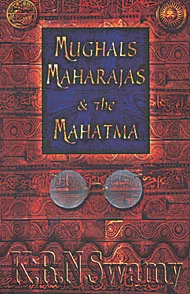
Neither India nor the Mughals are unknown in the wider world. Maharajas as well as the Mahatma are also familiar to most. One who knows the history of colonial India is certainly no stranger to either maharajas or Mahatma Gandhi or to India’s struggle for independence. K.R.N. Swamy, a lucid historian writes about the British government’s affecting India’s social and political fabric. This book is a tale of India’s movement from riches to rags and how the British offered Indians lessons on civilization but at such a high price that they became virtual paupers. Swamy’s style does not fictionalize history but it will make readers think of emperors, kings and fakirs. What is most evident is his love for India, the land where his heart is at home.
In the chapter “Martyr-Emperor’s Unfulfilled Wish,” he writes how the last Mogul Emperor of India, Bahadur Shah, was dazed when on May 11, 1857 — during what is known in the West as the Mutiny and in India as the first war for independence, sepoys from the Meerut cantonment proclaimed him Emperor of India and thus a focal point in the freedom struggle. The aged emperor was imprisoned and brought to trial in January, 1858 in the chambers of his own palace. The trial lasted 40 days and the all-British jury found him guilty of acts of war, of abetting rebellion, of proclaiming himself sovereign of India and of causing or being accessory to the deaths of 49 people of British or European descent. The court sentenced him to transportation and exile for life. When the aged and deposed monarch reached Rangoon on April 16, 1859, he was kept under heavy military guard where the brokenhearted patriot died on Nov. 7, 1862. The martyred emperor himself prophetically foretold:
Kitna hai badnaseeb Zafer dafn ke liye
Do gaz zamin bhi na mili kue yaar mein
How unlucky is Zafar!
For his burial, not even two yards of land were to be had in his beloved country.
The unfortunate man’s remains are still waiting to be buried in his beloved country.
Swamy writes about the actual thrones of 500 Indian princes. By subduing Indian sovereigns, their fabulous thrones were taken to Great Britain as the spoils of war. Tipu Sultan’s magnificent throne was destroyed after his defeat and the gold sheets covering it were distributed as prize money to the British Army. A few pieces of the throne’s tiger-faced supports are today in the Powys Castle Museum in Britain.
In the chapter, “A British View of the Jallianwala Bagh Massacre, “ Swamy paints a good picture of the event by using the statements of British journalists and historians. On April 13, 1919, 379 unarmed civilians were shot dead and 1,500 others wounded on orders from General Reginald Dyer of the British Army. Thus were Indo-British relations changed forever. Jallianwala Bagh in Amritsar became a byword for suppression. The general directed his men to fire “where the crowd was thickest.” If we compare General Dyer with present rhetorics of liberation, democracy and freedom, we find conscience in him when on his death bed he said to his daughter-in-law, “So many people who knew the conditions in Amritsar say I did right, but so many others say I did wrong. I want to die and know from my Maker whether I did right or wrong.”
In spite of hard facts and bitter truths, Swamy is fair and humane in judging the events and analyzing human psychology. One is much impressed by the both the depth and breadth of culture in this book.