
Kangaroos and koalas are the first things that come to most people’s minds when thinking about Australia. To my delight, a recent three-week trip to Australia where I spent a week each in Australia’s three main cities, Sydney, Canberra and Melbourne, unraveled various bits and pieces of this continent’s rare beauty.
While people in the Middle East and the Northern Hemisphere endure the heat of the summer season, Australia’s leaves are tinged with red and yellow tints welcoming winter with its cool gentle wind and cloudy rainy weather.
Australia is often described as “the land down under” because of its location in the Southern Hemisphere. Surprisingly, many people think that Sydney, being the oldest and largest city and having one of the most spectacular harbors in the world, is Australia’s capital. Yet, Canberra is Australia’s capital city and was selected as the location of the nation’s capital as a compromise between Sydney and Melbourne. However, Sydney is the state capital of New South Wales and a very much outdoor city.
Sydney
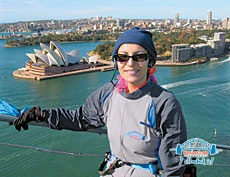
To have a general overview of Sydney’s interesting merge of the past and the present, there’s nothing better than challenging yourself and experiencing a small group adventure offering the ultimate experience of Sydney with two hours of guided climbs to the summit of the city’s most prominent icon: The Sydney Harbor Bridge. You may panic or feel nervous at the beginning of the adventure as we did, but the climb leaders put you through a process of preparations including breath tests and safety equipment training to enjoy the climb without fear or hesitation. Groups of 12 are guided along catwalks, up ladders and over the arch to the summit of the Sydney Harbor Bridge, where you can enjoy stunning 360-degree views of one of the world’s finest harbors either during day or night. One of the many stunning icons of Sydney your eyes immediately spot when climbing the bridge is the Sydney Opera House with its fabulous architectural design.
The Sydney Opera House is consolidating its position as Australia’s leading performing arts center by significantly increasing the profile of its own programming and by nurturing the development of new artists and audiences. A variety of modern and classic musical and theatrical performances can be viewed daily inside the house’s spacious and technically advanced halls. The outdoor fancy restaurants and shops dotted around the Opera House are very popular allowing people to eat and enjoy the spectacular view of the harbor and the bridge.
Discovering Sydney is never complete without a visit to the Greater Blue Mountains Area. Located around a two and a half hour drive west of Sydney, the Greater Blue Mountains area was included on the World Heritage List at the 24th Session of the World Heritage Committee.
A trip to the area offers breathtaking views, rugged tablelands, steep and sharp cliffs, deep and inaccessible valleys and swamps teeming with life. The unique plants and animals that live in this outstanding natural place relate an extraordinary story of the evolution of Australia’s unique eucalypt vegetation and its associated communities, plants and animals. The oil produced by the eucalyptus and gum trees affected by the sunrays colors the natural scenery with blue shades at certain times of the day and that’s the reason why the area is called the Blue Mountains.
The Greater Blue Mountains Area consists of 1.03 million hectares of mostly forested landscape on a sandstone plateau, which is 60 to 180 kilometers inland from central Sydney. The area includes vast expanses of wilderness and is equivalent in area to almost one third of Belgium, or twice the size of Brunei.
On the way to the Greater Blue Mountains Area is the Featherdale Wildlife Park, where visitors get to see various rare and unusual animals of Australia including koala bears and kangaroos. In fact, people get a chance to feed the kangaroos and pat sleeping koalas under the supervision of the park’s guides.
In order to discover the landscapes and mysterious beauty of the Greater Blue Mountains Area, Scenic World is a place where adventurers can indulge in observing the marvelous nature, enjoy 360-degree views of the famous Three Sisters, the magnificent Katoomba Falls, Mt Solitary and the near endless vista of the Jamison Valley. You could float on air in the recently unveiled Skyway with its world first Electro-Scenic Glass Floor, ride the steepest incline railway in the world down to a lush and hidden valley or stroll along the walkway through towering Jurassic rainforests and refresh both your spirit and soul.
Along with many distinguished hotels and resorts found in the Greater Blue Mountains Area, the Carrington Hotel in Katoomba stands as the best for the various unique facilities available there. The Carrington has a long and rich history spanning almost 125 years since its establishment in 1880 by Sydney hotelier, Harry Rowell. It became a popular mountain retreat for international visitors and for people who want to be swept into the history and romance where dreams have come true for over a century and where kings, queens and fourteen past prime ministers have stayed. For more gratification while experiencing the unique ambience of the Grand Old Lady of the Blue Mountains — the Carrington, the Yindi day spa is located inside the Carrington welcoming visitors from inside and outside the hotel to complete your stay.
Looking for more excitement or something that thrills you without the spills, maybe a little on the dark side? The wonder of the underworld at Jenolan Caves Reserve Trust is what you yearn for. Cave guides accompany you on adventurous and personal tours of the wild, undeveloped caves, taking you through many challenges while visiting naturally unique and fragile eco-systems. Over 250,000 visitors annually enjoy the wonders of the nine show caves, and an ever-increasing number enter into the world of adventure caving. If you dare for more challenge, there are also the cave-diving tours for professional divers.
Sydney attracts the majority of Australia’s immigrants — a potpourri of ethnic groups reside in Sydney and contribute to the city’s cultural life: Chinese newspapers, Lebanese restaurants and Greek Orthodox churches are as much part of the city as it’s Anglo-Irish traditions. Evidence of the region’s original inhabitants survives in the Aboriginal stencils that can be found in coastal caves.
Canberra
History of the Aboriginal and indigenous people of Australia is exhibited in the National Museum of Australia in Canberra. It is believed that Canberra is an Aboriginal term for “meeting place”. The National Museum holds a number of significant collections relating to each of its three primary subject areas: Land, nation and people. Significant elements include a collection of 80,000 stone tools and Australia’s largest collection of bark paintings, comprising 1600 works by numerous artists, spanning two centuries and the width and breadth of Australia.
At the core of the museum and its exhibitions is the National Historical Collection, a collection of nearly 200,000 objects representing Australia’s history and cultural heritage.
Located inside the premises of the museum is the Axis Restaurant. Axis is an intimate and contemporary restaurant with stunning lake views for a relaxed and stylish dining experience.
Canberra was designed by the Chicago architect Walter Griffin and across the lake that was named after him is the new Parliament House. Construction of the new Parliament House, the world’s largest stainless steel structure, cost the government one billion Australian dollars. The House is open for the public the world’s largest stainless steel structure the world’s largest stainless steel structure, free of charge, on a daily basis from 9 a.m. to 5 p.m. with people able to visit the public gallery, the Senate Chambers, the House of Representatives and the 23 hectares of landscape surrounding and covering the roof of the Parliament House. Interestingly, visitors have the chance of attending when parliament sits for “Question Time” in both Chambers. Parliament House welcomes 1.1 million visitors from Australia and overseas each year, making it one of Canberra’s most popular attractions.
The Mosque in Yarralumla is Canberra’s only mosque. Its simple design reflects the simplicity of Islam. There is a green dome on top of the mosque with writings of the Qur’an that decorate the inside wall. Visitors are welcome to visit the mosque in times other than prayer times. Muslims are only spotted in Canberra during prayer times in the mosque.
Melbourne
Located beside the Yarra River, Melbourne is the capital of Australia’s second smallest state, Victoria. With its cosmopolitan make up, Melbourne is widely known as one of the world’s most livable cities. Melbourne citizens are very much known for their passion about sports, more likely it is their official “religion”. Australian Football League or “footy” as Aussies name it is played in Melbourne on the ground of the Melbourne Cricket Ground. The game my colleague and I attended was between the Essendon and Carlton teams. It was an exciting experience of soccer but with Australian rules.
Another fascinating sports ground is the Rod Laver Arena at Melbourne Park. The Arena was named after Rod Laver who was the World No. 1 player for 6 consecutive years. More famously, he is the only player in tennis history to have twice won all four of tennis’ Grand Slam singles titles in the same year-first as an amateur in 1962, and then again as a professional in 1969. For this achievement, Laver is considered by many tennis fans to be the greatest player of all time.
The tour guide explained that Rod Laver was a left-handed player and that his left arm was of similar size to Mohammed Ali’s. The Open Australian Grand Slam of Asia\Pacific is hosted on the arena premises along with other activities such as motorbike super-cross action, rock concerts, conferences, classical ballets and Disney on ice performances.
Like the Greater Blue Mountains Area of New South Wales, driving 140 kilometers from the center of Melbourne to Phillip Island allows you to discover some of its hidden secrets, such as Churchill Island, site of the first farm in Victoria, the Penguin Parade and the Koala Conservation. In Phillip Island visitors and tourists can interact with nature and its beautiful animals in their natural habitat.
Every day at dusk people gather at the Phillip Island Penguin Parade waiting for the little blue Penguins, the world’s smallest, to gather in groups at the water’s edge. They cross Summerland Beach to return to their sand dune burrows. Penguins come out of the water waiting for each other to form a small group and as they start heading to their borrows, people sit at the viewing platform enjoying the penguins’ adorable walks and noises.
At the Koala Conservation Reserve you can stroll around the raised boardwalk that provides excellent viewing opportunity of some of the koalas. Park rangers have named young and old koalas as they spend most of their time studying them and providing them with natural environment. It makes the animals wander freely in their natural habitat on the contrary to zoos and parks where they are usually imprisoned behind bars.
As our journey came to an end, there were still remaining jewels of Australia that we haven’t discovered. However, for those with eyes to see and willingness to venture Australia is like a treasure, a vast land area of extraordinary natural and man-made exquisiteness welcoming people from around the world to get a delightful taste of it.