
ALKHOBAR, 23 June 2006 — In Saudi Arabia no one would take medical advice from a physician who lacked the proper certifications so why is it acceptable for us to allow uncertified mechanics to work on our vehicles or uncertified engineers to oversee the operations of our factories?
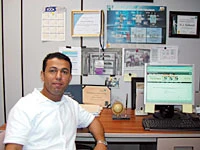
“Many people aren’t aware of the need for professional certification by internationally recognized organizations. But the truth is that certification is as important a qualification as professional training and on the job experience. Certification is a validation of a professional’s skills and it is an achievement on which we need to place more emphasis,” said Hamad Salem Balhareth, an instrumentation engineer working with Saudi Aramco’s Process & Control Systems Department.
Balhareth has recently obtained recognition as a certified automation professional (CAP). The recognition was achieved by obtaining a four-year engineering degree, combined with five years experience and successful completion of a four-hour automation examination sponsored by the International Society for Instrumentation, Systems and Automation (www.isa.org). The examination covered a broad range of automation topics including process instrumentation, regulatory control, advance process control, motion control, motor control, process safety systems and project management. Passing this exam confirms the engineer has demonstrated the highest level of automation knowledge and experience.
Balhareth joined Saudi Aramco in 1993 as a participant in the oil giant’s College Degree Program for Non-Employees (CDPNE). He graduated from Michigan State University with a BS in Electrical Engineering in 1998 and has continued his career with Saudi Aramco since that time. Scheduled to deliver a paper at ISA’s Expo 2005, Balhareth learned that he would be able to take the CAP examination at the same venue. In high spirits, he blithely went off to attend ISA’s Expo in Chicago. Seated to take the CAP exam, he found himself in a room filled with engineers, most having 15 years or more experience. It was an eye-opener.
“I quickly discovered that the test was no cakewalk,” explained Balhareth. “The questions on the exam had been drafted by Certified Automation Engineers having up to 30 years of experience in the field. I was stunned, and being jetlagged didn’t help. In the end, I missed a passing score by a few points.”
Returning to the Kingdom without the certification wasn’t pleasant, but Balhareth was up to the challenge. He was advised that he had six months to retake the test and even better, found that the CAP exam had just been made available through the Prometric testing facility at the Eastern Province Chamber of Commerce and Industry. After an intensive month of study, Balhareth was ready to conquer the exam.
“I was more prepared the second time I took the CAP exam and had a better idea of what to expect. Plus, taking the exam close to home meant I was more relaxed and in ideal physical condition. The test still wasn’t easy, but this time I did much better,” Balhareth said.
Balhareth is the first Saudi engineer to become a certified automation professional at a Middle East testing facility and he is publicizing his experience to encourage other Saudi automation engineers to go to their local Saudi chamber of commerce and achieve this essential recognition. Certified automation professionals are acknowledged by the automation industry as having a wide variety of skills in the field — not simply the ones gained from their current or previous job assignments.
“In the United States, employers already consider the CAP a big plus on an engineer’s resume. It is not yet a must, but it is gaining momentum and may be required for senior positions in the future,” remarked Balhareth. “In Saudi Arabia we should begin doing the same. In fact, it is time that we requested certification from all technicians, mechanics and engineers. It is impossible to tell if a person is really qualified for a job just based on their training and years of experience. Achieving certification by an internationally recognized nonprofit organization gives both the employer and the public a degree of confidence. Certified individuals are sure to have the knowledge and skills required to perform to an international standard in a specific profession. As Saudi Arabia has joined the WTO, professional certifications should no longer be considered optional for anyone hired to a position of responsibility in this market.”