
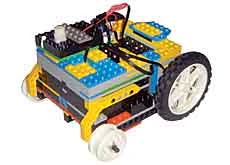
Parallel to the FIFA World Cup for the real flesh and blood players, the world champions of robot soccer are also emerging. RoboCup 2006, the most significant robotics competition in the world, was held at the Bremen Exhibition Center from June 14 to 18 in Germany. The goal of the RoboCup initiative is to develop a team of fully autonomous humanoid robots by the year 2050 that can play — and win — against the human world-champion soccer team.
This year’s RoboCupJunior “Team Salam” participants from the National Talent Training Center located in Al-Khobar, Saudi Arabia included Faisal Abdulwahed, Mohammed AbdulQader, Khalid Dhubaib, Abdul Mohsin Belushi, and Vernon Williams led by their esteemed coach and mentor Saeed Atef Saeed, a graduate of Cornell University and electrical engineer with Saudi Aramco. The team’s members were selected from the First, Second, and Third Place winning teams of Saudi Arabia’s First National Robocup competition held in May, 2006.
Coach Saeed believes that the team’s signature left behind was great! Team Salam received a Certificate of Excellence for their poster which highlighted the team’s mission to show other nations of the world what Saudi Arabian youth have to offer and what they can achieve. The judges’ and committee organizers also commended Team Salam’s exemplary behavior and team work throughout the event. Saeed was even voted to serve on the technical committee of organizers for RoboCup 2007.
RoboCup Junior is the educational branch of the event designed to introduce RoboCup to primary and secondary school children. The mission of RoboCup Junior is to promote scientific and cultural exchange, encouraging dialog between participants from different countries. This is achieved by grouping three teams from different countries each day to form combined Super Teams. The first day Saudi Arabia’s team was grouped with teams from Germany and China; the second day they were grouped with the US and Singapore teams; and on the final day the Saudi team was grouped with two teams from Japan. Each team’s accumulative score depended upon how the Super Team performed as a whole for the day. After winning 3 games and one tie, team Salam tied for 12th place out of 24 teams in their league.
Robots playing against one another can be as exciting as humans competing to gain control of the ball. Soccer requires greatness from the robots — intelligence, mobility, quick reaction, and team spirit. The robots move autonomously over the field — without remote control — on wheels, on four or two legs, or as virtual players. They have to know where they are at any time, follow the movements of other players and the ball, and react to these in an appropriate way. Team Salam’s tactic for this year was to have an offensive and a defensive player. One of their programmers innovatively developed a unique feature in their offense robot to recognize when it is stuck, back up, and resume seeking the ball.
The first world championship RoboCup was held in 1997 in Nagoya, Japan. There were 38 teams from 11 countries competing in three leagues. This year’s 10th annual RoboCup brought together about 2,500 scientists including, information technologists, professors, university students, engineers, mentors, and young people from 36 nations around the world. New teams participating in Robocup 2006 included Romania, the United Arab Emirates, Brazil and Taiwan. Iran was the strongest represented foreign nation, with 50 teams at the RoboCup championships, six of them having all female participants.
Astonishing results, in robotics and artificial intelligence, are helping to make people’s lives easier with service robots for applications in industry, home and personal robots, research and exploration in medicine,
in garden and farming, and in public safety. Robots are precise assistants in industrial production environments and increasingly finding their way into private households. Experts believe the use of personal robots will spread much like personal computers. In fact, eight million home robots are predicted to be in use by the end of 2007.
Saeed Atef Saeed owns and operates the National Talent Training Center in al-Khobar, a safe, fun and innovative environment where children can learn fundamental computer and technical skills and explore their imagination through technology. Saeed’s vision for local business and industry is to see products made in Saudi Arabia sold in Germany for their high quality with the capabilities and potential of Saudi youth who will be joining workforce of the future.
National Talent Training Center youth and families appreciate what Saeed is doing to supplement the development of young Saudis. In addition to gaining applied technical knowledge, children also engage in language learning, communication, teamwork, problem solving,
decision making, and leadership. These are some of the key competencies that will serve to enhance the success of our youth from high school to college and ultimately to the workplace.
These young people will always remember Saeed’s commitment to and passion for excellence, family, community, country, and global diversity. The parents are honored that their children are among the first groups in the National Talent Training Center of many more to be prepared for the World Cup 2050! Sincere gratitude goes to Saeed for believing in and taking part in nurturing the talent that resides within the children of Saudi Arabia.
Preparations are underway for the Center to organize the “FIRST Lego League” in the Kingdom this December.
For more information on how to participate or to get involved, contact Saeed A. Saeed at: [email protected]. For further information on Team Salam’s participation in Robocup 2006, visit:
http://robocup.talentscenter.com.