BAGHDAD, 2 July 2006 — At least 66 people were killed by a car bomb in a busy Baghdad market in a Shiite neighborhood yesterday, despite a massive security crackdown in the Iraqi capital.
It was the second deadliest attack this year and the worst since Al-Qaeda in Iraq leader Abu Musab Al-Zarqawi was killed by a US airstrike on June 7.
Meanwhile, a Sunni woman MP was kidnapped in north Baghdad along with eight of her bodyguards despite a peace plan launched by Prime Minister Nuri Al-Maliki.
The sprawling Shiite district of Sadr City, a stronghold of militiamen loyal to radical leader Moqtada Sadr, has been a repeated target for Sunni Arab insurgents amid mounting sectarian violence.
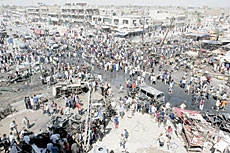
The massive bomb exploded as a police patrol passed through Al-Ula market which was packed with morning shoppers, an Interior Ministry official said.
Deputy Health Minister Sabah Al-Hussein said at least 66 people were killed and 98 wounded but added that more casualties were still arriving at hospitals.
It was the deadliest attack since a suicide bomber killed 67 people and wounded 105 at a police recruitment center in the insurgent bastion of Ramadi, west of Baghdad, on Jan. 5.
“The explosion happened in a very crowded market frequented by many people even from outside the area,” Hussein told state television.
“At the beginning of this market, the criminal blew up his dynamite-packed truck after trying to go over the pavement.” The market contains shops selling everything from bridal gowns to kitchenware. Many vendors also have stalls along the main market street and in packed alleyways selling fruits, vegetables and other goods.
The force of the blast torched nearby stalls and around 20 vehicles.
Fearful residents were seen desperately searching through the mangled wreckage for missing loved ones.
A US military vehicle which attempted to approach the blast scene withdrew in a hail of stones thrown by angry residents.
Maj. Gen. Jihad Taher Al-Luaibi, head of the Interior Ministry’s anti-explosives unit, said: “The martyrs were of all sexes and ages — innocent people. Their bones and flesh were crushed together.
“The impact of the explosion scattered pieces everywhere, as far as 500 meters from the scene,” he told state television.
The body of one young girl was found on the roof of a nearby gymnasium.
Stressing that the security forces had asked for new equipment to detect car bombs, Luaibi pleaded: “If the prime minister is listening, please approve our request because this will save human lives.” Militiamen of Sadr’s Mehdi Army threatened to take over patrolling the neighborhood following the failure of security forces to prevent the attack.
“The Iraqi forces are not doing their job properly... they are not checking cars that are entering the area. If this is the case, we will take the security of the area into our own hands,” a Shiite militiaman told AFP.
Iraqi Shiite and Sunni leaders traded blame over the attack. Hard-line Shiite MP Sheikh Jalaleddin Al-Saghir said after meeting Shiite leader Grand Ayatollah Ali Al-Sistani in the southern city of Najaf that the bombing was “a conspiracy being hatched by outside enemies.”
Without naming the alleged culprits, Saghir said Sistani was of the same opinion. Saghir has always accused neighboring countries of turning a blind eye to their extremists flocking to Iraq to attack Shiites. Riyadh Al-Nuri, a senior aide to Sadr, blamed the attack on those who were part of the government but continued to “pander to terrorists” in a veiled reference to Sunni Arabs.
Sunni Vice President Tareq Al-Hashemi’s Iraqi Islamic Party said: “We condemn the bombing in Sadr City and we hold the interior and defense ministers and Prime Minister Nuri Al-Maliki responsible for an impotent security plan that is unable to prevent such attacks.”
Elsewhere in Iraq eight people died and eight bodies were also found.
Taiseer Najeh Awad Al-Mashhadani, an MP for the National Concord Front, the largest Sunni Arab bloc in Parliament, was seized in north Baghdad, political and security sources said.
Her abduction came after Maliki, a Shiite, launched a national reconciliation plan aimed at wooing members of the disenchanted Sunni community away from the protracted insurgency and back into the political process.
The violence was a reminder of the precarious security situation in the capital despite a massive security clampdown that has seen tens of thousands of US and government troops patrolling the streets in recent weeks.
As part of the premier’s plan, 495 suspected insurgents were released yesterday, the seventh such batch to be freed since he first floated the idea of a partial amnesty on June 6.
In another development, Al-Qaeda leader Osama Bin Laden has accused Iraqi Shiites of waging “genocide” against Sunnis and warned of retaliation, in an audiotape attributed to him and posted on the Internet yesterday, the second in as many days.
“The unarmed Muslims in the Land of Two Rivers are subjected to a campaign of genocide at the hands of the gangs of grudge and treachery,” the speaker purported to be Bin Laden said in a reference to Shiites.
Those “gangs” were “deployed in all key posts in the former government of (Ibrahim) Jaafari and are present today in the incumbent (Nuri) Al-Maliki government,” the speaker said of Iraq’s previous and incumbent Shiite prime ministers.