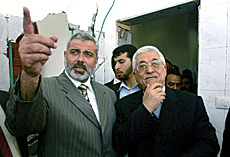
GAZA CITY, 3 July 2006 — Israeli missiles slammed into the office of Palestinian Prime Minister Ismail Haniyeh yesterday in an unmistakable message to get the release of an Israeli soldier as mediation attempts seem to have failed.
Israeli Prime Minister Ehud Olmert said the military was ordered to do “everything” within its power to return the captured 19-year-old corporal, and cautioned that arrests of senior Hamas officials could spread to Gaza, the group’s power base.
Defense Minister Amir Peretz, meanwhile, said Israel would go after “higher-caliber targets” in the future — a reference to senior Hamas officials inside and outside of the Palestinian territories, a political ally said.
Israeli aircraft, tanks and naval gunboats have been pounding Gaza for the past week in an effort to win the freedom of Cpl. Gilad Shalit, seized in a cross-border raid. Thousands of troops were also sent into the coastal strip for Israel’s first ground invasion since quitting Gaza nine months ago.
The armed wing of Hamas threatened to retaliate by resuming attacks inside Israel, predicting the region would sink in a “sea of blood” if the Israeli offensive continued.
“The Ezzedine Al-Qassam Brigades warn the Zionist enemy: If its operations continue, we will hit the occupation targets we were previously reluctant to strike,” said a statement in Gaza City.
In other attacks yesterday, Israeli aircraft hit a school in Gaza City and Hamas facilities in northern Gaza, where a Hamas fighter was killed and another wounded, Palestinian officials said.
Shaaban Manoun, 34, was the second fighter killed in the five-day Israeli operation. Israeli artillery also fired at open spaces near the southern Gaza city of Khan Younis, the military said.
So far, the ground invasion has been focused on southern Gaza, where Israel believes Shalit was taken. Yesterday, officials decided to invade northern Gaza if rocket fire on southern Israel resumes from that area, security officials said.
Palestinians said two missiles fired by attack helicopters set Haniyeh’s office ablaze, but because of the early hour — 1.45 a.m. — it was empty, witnesses said. One bystander was slightly injured, hospital officials said. Haniyeh, inspecting the burning office building shortly after, called the Israeli attack senseless.
“They have targeted a symbol for the Palestinian people,” he said. Later, before meeting with Palestinian President Mahmoud Abbas, Haniyeh vowed, “This will not break the will of the Palestinian people.”
After the meeting, the two men surveyed Haniyeh’s damaged office together, waving through a hole in the wall. “The world must understand that this is a dirty, criminal act,” Abbas said. Roni Bar-On, an Israeli Cabinet minister, said the objective of the attack on Haniyeh’s office was to “compromise the Hamas government’s ability to rule.”
The International Committee of the Red Cross (ICRC), meanwhile, expressed concern about the humanitarian consequences of the escalation of violence in the Gaza Strip in recent days. It appealed for the rules and principles of international humanitarian law to be fully respected. The ICRC urged all parties to spare civilians not taking direct part in hostilities and reminded them that attacks must not be directed against civilian objects. In particular, it recalled the obligation to exercise precaution.
— With input from agencies