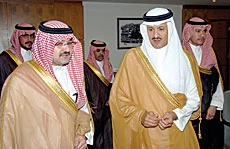
JEDDAH, 3 July 2006 — Prince Sultan ibn Salman, secretary-general of the Supreme Commission for Tourism (SCT), accompanied by Prince Mishaal ibn Majed, governor of Jeddah, opened the Jeddah offices of the SCT yesterday.
The new office is to coordinate with 13 new offices planned for the Makkah region in the near future.
The new premises are the latest stage in an expansion of the Kingdom’s tourist industry infrastructure.
“In the next few years,” said Prince Sultan, “we will complete the circle of supporting units in each and every region”.
These units are part of SCT’s plan to develop, organize and support tourism in every region of the Kingdom. The SCT has already established 10 units around the Kingdom. Each employs specially trained employees and is equipped with the necessary financial, human and technical resources.
“Jeddah is an old and culturally rich city,” said Prince Mishaal. “We have a lot of tourism experience in the region, aided with the help of SCT. Now with their new unit in Jeddah, that help will be more closely integrated and we will see actual development in Jeddah soon.”
Each new unit will be in direct contact with regional tourism development councils. Each council includes members from both public and private sectors which will play a direct role in developing tourism in their regions.
“We are opening branches not because we believe that central management would fail in this field,” explained Prince Sultan, but because “tourism is a dynamic and multi-faceted trade and it needs regional management to improve. We only provide support and consultancy through our offices or units.”
Tourism visas are not new to the Kingdom and over many years tourists have visited the historical and cultural sites that Saudi Arabia has to offer. Part of that cultural heritage is to be found in the traditions and craftsmanship of the people who make up the culture.
“We have only this week presented a study conducted by SCT and other ministries to the authorities to develop the handicrafts and traditional skills. We will also complete 10 cultural villages this year which will attract cultural displays, crafts and arts.”
Prince Sultan defined the SCT’s target market. “We are not looking to attract big groups of international tourists,” said Prince Sultan. “We want only small selected groups.”
He said that the target of the SCT is the local tourist as recommended in the national strategy plan that was recently approved by the Council of Ministers.
Prince Sultan said that he wanted to build on current achievements, to develop internal tourism and restructure it, providing the facilities and infrastructure to make it more attractive and a real competitive alternative to traveling abroad.
Cultural tourism forms 70 percent of international tourism and with that in mind, the SCT has a strategy to develop museums and historical sites. “We have also presented a new system for categorizing and preserving historical sites. Now no one can demolish a site until the authorities check its historical value, and if proven to be historically valuable it would not be demolished,” the prince said.
To give the system teeth, SCT has produced regulations that will clarify and ensure the rights of ownership and other legal regulations.
“We still have a lot of work to do,” said Prince Sultan. “The Kingdom is one of the most important countries in terms of historical value.”
The development of tourism is an investment. In the future that will need financing. The SCT will start developing investment strategies to ensure a flow of finance to see through the many plans it wants to complete. To develop interests and ideas, a forum on the investment in local tourism will be announced next week.
A number of ministries have already contributed to a study on ways to fund tourism in the Kingdom. “We are optimistic that the authorities would approve this study soon,” said Prince Sultan.