
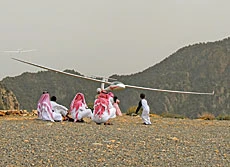
Continuing last week’s journey from Riyadh to Madain Saleh.
Leaving the dreaming tombs of Medain Saleh shimmering in the waves of heat rising from the desert, the Otter climbed southwards and followed the course of the Hijaz railway for a few kilometers, its rail bed clearly visible as a dark thread stretching into the heat haze. Fortified stations and barracks stood in splendid isolation, guarding the ghosts of pilgrims and troops who had traveled the line between Damascus and Madinah for the few years it was open. The Otter flew directly over Madinah and the Prophet’s Mosque, a sight that awed the media crew into silence. It then met the gliders over the impressive scenery of Jebel Abiyadh. This is one of the world’s natural wonders, which only a handful of people has ever seen it from the air. Impressive from the ground, when seen from above the cluster of volcanoes north of Madinah, evidence of the cataclysmic forces of nature boiling under the thin crust of the planet, it is simply stunning. It would be easy to imagine the landscape as one having been bombarded by projectiles from space. The cratered and shattered terrain, much of it a hazy black, suggested images from Dante’s Inferno. The topography is the result of intense volcanic and seismic activity triggered by the tectonic plate that forms the Arabian Peninsula tearing away from Africa eons ago.
Sharply defined red and brown ash cones litter the barren black landscape. Dominating the area are two enormous pale cones, streaked with honey brown and standing stark against the somber background. Desolate and with only tracks to drive on, the support vehicle had one of the toughest jobs of the day, not only chasing the gliders but also meeting and refueling the helicopter, which had limited range, at an isolated location in the area.
Reluctantly, the gliders then turned southwest, following a course which intercepted the coast at Rabigh and then followed the necklace of aquamarine shallows and reefs down to Jeddah. As good fortune would have it, the approach to Jeddah International took the Otter in a wide circle across the Al-Hamra beach where the landmark fountain, miniaturized by altitude, stood in the setting sun, gracefully trailing its 1000-foot high plume like a feather on azure silk.
After three days, the entire team was feeling the strain.
A rough start the following day, when the day’s route to Abha took the flight into turbulent conditions near Taif, did not improve matters. The Taif escarpment east of Jeddah is a 3000-meter cliff, another leftover from the enormous upheaval of the Arabian tectonic plate’s break away from Africa forming the Red Sea in the rift. Rugged and sharp, the barrier diverts the cool westerly winds sharply upwards and provides both thermals and powerful updrafts. It is perfect for glider pilots to soar and climb but proved the most difficult challenge of the trip for the chase aircraft.
The gliders rode the sea breeze and got extraordinary amounts of lift at the convergence of the hot and cold air masses, climbing rapidly to 19000 feet. “The visibility was outstanding,” said Bally, “We were euphoric! Many glider pilots fly 30 or 40 years without encountering a sea breeze convergence like this. It was a different type of flying and part of that learning is making mistakes.”
The combination of thermals, mountains and narrow valleys made filming over Taif almost impossible. Added to the wild gyrations of the plane to avoid the peaks and valley sides, the Otter encountered two hours of violent turbulence. Those wise enough to have taken seasickness pills before the flight suffered little; for those who had not, the trip was purgatory. Even pushing the Otter to its limits — much to the consternation of its passengers — Tahir was unable to keep the elegant gliders soaring easily in their element within the viewfinders.
Bally was reflective at the beginning of day five. “One tends to focus on one’s own problems but looking around, you become aware of the effort that everyone is putting in.” The scenery rewarded the effort by supplying dramatic views of terraced fields and hamlets tucked away in the towering mountains. The Kingdom’s southwest has the country’s highest rainfall and true to form, clouds developed early in the afternoon and rain fell in scattered areas. The result was that thermals stopped and made life problematic for gliders which powered their way at relatively low altitudes through the mountains to Abha.
Taking advantage of weak thermals and flying at very low altitudes, the glider pilots faced yet another variation of the complex gliding conditions the Kingdom offers. “It was extremely challenging flying,” said Bally, “because the escape routes — being able to glide to a landable area — were few. We were looking down into gorges, canyons with vertical walls and rocky floors. Some of those canyons you couldn’t get an aircraft into. It was serious stuff; we were flying 1500 meters below the mountain tops in valleys for much of the way.” In such conditions, pilots concentrate solely on flying and are largely unaware of the scenery. “In the evening, when we saw the pictures, we hit the “wow!” factor.”
One natural beauty they did notice was the flight of 20 or so large soaring birds — probably Egyptian Vultures. They shared the same thermal as the gliders, all rotating at the same speed and maintaining distance. “That was a moment of pure magic,” the pilots said. For camera crews in both plane and helicopter, the day was a success as there were ample opportunities for mountain footage.
“The idea of the trip from the beginning was to explore gliding areas in Saudi Arabia and to confirm that gliding could be successful here,” said Prince Bandar. Later, the idea arose to make a documentary about a glider trip round the Kingdom, recording the landscape from the air. However, the project developed into a full expedition as the scale of the challenge became clear. “The conditions are amazing for most of the year,” he said. There were also other aims. “By mounting the expedition,” said Prince Sultan, “we were really testing the system.” He said that the venture was not only training and testing the expedition members, but also the air traffic control and regional authorities to whom recreational flying and gliding is something entirely new. Thus the documentary and recording is important insofar as it forms a record and a source of promotional material for the development of the Saudi tourist industry.
The penultimate day of the expedition saw one of the camera crew on the ground at the top of the mountains in Sooda National Park and the other in the helicopter chasing gliders between mountain tops. The position was ideal as it afforded downward views into the gliders from a stable platform and gave superb footage. As it was a Thursday, families turned out in force to watch the fun. They were rewarded with some spectacular disciplined flying by Prince Bandar and John Bally — the former making a series of low passes over the picnic area much to the delight of squealing children and the latter performing a spectacular loop without power.
Not all the problems are technical. Day seven dawned with a sense of anticipation that the team was on the home run. The plan was to fly south from Abha to Najran and, after refueling the Otter at Wadi Al-Dawassir on the way to Riyadh, complete the journey. The journey to Najran was uneventful — smooth air, mountain scenery and some excellent filming. The gliders peeled off over the edge of the Empty Quarter and headed for Riyadh and the Otter dropped into Wadi Al-Dawassir. Pilot and passengers were warmly welcomed by the security staff, led to the cool waiting area and offered the usual hospitality.
The final leg from Abha to Riyadh took in the edge of the Rub Al-Khali. Prince Sultan, called back to Riyadh by work, was unable to fly this last leg much to his disappointment. Dull yellow dunes and flat featureless sand stretched far into the heat haze. It was humbling to think that people had actually walked across so incredibly inhospitable a place. But even there, tiny enclosures containing half a dozen camels and a hut showed that people were clinging on and surviving.
Eventually, Riyadh loomed out of the haze and a few minutes later, Thumama. The final leg was also the longest for the gliders. In a difficult 9.5 hours, they covered 1100 kilometers of cross country flying — a very long time by any gliding standard and more so in this case given the temperatures and ground conditions. “It was tough in the cockpit,” Prince Bandar later commented.
After seven grueling days and 4,500 kilometers of adventurous and demanding flying, the wheels of the Otter puffed smoke as they touched the runway and completed the circuit. The chase vehicles and gliders had yet to arrive, but the job of unloading and repacking began at once.
Part adventure, part publicity operation and part field test, the expedition collected huge amounts of information and firmly established the potential of the Kingdom for recreational flying. It is possible that the project might attract criticism as a piece of self-indulgent fun. That would be to short change the efforts of those involved and the long term view taken by Prince Sultan who is Secretary General of the Supreme Commission for Tourism and both founder and chairman of the Saudi Aviation Club.
“I think it is a shame that Saudis don’t see Saudi Arabia the way I see it from the sky,” he said. “It hasn’t been opened up or really explored, and that is what we are working on. I think that the next few years will see tremendous changes in Saudi tourism.” He said his biggest target audience was Saudi citizens, especially young ones. “If it is going to take adventures to get people’s attention, maybe they could be gliding and getting a chance to feel the wind.”