
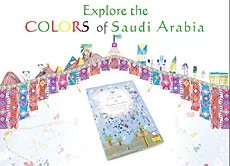
“We have certainly come a long way from the time when Saudi Arabians had to live in tents and travel by camels! Right now, broad highways and causeways connect many cities in Saudi Arabia. Aside from television and airplanes, everyone is now connected to everyone else through telephone lines and mobile phones.” So advises the character “Ali” in the book, “Colors of Saudi Arabia.”
Whining is in fashion. Go to any social event and the complaining never ceases. Turn on the news and a parade of crabby cranks march down the airways. In fact, it is now anticipated that something must be wrong with everything. Thanks to the extreme level of pessimism all around, it is no wonder that depression is the No. 1 illness in the world today.
Of course complaining is so much easier than having to get up and make a positive move. Positive activity generally requires a bit of creativity, which assuredly involves thinking and if everybody actually started thinking for themselves, there’s no telling what might happen.
But lo and behold! Thinking is exactly what Yasmeen Husain, founder of Alkhobar’s Bayan Gardens School (www.bayaan.com), did last September on Saudi National Day. To celebrate the occasion, all the boys and girls at the school, from preschool to sixth grade, created artwork that showed what they liked about Saudi Arabia. The children were divided into groups to draw and paint the best of the Kingdom, past and present, and some youngsters were even asked to “color the future” of Saudi Arabia.
“The children drew pictures of how they saw themselves in the world around them,” said Yasmeen. “Their artwork was wonderful and I felt that this was something we should carry forward. We have a beautiful country, rich in tradition and culture that should be preserved. We wanted the children to be able to convey the message of what Saudi Arabia is all about to others in order to help promote peace and tolerance in our world.”
That’s when the real work began. All the students’ drawings were incorporated in a book, “Colors of Saudi Arabia,” which tells the world about the Kingdom from the children’s perspective. Nestor B. Bande wrote a story that weaves its way through the drawings on the book’s pages. In the tale, a boy named Ali explains in English the scenes depicted in the pictures. Nestor F. Lacson was responsible for the book’s design and illustration.
“We wanted the world to see that these Saudi children are different in certain ways from children of other nations, but in many ways they are so much the same as children anywhere,” Yasmeen said. “As a modern touch, the hard copy edition of ‘Colors of Saudi Arabia’ includes a CD that holds a digital version of the book as well as ‘Ali’s Activity Book’ that can be printed out for playtime enjoyment.”
Yasmeen plans to distribute the book to embassies, consulates and libraries in the Kingdom and abroad. Students of Bayan Gardens School have taken copies of the book on their travels to share during the summer vacation and the book is being sold to the public through several art galleries in the Kingdom. It is hoped that in a few months, an international distributor will be signed to make the book widely available.
Proceeds from the book will go to support the school’s ongoing programs with local orphanages. Yasmeen also hopes that “Colors of Saudi Arabia” will serve as a foundation for the students at Bayan Gardens School to develop at least two or three projects relating to peace, health, literacy and humanitarian needs during the upcoming academic year.
“At school we need more time for involving the children in case studies, analyzing simple problems, discussing the issues, brainstorming solutions and implementing the solutions for these problems. ‘Case studies’ may seem like too advanced a phrase but it really isn’t,” remarked Yasmeen. “Let the children work on problems within the school, in the community and in their homes. We need to interest them in hobbies or projects from a young age, so they do not wander into trouble, hang out in the malls, sit at home staring at the TV or surf the Internet all day.”
She continued, “With this book project, we were able to integrate art, history, culture, science and geography. If you look at the pictures, you will even see some math equations in their drawings, as well as the girls’ wish for physical education. Our children are so creative and we need to enable them to do more at school and learn more within a nurturing, caring school environment. As the mission of Bayan Gardens School states, ‘we must learn from the past, integrate with the present, to prepare for the future.’”