NEW DELHI, 7 July 2006 — India and China yesterday reopened the historic Nathu La Pass, part of the ancient Himalayan Silk Route, that was closed after a war between the two Asian giants in 1962.
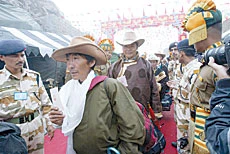
It was indeed a euphoric moment for the people of the region. To the beating of drums at the Sino-Indian border, Sikkim’s Chief Minister Pawan Kumar Chamling cut the ribbon at the inaugural ceremony throwing opening the pass to Indian and Chinese traders. Quoting India’s first Prime Minister Jawaharlal Nehru, Chamling said: “The people of China and India were knit together with a thousand bonds since the dawn of history.”
Chamling and Champa Phuntsok, chairman of the Tibet Autonomous Region, presided over the function. Describing the reopening of the border as a symbol of Sino-Indian friendship, Phuntsok expressed hope that the two countries would be able to expand other activities besides trade.
At a height of 4,545 meters, or 14,911 feet, Nathu La Pass connects Yadong County in Tibet with the northeastern Indian state of Sikkim. Changing border signboards are a sign of changing times. An earlier signboard warning in Chinese, “You are under enemy observation now” has been replaced by one saying, “Please come here. We are very good friends.”
Nathu La is the third border trade point between India and China; the other two are Lipulekh Pass in Uttaranchal and Shipki La in Himachal Pradesh.
Highlighting the chief features of Nathu La Pass as a Sino-Indian trade point, the Indian External Affairs Ministry said: “The border trade mart shall be open from June 1 to Sept. 30 every year. It will be open to the designated authorities of the two sides to extend or reduce the period of trade when considered necessary on account of exigencies like weather conditions.”
On the Indian side, Changgu border trade mart is at Sherathang, while on the Tibetan side it is Renqinggang trade mart, which would work Monday through Thursday every week. “Border trade would be transacted for items contained in the agreed list of commodities for trade between the two countries, which currently includes 29 items for exports from India to China and 15 items of import into India,” a ministry statement said.
The world’s highest trade mart at Sherathang, five km from Nathu La, was also inaugurated by Chamling. “The route has the rare distinction of bringing together nomads and city dwellers, pastoral people and farmers, merchants and monks, soldiers and pilgrims and scientific and literary figures,” he said.
Welcoming the reopening of the trade route, Federation of Indian Chambers of Commerce and Industry described it as a landmark initiative. “The opening will embolden the two sides to go full steam ahead with strengthening bilateral trade,” FICCI President Saroj Poddar said. Businessmen are keen to take advantage of the new opportunities opening the pass will create in the remote area. “I am excited. How can I not be, considering this is international trade,” said Dhurba Sharma, a cosmetics businessman from Sikkim. “Although the list of goods that can be traded is restricted, I want to see how good their leather is.”
Ties between India and China, the two most populous nations, were dogged by mutual suspicion for almost three decades after the border war, until surging trade and economic ties pushed political disputes into the backseat.
The reopening of the pass occurred on the birthday of the Dalai Lama, the Tibetan and Buddhist leader in exile in India. It came days after Beijing linked the Tibetan capital of Lhasa with a railway and is seen as another move by China to help modernize the long-isolated region.
— Additional input from agencies