GAZA CITY, 8 July 2006 — Israeli troops killed seven Palestinians in the Gaza Strip yesterday, a day after killing 24 over a soldier’s capture. But in a possible attempt to find a way out of the crisis, an Israeli Cabinet minister suggested that Palestinian prisoners might be released as a “goodwill gesture” if the captured soldier, Gilad Shalit, is freed and rocket attacks on Israel are halted.
Previously, Israeli officials had flatly rejected Palestinian demands for a prisoner swap, insisting on unconditional freedom for Cpl. Shalit, who was seized nearly two weeks ago in a cross-border raid led by Hamas gunmen. But Israel has negotiated the release of captured Israelis in the past — usually in deals that free far more Palestinians than Israelis — and privately, Israeli officials have said they did not rule out talks in Shalit’s case either.
Avi Dichter, Israel’s minister of public security, alluded to that history when he said that once Shalit is freed and Palestinians stop rocket attacks from Gaza, Israel could release Palestinian prisoners as a goodwill gesture.
“The release of the soldier, Gilad Shalit, is a must,” Dichter said in a speech to Israeli business people.
If the Palestinians halt attacks, “Israel will need to, after some time, release prisoners as a reciprocal gesture,” Dichter said. “Israel knows how to do this. Israel has done this more than once in the past.”
Dichter also said Shalit is alive.
Hamas rejected the apparent overture, warning that Israel’s offensive had hurt efforts to free Shalit and said the Jewish state would “pay the price for every drop of blood.” “Our people have no faith in goodwill gestures,” Hamas lawmaker Mushir Al-Masri said. “There is no talk at the moment about the missing soldier. We are talking about 30 Palestinian martyrs and 100 wounded in an Israeli military aggression against our people.”
Earlier, the group said in a statement: “The issue of the captured soldier has become more complicated than before. The government of the occupation is wrong to think the Zionist massacres it is committing against our people will serve its goals of applying pressure to regain the captured soldier.”
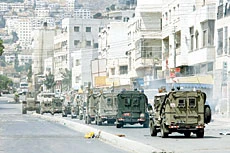
Yesterday, Israeli aircraft struck Palestinian fighters in northern Gaza while ground troops backed by tanks pursued them in crowded towns. Six people were killed in the air assaults and heavy artillery barrages.
Israeli Prime Minister Ehud Olmert ordered tanks into Gaza after Hamas activists fired rockets into a major Israeli city for the first time. The offensive began last week with the main goal of freeing Shalit, captured in a raid on June 25. “The terrorists have paid a heavy price so far,” Israeli military chief Lt. Gen. Dan Halutz said.
Hamas accuses Israel of using Shalit’s abduction as a pretext to topple its elected administration. Israel has detained more than a third of the Cabinet and hinted it could assassinate Hamas leaders if Shalit is killed.
Despite Israel’s push into Gaza, Palestinians fired at least five homemade rockets into the Israeli border town of Sderot yesterday, with one strike wounding three people, medics said.
The casualties came when one of the makeshift rockets hit a potato processing plant in the town. Another rocket hit a school without causing any damage or injury.
The European Union accused Israel of disproportionate use of force. “The EU condemns the loss of lives caused by disproportionate use of force,” a statement by the Finnish EU presidency said. The fighting has compounded the misery of Palestinians in Gaza and the West Bank. International sanctions imposed to pressure Hamas to recognize Israel have resulted in nonpayment of government salaries. But yesterday, Palestinian officials said about one-fifth of the 165,000 civil servants would receive a small down payment.
The source of the money was in dispute. The Hamas government said it used internal revenues and brought funds through the land border to make the payments. Other officials said President Mahmoud Abbas drew on the first foreign aid transfer the Palestinians have received in months.
— Additional input from agencies