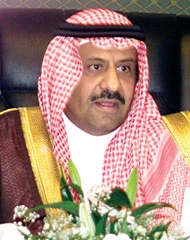
RIYADH, 12 July 2006 — In a gesture of love for his alma mater, Prince Khaled ibn Sultan, deputy defense minister, has donated SR9.4 million to America’s Auburn University Montgomery (AUM) from where he graduated in 1980. The donation also includes an amount of around SR3.75 million to establish a new fellowship program called the “Prince Khaled ibn Sultan Global Initiative.”
Speaking yesterday, AUM’s Chancellor Dr. Guin Nance said, “It was our desire to reconnect with one of our distinguished graduates and ask him to support AUM. Prince Khaled’s contribution will foster the desire at AUM for more internationalization of the curriculum and its students.”
In reply to a question about how the funds will be used, Dr. Tom Vocino, head of AUM’s Political Science & Public Administration Program, said that the donated money would be used to establish the Prince Khaled Fellowship Program.
More than SR4.5 million of the donation will be used for giving financial assistance to students at AUM, whereas some money will be used for fellowships and scholarships in the coming school year. Daniel Dye, AUM’s media manager, said, “Prince Khaled was one of the most distinguished old boys of AUM.” The prince was presented with AUM’s second annual ‘Distinguished Alumnus Award’ in 1995.
Born into the Saudi royal family, Prince Khaled is a versatile genius, a humanist and a war veteran. By the age of 41, he worked side-by-side with Gen. Norman Schwarzkopf to protect Kuwaiti sovereignty during the Gulf crisis. As a youth, he left home to attend Britain’s world-famous military academy at Sandhurst and continued his training with regular stints in the US. In 1979, Prince Khaled embarked on what is to date his only civilian degree, a Master of Political Science at AUM. By the age of 40, the prince had developed a reputation as a strategic air defense expert and diplomat. His career had already taken him on a number of secret missions, including the successful purchase of medium-range surface-to-surface missiles from China. In many cases, Prince Khaled’s role required him to act as both a military and cultural intermediary between the Saudi government and Western countries or defense forces.
The prince conducts himself in a very commendable and successful manner because of his experience of British and American customs. He always ensures that differences in religion, philosophy and protocol do not prevent people or the defense personnel of different countries from working together. Prince Khaled has also pursued various hobbies and interests. His 478-page book spanning the modern history of Saudi Arabia deserve special mention.