BOMBAY, 12 July 2006 — Nearly 200 people were killed and hundreds hurt as eight explosions rocked Bombay’s commuter rail network during evening rush hour yesterday. India’s major cities were put on high alert after the blasts.
There was chaos throughout Bombay’s crowded rail network following the explosions, and authorities struggled to determine how many people had been killed and injured.
As the death toll rose through the night, officials gave out different — and sometimes conflicting — figures, often within minutes of each other. Vilasrao Deshmukh, the chief minister of Maharashtra state where Bombay is located, said that bombs had caused the blast and that as of late yesterday 174 people had died and another 439 were wounded. The figures are likely to go up.
Deshmukh also corrected initial reports of seven blasts, saying there had been eight explosions, including two at one station.
The first explosion hit a train at a railway station in the northwestern suburb of Khar at about 6 p.m. as thousands of people packed the trains for the journey home.
A series of six more blasts followed down the line of the Western Railway at the Mahim, Matunga, Bandra, Jogeshwari, Borivali and Mira Road stations. Some passengers reportedly jumped out of speeding trains in panic.
Bombay Police Commissioner A.N. Roy said, “Obviously a terrorist outfit is behind the blasts because a normal human being could not have done this.”
Prime Minister Manmohan Singh called an emergency Cabinet meeting, calling the attack an “evil design” of terrorists. Home Minister Shivraj Patil told reporters that authorities had “some” information an attack was coming, “but place and time was not known.”
Police were also reportedly carrying out raids across the country following the explosions, presumably in search of suspects. One television report said a suspect was in custody. Maharashtra’s Director General of Police P.S. Pasricha said the explosions were part of a well-coordinated attack.
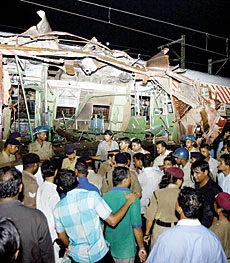
Train cars were blown apart and television images showed ghastly footage of bloodied limbs and dead bodies in the wreckage. This was one of the worst such attacks in India in recent years and there were fears the death toll could rise. Doctors in three hospitals in Bombay, a sprawling city of almost 18 million people, were struggling to treat the injured.
Witnesses reported seeing body parts strewn about stations, and Indian television news channels broadcast footage of bystanders carrying victims to ambulances and searching through the wreckage for survivors and bodies. Some of the injured were seen frantically dialing their cell phones.
The force of the blasts ripped doors and windows off carriages, and luggage and debris were strewn about, splattered with blood. Survivors were seen clutching bloody bandages to their heads and faces. Some were able to get up and walk from the stations.
Pranay Prabhakar, the spokesman for the Western Railway, confirmed that seven blasts had taken place. He said all trains had been suspended in Bombay, and he appealed to the public to stay away from the train stations in the city, India’s financial and commercial center and principal port on the Arabian Sea.
There was no immediate claim of responsibility for the attacks, but the blasts came in quick succession — a common tactic employed by Kashmiri militants who have repeatedly targeted India’s cities.
“The blast was so powerful that we thought we were hit by lightning. It shook our market,” said shopkeeper Gopi Chand, who witnessed the blast in Khar.
Led by Pakistan, leaders worldwide condemned the blasts and vowed to step up the global fight against terrorism.
The Pakistani Foreign Ministry issued a statement late yesterday condemning the attacks as a “despicable act of terrorism.”
“Pakistan strongly condemns the series of bomb blasts on commuter trains in Bombay, India,” a Foreign Ministry statement said.
“This despicable act of terrorism has resulted in the loss of a large number of precious lives,” it said.
Pakistani President Pervez Musharraf and Prime Minister Shaukat Aziz also strongly condemned the attacks and offered condolences over the loss of life, the ministry said.
“Terrorism is a bane of our times and it must be condemned, rejected and countered effectively and comprehensively,” it said.
British Prime Minister Tony Blair, who only last week marked the one-year anniversary of the July 7 London bombings, said his country stood united with India in a shared determination to defeat terrorism “in all its forms.”
“I condemn utterly these brutal and shameful attacks. There can never be any justification for terrorism. Our thoughts are with the victims and their families,” Blair said.
“We stand united with India, as the world’s largest democracy, through our shared values and our shared determination to defeat terrorism in all its forms.”
Spanish Prime Minister Jose Luis Rodriguez Zapatero said the tragedy had revived the horrors of a similar attack in Madrid two years ago, in which 191 were killed in coordinated bombs on four commuter trains.
“In the name of the Spanish government and on my own behalf, I want to express my profound sadness for these very serious terrorist attacks which have struck your country,” Zapatero told Manmohan in a cable.
“I also want to express the solidarity and affection of the Spanish people.... Today’s attacks against seven trains in Bombay recall the tragic scenes we lived out in Madrid on March 11, 2004.”
US Secretary of State Condoleezza Rice responded by pledging to stand with India in the “war on terror.”
“There is no political cause that can justify the murder of innocent people,” Rice said in a statement.
“The United States stands with India in the war against terror. Those responsible for these terrible acts should be swiftly brought to justice.” The State Department said the US government was in touch with the Indian government to offer any assistance needed.
Russian President Vladimir Putin, whose country is regularly targeted by Chechen rebel strikes, called for the perpetrators to be “severely punished.”
“There is no, and there can be no, justification for a crime of such cynicism and monstrosity,” he said in a statement.
“The terrorists guilty of this crime must be severely punished.” India’s neighbor Pakistan described the attacks as a “despicable act of terrorism.”
Afghan President Hamid Karzai drew on his own country’s experience of terrorism as he offered his condolences to the victims of the tragedy.
“This terrorist act is shocking and despicable. It is aimed at killing innocent civilians and I condemn it in the strongest terms,” Karzai said in a statement.
“Afghans have suffered at the hands of terrorists for many years and understand the pain and suffering that terrorism causes.”
European Union foreign policy chief Javier Solana said he was “shocked” by what he called “these despicable acts of terrorism, which have caused death and injuries to scores of innocent people.”
Italy’s Foreign Minister Massimo d’Alema said the attacks would “only strengthen the international community’s resolve to act with determination in the fight against terrorism,” while Canadian Foreign Minister Peter MacKay denounced them as a “deplorable act of violence against innocent civilians.”
And French President Jacques Chirac expressed his country’s “solidarity” with India, saying nothing could justify the attacks.
South African President Thabo Mbeki, too, expressed his “outrage” and condemnation in a message of support to Indian President Abdul Kalam.
The federal government has announced all assistance to the Maharashtra government in the wake of the serial blasts. Congress party President Sonia Gandhi condemned the bomb blasts.
Meanwhile, the Pakistan-based Lashkar-e-Taiba (LeT) last night condemned the blasts and denied involvement in it. Lashkar spokesman Abdullah Ghaznavi condemned in strongest terms the blasts.
“These are inhuman and barbaric acts. Islam does not permit killing of an innocent person,” he added.
Ghaznavi said those who have perpetrated such “dastardly acts” were “enemies of humanity”.
“Blaming the Lashkar-e-Taiba for such inhuman acts is an attempt by the Indian security agencies to defame the freedom struggle in Jammu and Kashmir,” he said.
Indian security agencies last night launched an investigation to identify the terrorist outfit behind the deadly blasts to determine whether it was linked to grenade attacks in India-administered Kashmir earlier in the day, officials said.
Police in Kashmir had claimed that the LeT group was behind the grenade blasts that killed eight people Tuesday afternoon.
— With input from agencies