
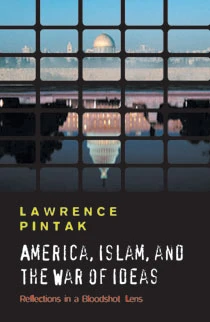
LAWRENCE Pintak, a former CBS News Middle East correspondent, is presently the director of The Adham Center for Electronic Journalism at the American University in Cairo. His latest book “America, Islam, and the War of Ideas Reflections in a Bloodshot Lens” is an attempt to understand why the United States lost the widespread sympathy it had earned in the aftermath of 9/11.
Throughout the book, the author clearly demonstrates that the conflicting worldviews of Americans and Muslims have caused them to judge events in different ways. Moreover, these opinions have been constantly stimulated by the growing influence of satellite television and the Internet especially in nonwestern countries. These factors eventually strengthened the intangible presence of the Ummah or the ‘global community of Muslims’ and “reinforced the connection between Muslims across the geographic and political spectrum by reemphasizing their essential sense of Muslim identity in the face of the American Other” says Pintak.
Drawing from thirty years of experience as a journalist and some thorough scholarly research, Lawrence Pintak writes an in depth essay on the causes of the present confrontation between Islam and American policies. He reminds us that the US media has a long history of distorting the truth about Muslims. The late Edward Said criticized academics and reporters in his book Covering Islam. Said blames the US news organizations for not allowing their reporters to stay long enough to gain experience in the region and even learning the language. In this classic work, published in 1981, in response to the biased coverage of the Palestinian-Israeli conflict and the Iranian revolution, Said shows that misrepresenting Islam, as a threat is “capable of generating much more excitement, whether for purposes of entertainment or of mobilizing passions against a new foreign devil”.
A majority of Americans still equate suicide terrorism with the Middle East despite the fact that most of the suicide bombings between 1983 and 2000 were connected with the political situation in Sri Lanka. The truth is that Americans were simply not interested in following these events but when suicide bombers targeted Israelis and US embassies, they deeply cared.
After 9/11, it became increasingly difficult for American journalists to show that there existed another way of thinking as orders were given to explain facts from a pro-US perspective. Even the CNN embraced a pro-American bias view as its chairman, Walter Isaacson, told his staff that it “seems perverse to focus too much on the casualties or hardship in Afghanistan”. Pintak goes on to quote the New York Times foreign editor, Roger Cohen, who acknowledges that the public was not interested in hearing about the collateral damage of America’s War on Terror and it was difficult to get a story about Afghans killed by misdirected attacks on the front page. He concludes that “where audiences watching Al-Jazeera and the other Arab broadcasters saw bleeding children and destroyed homes, Americans experienced the war as a Hollywood extravaganza on the small screen, billed in advance by the White House as certain to evoke ‘shock and awe’”.
Christiane Amanpour also admits that the post 9/11 era was “a climate of fear and self-censorship” during which American journalists were being manipulated. On the other hand, people in the Arab world, showed an insatiable hunger for information.
“Many Arabs skim several newspapers a as they try to piece together a coherent picture of the news… With the advent of satellite TV, the television provides constant background noise in coffeehouses and grocery stores. To a degree seen in the US only during times of national crisis or catastrophes, Arabs are fixated on the events that constantly buffet their turbulent region. In Jordan, for example, 83% of people say they watch TV news. That’s more viewers than entertainment programs attract, the exact reverse of the United States,” says Pintak.
As the Arabs and their non-Arab Muslim brethren watch their own satellite channels they finally have an opportunity not only to view the world according to their environment, their culture and their religion but also to voice their own opinions. This new era of mass communications has strengthened like never before the sense of Muslim identity. It has also highlighted “America’s failure to acknowledge that Israeli violence fit the definition of terrorism, while condemning Palestinian actions as exactly that”.
Secretary of Defense Donald Rumsfeld admitted the US had lost the initiative in the ‘War of Ideas’ and that this “is perhaps our most significant shortcoming so far in the war against terrorism”.
The author concludes that the United States can no longer say one thing and do another. “Americans must reach out to the majority of the world’s Muslims with respect and equality; break down the distinction between Us and Them; learn to communicate in an era in which the United States no longer writes the script. Until then, Americans and the world’s Muslims will each continue to view the other through a bloodshot lens. And innocent people on both sides will continue die,” writes Pintak.
This compelling analysis should be read by anyone trying to understand the origin and the hidden agenda behind the War on Terrorism.