
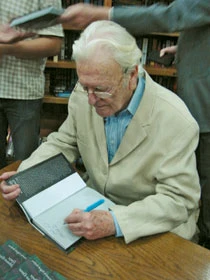
DENYS Johnson-Davies, the best-known Arabic to English translator has written his memoirs, aptly entitled ‘Memoirs in Translation, A Life between the Lines of Arabic Literature’. To celebrate the occasion, the Director of the American University in Cairo Press (AUC), Mark Linz, invited a host of literati, celebrities and the author’s personal friends to the AUC bookstore situated in Zamalek, a leafy island in the heart of Cairo.
The author who divides his time between Marrakech and Cairo confided on this occasion that he intends to leave Morocco and take up permanent residence in Egypt: “I belong to Egypt” he said in a tone which leaves no doubt as to the reasons for this choice.
With a career spanning some sixty years, Johnson-Davies has traveled extensively throughout the Arab world but Egypt remains the country he knows and loves the most for having lived there for long periods of time.
‘Memories in Translation’ is both an informative and touching piece of writing. When asked why he wrote this book, the author, in an outburst of sincerity, said, “I felt I had a lot to say.”
The sub-title ‘A Life between the Lines of Arabic Literature’ highlights in a purely entertaining manner, how the author’s life is a formidable web of encounters and enduring friendship with some of the most famous Arabic writers of the twentieth century: Naguib Mahfouz, Tewfik al Hakim, Yahyia Hakki, Louis Awad, Mahmoud Teymour, Yusef Idris, Badr Shaker al-Sayyab, Jabra ibrahim Jabra to name but a few.
The anecdotes related to these famous writers are both enlightening and amusing. Furthermore, I could not but agree with many of the author’s pertinent remarks about the state of Arabic literature but I was mostly enthralled by his endearing love for the Arabic language and his total commitment to translate the best of Arabic fiction.
Johnson-Davies was merely fourteen when he told his father he wanted to study Arabic. Determined to fulfill his dream, he successfully passed the entrance exam for Cambridge University at the age of fifteen. Too young to enter the prestigious university, he was exceptionally admitted at sixteen and special arrangements were therefore made so he could spend a year at the School of Oriental Studies and the summer in Cairo to learn the Arabic alphabet.
Although Johnson-Davies has already translated 28 books from modern Arabic literature; he writes humorously that he was able to persuade himself that he should round it up to thirty. In the course of his long career, he admits disarmingly that he has never thought about whether a writer was well known, being always on the lookout for new talent, “I find translation exacting work, and it is not well paid, so there seems to be little point in translating books of which one does not have a high opinion,” he explains.
I agree with the author that France, in particular, has made more efforts to translate modern Arabic fiction than Britain and the United States despite their strong political and economic interest in Arab countries. Johnson-Davis actually doesn’t fail to mention how surprised he was when even in 1938 “Britain had acquired this great empire, which included a large number of people whose native language was Arabic, and yet appeared to boast virtually no one who knew the language”.
It is sad that Arabic literature in translation is still not generating the interest it deserves. Publishers just point out that it does not sell well. Profit sadly dominates the world of Arab literature and one can only praise the AUC Press for translating and publishing on a regular basis some of the best modern Arabic novels.
The author’s success as a translator is not only due to his genuine love for Arabic literature but also and mainly for the way he writes. When a translation is good it is because the translator has rewritten the book in another language. As Johnson-Davies was translating the first volume of Arabic short stories (which were eventually published in 1947) he learned a lesson in translation that he never forgot. He was told that the role of a translator is to absorb the language, to feel its musicality, its color and inner life, to grasp its hidden meanings and only then should he attempt to render it in proper English.
Johnson-Davies in conclusion said, “Translation is not simply a matter of putting one word in place of another. It is an art, and as someone said ‘nothing moves without translation’.”