
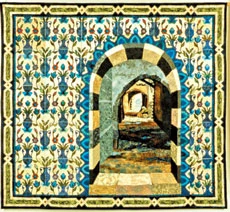
IN a world where people always seem to be running after time and wanting to make more money, it does seem strange that traditional pastimes (requiring time and patience), quilting for one, have never been as popular. Perhaps because quilting generates a huge interest in the United States where it has evolved into a multibillion-dollar business, one often thinks that it originated in America.
“In fact, quilting started in Ancient Egypt. Quilted garments have been found in tombs and the well-known log cabin pattern came from wrapping on mummies. Cotton as a textile has a greater resistance to heat than most others and can be kept in storage for a long time without deterioration,” explains Jenny Bowker, an expert quilt maker and teacher.
Jenny Bowker has bookings until 2009 and she is just back from Tehran where she has been setting up patchwork classes. Despite Iran’s great sewing tradition (there are over three hundred sewing schools in the capital) she was surprised to learn that quilting had never been taught before.
She is convinced that quilting empowers women and men do not mind women sewing. That fact explains why so many women around the world are able to earn some extra money by sewing at home. Jenny Bowker has recently participated in the Ramallah Quilt Project, which is intended to help students make an extra income by making home accessories in quilt.
Jenny, whose husband is the current Australian ambassador in Egypt, has lived a total of eleven years in Arab and Islamic countries including Syria, Western Samoa, Malaysia, Jordan and Jerusalem. She recognizes that although there is not a lively tradition of quilting in the Arab countries. There are notable exceptions. Quilts are found in Syria where they are made with four inches of pure wool and one inch stitches. Palestine has a quilting stitch known as ‘the civilian stitch’. Egypt also has a wonderful tradition of stunning appliqué work, which in some ways is similar to the art of quilting. Appliqué, or applied work, means that at least one different piece of material has been placed on a ground fabric and held in place with stitches. The term comes from the French verb ‘appliquer’, which means “to put on”. This technique was used by the ancients Egyptians, Scythians and Greeks.
In the past, it appears that quilting was mainly used for clothing. It is also likely that quilting was brought to Europe through the Crusades. The victorious Muslims wore tightly quilted garments as part of their armor, which was soon adopted by medieval European soldiers.
In between her busy teaching schedule, which takes her all around the world, Jenny Bowker finds the time to make stunning quilts. She is presently acknowledged as a leader in the field of contemporary quilt making. She recognizes that living in the Arab world has inspired her work, which reflects her love for the East. “My work is about the items I collect as I travel and live in different places, each holds a wedge of memories for me: Sounds and smells, memories of the place and the people,” she said.
Quilting, like embroidering, has been a way for women to express their creativity throughout the ages. “Working with textiles is a woman’s language. It is sensuous and comforting,” it has also been said that “quilting softens and smoothes the rough edges of painful realities”.
There exists a long tradition of women turning to quilting in times of crises and tragedy. Women find that quilting helps them cope with problems as well as fears and anxieties about the future. Women traditionally quilt in small gatherings, which create intimacy amongst them. They open their hearts to each other and find solace, comfort and even the strength to come to terms with the object of their fears. Quilting gives women a mindful space where they can face their problems in a calm and soothing way. By creating something new with pieces of fabric, a woman feels a sense of empowerment and less helpless in coping with difficult moments.