BEIRUT, 23 July 2006 — Israeli tanks and armored vehicles rolled into south Lebanon yesterday and its troops kept hold of a Lebanese village as it opened a humanitarian corridor amid mounting concern over the plight of civilians in its war against Hezbollah.
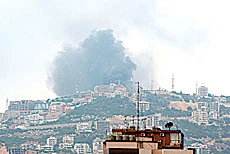
Striking television towers and mobile telephone masts, Israel also kept up its devastating air blitz on Lebanon that has killed at least 352 people and displaced over half-a-million in 11 days of military action on the country.
Meanwhile, Prince Saud Al-Faisal, the Saudi foreign minister, and Prince Bandar ibn Sultan, the secretary-general of the National Security Council, are set to visit the US, the UK and Russia to discuss with regional and international leaders ways to defuse the Middle East crisis and bring an end to Israeli attacks on Lebanon and Gaza.
The visits are part of consultations by the Kingdom to stop Israeli excesses, the Saudi Press Agency reported yesterday.
Also, Britain’s junior foreign minister openly criticized the Israeli military offensive as “difficult to understand,” as US Secretary of State Condoleezza Rice was to visit the region after once again rejecting the idea of a cease-fire.
Around 10 Israeli armored personnel carriers and bulldozers punched across the border at Avivim, around 35 kilometers (23 miles) from the coast, bypassing an observation post of the UN Interim Force in Lebanon.
“This is only a pinpoint operation,” army spokesman Capt. Jacob Dalal said. The army has made clear it has no plans for a full-scale invasion but has consistently refused to rule the option out. Israel had Friday urged the remaining people living in south Lebanon to leave and also called up thousands of reservists as it massed troops along its northern border.
The army said that its ground troops had pulled back from one of two positions it had been occupying inside southern Lebanon for the past three days but a spokesman for the UN interim force on the border said it was keeping four tanks in the village of Marun Al-Ras.
Israeli military observers said Marun Al-Ras, close to the Israeli border, is a strategic location because it lies at 911 meters (3,000 feet) above sea level.
One employee of the LBCI television station was killed and another wounded in the Israeli airstrike on TV transmission towers and mobile telephone masts at Fatka, in the Kesrwan mountains northeast of Beirut, police said. Transmission towers for Hezbollah’s Al-Manar and the privately run New TV, as well as mobile phone networks, were also destroyed in Terbol in northern Lebanon.
The strikes targeted transmission towers for a number of private TV stations, including LBCI and Future, and some private radio stations in Fatka and further up Mount Sannine, police said. Mobile telephone networks were down in the north of Lebanon after the strikes while local television transmission for LBCI was cut in the north and in Kesrwan mountains, although people could still view the channel on satellite.
A Lebanese man and his wife were killed and their four children wounded near the southern port of Tyre when a missile hit their car while another civilian was killed and his two children were wounded when an Israeli shell hit their house in the southeast Druze village of Kfardiss.
As tit-for-tat strikes continued, Hezbollah kept up a defiant stream of rockets onto northern Israel, with police there saying 70 rockets landed yesterday, lightly wounding two people in Carmiel.
An Israeli soldier was moderately wounded by Hezbollah sniper fire on a border outpost — the first such incident in the worst cross-border fighting in a quarter century that has killed 33 Israelis.
The comments by Britain’s junior Foreign Office minister Kim Howells marked London’s most unequivocal criticism yet of Israel’s military offensive and were in stark contrast to the line taken by Washington and his own prime minister. “These are not surgical strikes. It’s very difficult to understand the kind of military tactics that are being used,” Howells told journalists during a visit to Beirut.
“If they are chasing Hezbollah, then go for Hezbollah. You don’t go for the entire Lebanese nation.”
“I very much hope that the Americans understand what’s happening to Lebanon — the destruction of the infrastructure, the death of so many children and so many people,” he said.
His stance echoed similar concerns raised by French Foreign Minister Philippe Douste-Blazy who warned in Cairo that the spiraling conflict and blockade of Lebanon could lead to the “destruction of the Lebanese state.”
UN humanitarian coordinator Jan Egeland was due in Damascus yesterday, from where he will go on to Beirut to launch an appeal tomorrow for millions of dollars in humanitarian aid for Lebanon, in particular the half-million civilians displaced by the Israeli onslaught. Following United Nations warnings that Lebanon was facing a humanitarian catastrophe as food and medication runs out, Israel opened a safe maritime and air corridor to allow humanitarian aid shipments to reach Lebanon.
“We have authorized a 50-mile-long and five-mile-wide (80 by eight kilometers) safe passage to the Beirut port for ships and aircraft,” the head of the Israeli Army coordination office Maj. Asahel Avraham said.
Israel’s air and sea blockade put Lebanon’s only international airport out of action, and the bombing of houses, roads, bridges, factories, warehouses and trucks created scenes reminiscent of the 1975-1990 civil war.
But US President George W. Bush maintained his backing for Israel’s campaign against Hezbollah as Rice prepared to travel to the region today in search of what she described as a long-term solution. “I believe sovereign nations have the right to defend their people from terrorist attack, and to take the necessary action to prevent those attacks,” Bush said in his weekly radio address.
“Secretary Rice will make it clear that resolving the crisis demands confronting the terrorist group that launched the attacks and the nations that support it,” Bush said.