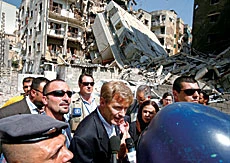
BEIRUT, 24 July 2006 — The UN relief chief condemned Israel yesterday for “violating humanitarian law” over its blistering raids on Lebanon as the Jewish state killed more civilians in another wave of attacks.
As Israel tightened its grip on a strategic border village seized in south Lebanon, Syria fueled fears the fighting could spread by issuing a warning that it would intervene if Israel dared to launch an all-out invasion of Lebanon.
US Secretary of State Condoleezza Rice was also heading to the Middle East with Washington increasingly estranged from European and Arab allies over a conflict that has killed close to 400 people in just 12 days and triggered a major humanitarian crisis.
Saudi Foreign Minister Prince Saud Al-Faisal and Saudi National Security Council chief Prince Bandar arrived at the White House yesterday to hold talks with President George W. Bush and Rice. Prince Saud made no comment ahead of the talks, but he planned to propose an immediate cease-fire in Lebanon. The minister would present “ideas about an initiative to stop the deterioration of the situation in Lebanon and bring an end to military aggressions against Lebanon,” a Saudi official told AFP.
UN Humanitarian Emergency Relief Coordinator Jan Egeland, in Beirut to launch an urgent appeal for funds for half a million people made homeless by the conflict, made no attempt to hide his fury as he toured bombed-out areas. “This is destruction of block after block of mainly residential areas. I would say it seems to be an excessive use of force in an area with so many citizens,” he told reporters in the southern suburb of Beirut, a Hezbollah stronghold. Asked if the Israeli raid that destroyed the burned-out buildings before him constituted a war crime, he replied: “It makes it a violation of humanitarian law.”
His comments came as at least eight civilians, including a Lebanese press photographer, were killed in new Israeli airstrikes across Lebanon on the 12th day of Israel’s punishing war on Hezbollah.
Hezbollah said three of its fighters had also been killed. In a wave of pre-dawn raids, fighter-bombers for the first time struck directly inside the southern city of Sidon, where tens of thousands of Lebanese have sought refuge from the relentless Israeli offensive. A three-story building housing a Hezbollah religious center was hit. Hezbollah responded with a new hail of rocket fire on Haifa, killing one person in his car and a second as he worked in a warehouse.
Syria, blamed by the United States for stoking the conflict, warned that if Israel invaded Lebanon it would have no choice but to respond. “If Israel makes a land entry into Lebanon, they can get to within 20 kilometers of Damascus,” Information Minister Moshen Bilal told the Spanish newspaper ABC.
“What will we do? Stand by with our arms folded? Absolutely not. Without any doubt Syria will intervene in the conflict.”
Israel, which has called up thousands of reserve soldiers and massed its troops on the border, seized control of the strategic hilltop village of Marun Al-Ras on Saturday after sending tanks, bulldozers and armored cars rolling across the border.
An unarmed UN military observer was seriously wounded in an exchange of fire in the village yesterday. The UN Interim Force in Lebanon (UNIFIL) said initial reports suggested Hezbollah fire was responsible.
Israeli Prime Minister Ehud Olmert said yesterday that his government would accept a peacekeeping force in Lebanon “made up of troops from European Union countries.”
“Israel is ready to see deployment of a force with military capabilities and combat experience made up of troops from European Union countries once its mandate has been fixed,” Olmert said during talks with visiting German Foreign Minister Frank-Walter Steinmeier.
Israeli Justice Minister Haim Ramon said the aim of the offensive was to keep Hezbollah — which controls southern Lebanon in the absence of the regular Lebanese Army — at least 20 kilometers from the frontier.
“For Israel, there are no longer civilians in southern Lebanon,” he warned.
Lebanon’s Parliament Speaker Nabih Berri — a close Hezbollah ally — said the group was ready for the Lebanese government to negotiate on its behalf through a third party for an exchange of prisoners with Israel.