
THE world is becoming a big “D.” There is development everywhere characterized by a race to build the tallest structures.
While, on the one hand, this is a sign of the progress that man has achieved in engineering and architecture, which can earn a “D” for “distinguished” achievement, on the other hand, it is unfortunate to see demolition, destruction and devastation of the structures that our forefathers built and bequeathed to humanity, for which even a layman would credit with “D-” grade. With widespread neglect and indifference, not only architectural monuments, but whole cities are being consigned to oblivion, resulting in massive loss of cultural heritage.
One such city is Nablus. Hamida Alireza, one of the trustees of Barakat Trust, a U.K. charity, told Arab News Review that the trust recently organized a presentation on “the cultural heritage and conservation of Nablus” at the House of Commons in London.
Alireza explained that the trust, established in 1987, aims to promote the study and understanding of the history of the art and architecture of the Islamic world. It provides grants, scholarships and fellowships to students and scholars all over the world.
She added that from its inception through last year, Barakat Trust supported more than 350 projects, academics and postgraduate students, including Ph. D programs, postdoctoral research, exhibitions, conferences, publications and conservation projects.
The House of Commons presentation was made by Nasser Arafat, director, Civilian Committee of Nablus Governorate, West Bank. A graduate in architecture from the Birzeit University School of Architecture, and a development and planning specialist, Arafat has participated in a number of conservation, urban regeneration projects and courses as well as scientific local and international workshops mainly focusing on Nablus to raise awareness of conservation efforts for the city.
He was a consultant to UNESCO on public awareness campaign about Nablusian cultural heritage in cooperation with the Nablus Municipality, through the Center for the Development of Society Resources in the Old City. Arafat has lent assistance in such research and books including a doctoral thesis on Nablus by Shadia Tuqan of the University of London and “Traditional Soap Factories in Nablus” by Husam Shareef, Nablus Public Library.
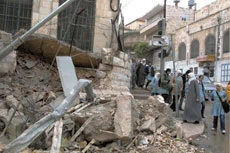
“UNESCO has called Nablus a site of outstanding architectural interest, a unique example of a living, traditional Palestinian city,” Arafat said in an online interview “The problem, however, is about having the city classified as a World Heritage Site, simply because Palestine is not represented as an independent state at the United Nations.” He said that tragically, a number of the most important heritage sites have been demolished partially or completely. These include the Al-Khadra Mosque, which was built during the 11th century, and the Shaikh Mosallam shrine in the northern part of the old city. The Roman Orthodox Church was adversely affected by the demolition of the soap factories in the western part of the old city.
“They were demolished with massive explosives, which caused the total destruction not only of the soap factories but also nine adjacent houses with furniture and people’s belongings still inside, creating a Ground Zero inside the old city,” he said.
The Al-Shifa Turkish bathhouse was partially demolished by three missiles that penetrated the roof of the hot room. Just before midnight on December 31, 2003, while Nablus was under curfew, four missiles from a heavy tank damaged part of the historic Abdulhadi family mansion that is a unique example of a nearly 200-year-old, castle-like house.
In 1994, before the invasion, the Municipality of Nablus had launched a comprehensive conservation program, which included repaving the streets and alleys of the old city in stone.
“When the invasions began, much of what has been done was destroyed, and of course we had to halt that project,” Arafat said.
“Nevertheless, several conservation and rebuilding projects started on the day the Israelis first left the city on April 18, 2002. In the face of ongoing destruction the Nabulsians have still continued to rebuild their homes and businesses and even do restoration work on a number of historic buildings,” he said.
“Various international emergency aid associations and governments have come to our aid,” Arafat acknowledged.
There has been generous funding of a number of conservation projects by the governments of Norway and Japan, The Welfare Association and the Prince Clause Fund while Arab and Islamic countries have given humanitarian aid. Nablus Municipality, the Cultural Heritage Enrichment Center of Nablus, and the Ministry of Public Works all have received help. The work of rebuilding and restoration is never-ending. It includes not just work on the fabric of the city; it also involves organizing visits, campaigning among scholars and archaeologists in the field of architectural conservation, establishing academic links, organizing scientific workshops and other cooperative projects that involve Palestinian and non-Palestinian experts.
"Sometimes I think of the wonderful historic cities of Rome, Istanbul, York, and Fez, and try to imagine these at similar risk. Why should anyone wish to destroy what is part of a cultural heritage of a nation, which should be shared by everyone? This is beyond imagination," Arafat said.
He explained that Nablus is very special in tradition and local customs, which are relatively different from other Palestinian cities, such as, wedding celebrations, Ramadan Festivals, Narjieleh gatherings, and cafes
The major component of the Nabulsian cultural heritage is the built fabric of the old city. The historic center of Nablus is considered one of the largest in Palestine; its traditional organizational pattern is very unique, the winding alleys and the clustered habitation zones are in total harmony with the natural topography of the site.
It has a number of monumental and historic buildings, such as, 10 Turkish baths, seven historic mosques, 30 olive-oil soap factories, 18 shrines, 17 water fountains, Sabeel, in addition to nearly 2,850 historic houses and small shops.
Underneath the old city lies the Roman Neapolis, some of which has been excavated, including the Amphitheater the Hippodrome, but much remains to be discovered.
Some of the monuments date back to the Byzantine Era, such as the Basilica, or the Crusades hospital. However, most of the existing buildings, mainly houses, date back to the Ottoman Period, beginning in 1517 AD. Traditional handcrafts and products comprise one of the main economic resources of the city and the old center in particular. These include sweets, stone and woodcarving, colored floor tiles, olive-oil soap, and many types of food particular to Nablus, such as A'ccoub and Zalabiah.
The Israeli occupation that started in 1967, began with economic destruction of the local industry. The export of soap was not allowed. Demographic change followed in the old city, from rich or middle class to mostly poor people, many refugees and villagers moved to live in the demolished houses and areas. During the first Intifada, 1987-1994, the old city was the center of demonstrations against Israeli soldiers; the fear from the Israelis pushed many people to leave the old city, increasing the number of abandoned houses.
“The most barbaric technique involves using explosives to destroy facades and walls between houses so that the army can safely walk through the old city," Arafat said.
“Since adjacent buildings overlap and share walls, this method wreaks havoc, beyond the buildings initially attacked,” he added.
Nablus is located in the northern part of Palestine, approximately 65 km. from Jerusalem. The historic city is situated in a valley and is surrounded by two mountains — Eibal to the north and Gerizim to the south.
Nablus was founded in 2500-3000 BC by the Can’anites — Arab travelers who came from the Arabian Peninsula; they called it Shakeem. The Romans, who invaded the region during the 1st century, destroyed the city and built a new one, to the west of Shakeem, where the current old city is situated. They named it Flavia Neapolis, from which the current name of the city was derived.
During the Byzantine period, starting from the 4th century AD, Neapolis became the seat of a Bishop. A mosaic map of Nablus, which was found in Madaba Church in Jordan, indicates the importance of the city during that period. Historian and traveler Al-Muqaddasi, who visited Nablus in 1320, described it as: “A palace in a garden.” The geographer marveled at its vast markets, stone houses, fine pavements, rich agriculture and water supply.
Arafat said that in addition to remnants of Roman, Byzantine, and early Arab structures, the physical remains of Mamluk rule, which spanned the 13th to 16th centuries, can still be seen in complete form through several mosques, arches and public baths. In the next centuries, Ottoman governors added greatly to the city’s architectural wealth, as evidenced today in the mosques and market colonnades.
Nineteenth century grand, vaulted-ceiling palaces abound, which Nablus families built from the fruits of their commercial success as merchants, sweet manufacturers and soap-processors. At the end of the 19th century, the population of 10,000 lived mainly within the walls of the old city, in the almost 100 hawash — the extended family complexes within the old city that open up from narrow arched passageways.
“The old city of Nablus is an authentic historic center. Its cultural value is evident in the outstanding monuments and built environment, as well as local traditions. These have survived many natural and man-made hazards but are currently at high risk,” Arafta said. “The main threat to the survival of this place is getting bigger as the siege curfew and constant attacks by the Israelis continue. No justification can be found for such actions that keep threatening its existence and survival.”