BAALBEK, Lebanon, 3 August 2006 — Israeli commandos struck deep into Lebanon yesterday and snatched five suspected fighters in a helicopter raid that provoked the heaviest rain of Hezbollah rocket fire in the 22-day-old conflict. “We have carried out this operation to prove that we can hit everywhere in Lebanon,” Army Chief of Staff Dan Halutz told reporters in the Israeli border town of Kiryat Shmona after the raid on Baalbek, 100 kilometers (60 miles) to the north.
Minutes later, a missile fell near Beit Shean, some 60 kilometers south of the border, Hezbollah’s deepest strike yet into Israel.
Police said at least 230 rockets had slammed into northern Israel in what was by midafternoon already the biggest single-day barrage from Lebanon since the Jewish state launched its offensive against Hezbollah on July 12. At least 36 rockets struck populated areas, killing at least one person and wounding 19 others.
The barrage came a day after Israeli Premier Ehud Olmert said the offensive had significantly weakened Hezbollah. “Today, the threat posed by Hezbollah is not what it was. It can no longer threaten this people, as this people have stood up to it and have come out victorious,” Olmert said late Tuesday.
Israeli warplanes meanwhile roared back into full-scale action, destroying two bridges in northern Lebanon and killing three Lebanese soldiers in the southern port of Sidon.
Israel had called a 48-hour partial halt to air attacks after a raid on the Lebanese village of Qana Sunday that killed 62 civilians, most of them children.
The deaths caused worldwide outrage and prompted calls for an immediate cease-fire. But Olmert dismissed the calls and Tuesday Israel broadened its offensive on the ground, pouring thousands of crack infantrymen, paratroopers and reserve units into southern Lebanon. Five soldiers were wounded in clashes with Hezbollah fighters in the village of Mhaibib in the southeast corner of Lebanon, an army spokesman said.
Olmert told British television yesterday that Israel would continue to fight Hezbollah until an international force — “an effective force made of combat units” — is deployed in south Lebanon. In a sign of progress, the permanent UN Security Council members embarked on intense talks on the conflict and ambassadors said a resolution setting out a possible settlement was close.
“I’m confident that by tomorrow we’ll be in a position to have discussions in the council on a text which actually takes us forward,” Britain’s UN Ambassador Emyr Jones-Parry told reporters.
France and the United States had been divided over whether a political settlement should be agreed between Israel and Hezbollah before any international force is sent in. This resulted in a meeting of countries likely to contribute forces to the UN peace mission set for today being postponed.
Police said the Israelis snatched five people in the raid, carried out within sight of three ancient Roman temples which rise dramatically from the valley floor. Eleven civilians, one of them a Syrian, died in the attack, they said.
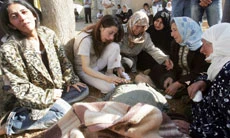
Israeli warplanes destroyed two bridges in northern Lebanon, about five kilometers from the border with Syria. And police in Sidon in the south said three Lebanese Army soldiers were killed when Israeli warplanes strafed a nearby military base, hours after resuming airstrikes. Farther south, the head of the town council in the port of Tyre said the funerals of those killed in the Israeli raid on Qana had been postponed in the face of the renewed Israeli bombardment.
In Tel Aviv, an army spokeswoman said the Hezbollah fighters captured in Baalbek had been brought to Israel and that all the Israeli troops involved in the raid had returned to their base. Hezbollah denied the claim, saying that “the citizens kidnapped in Baalbek are normal civilians.” A statement broadcast by Hezbollah’s Al-Manar television said: “The Islamic Resistance announces that it has foiled an Israeli landing operation in Baalbek and denies that the enemy has captured any of its members.”
A Hezbollah spokesman had earlier said that Israeli troops were surrounded after attacking Dar Al-Hikmeh Hospital, which is run by the group, about two kilometers southwest of Baalbek.
The spokesman said all patients had been evacuated from the hospital on July 12, when Hezbollah fighters captured two Israeli soldiers in a cross-border raid. That move prompted a massive Israeli offensive by air, land and sea in which more than 820 Lebanese and 50 Israelis have been killed.
Lebanese officials estimate that Israeli bombardments have caused losses of $2.5 billion, with half a billion this week alone, setting the country’s infrastructure back several years.