
Roger Harrison | Arab News
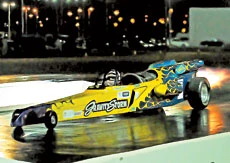
The world is for the young, but not until I have finished with it” goes the mantra of adventurous middle-aged “wannabes.” So it was something of a shock — followed by an afterglow of real pleasure — to wander into the pits area of the Jeddah Raceway on the 25th of October and ask a couple of unassuming grey-haired chaps where the drivers of two of the fastest dragsters on the planet were and get the reply, “You’re lookin’ at them.”Chuck Haynes, who hails from Billings, Montana and is owner of Volcano and Gravity Storm, is a compact man with a mischievous grin and slightly owlish spectacles. Looking more like an accountant than a race car driver, he is fifty-five years old and built on the lines of a Formula One driver; in other words, able to fit in the tiny cockpits of very fast cars. Gary Miocevich is in contrast a fifty year-old six-footer plus — a corn-fed ruggedly built Australian with the same suicidal weakness for extreme speed. Quite how he reduces his large fit frame to slide into the cockpit of Gravity Storm is a mystery. Perhaps it is possible after all to fit a quart into a pint pot.
The two drivers have a close and sparky relationship — almost gallows humour. They live “on the edge” in their professional lives. Although this frequently gives a new perspective on life and death, it belies the seriousness with which they take their driving.“We have been told we are mature gentleman,” quipped Haynes. Miocevich followed on without pause; “Really we are only 25 but it gets you that way.”
Fast cars are invariably associated with youth. Jets drive the cars; what drives these mature men? “It’s more fun than you can get any other way — and it’s legal,” said Gary. “In the last six to eight weeks there have been four people killed in these things. We know why and we are not immune from making the same mistakes.”
“It’s about experience and not touching the brakes at the wrong moment,” Haynes continued. “That’s a crash for sure and survival is doubtful.”Miocevich said that the tremendous discipline deriving from experience that is a function of age needed to drive jet cars did not come in the young “as early as it should.” Thirty years as a drag racer and raceway designer contribute experience and discipline in buckets. He said that there was a jokey atmosphere between the drivers in the pits and on the track. “Nobody gets to see the seriousness and discipline that we apply to the job.” Haynes agreed, adding, “They look deceptively easy to drive,” he said.
“Quite simply, they are not.” Touching the brakes at the wrong moment converts the rotational momentum of the rapidly spinning rotor in the jet into angular momentum that literally throws the car off the strip, often into the retaining wall with death the result. Wannabes they are not; they have arrived!
Haynes’ car Volcano is the fastest dragster in the world. Gravity Storm is very close behind. It takes chrome steel nerve in large quantities to drive these phenomenally powerful machines down a drag strip at speeds in excess of 500 kilometers per hour three times a day. As with most people who have the mettle, they are quiet, unassuming and very modest about their achievements. Haynes came to jet car racing by a chance visit to an air show in Montana, his home state. He had to give up traveling as a manufacturer’s representative after some domestic difficulties and took on a job as a building engineer. At the air show, he discovered that the crowds were as enthralled by a jet car demonstration as the aerobatics. He checked and found out what they paid the driver to bring his jet car and listened to the announcer who said that it had clocked 350 miles an hour. “I thought — it wouldn’t go 350 mph down a mine shaft — that took my interest. I wondered if it actually could be made to do that kind of speed and whether I could do it.”
Cashing in some pension plans, mortgaging and scraping a business development loan, he bought Volcano from famous jet dragster Billy Matteo. “Volcano the last of his line of cars. It’s the fastest in the world — 513 kph over the quarter mile at Gary’s track and completely irreplaceable,” he said. The statistics surrounding piston engine cars pale into insignificance when compared with Volcano or Gravity Storm. Powered by Pratt and Whitney J60 turbo jets, these 590 kilogram cars are driven by 6,000 lbs of thrust, boosted by custom “tricking” and full afterburners from the standard 2800 lbs when they are in aircraft. That translates into14,000 — yes, fourteen thousand — horsepower. In comparison, the Ferrari Enzo produces 660 hp and weighs 1366 kg.The jet cars redefine the idea of acceleration. In the time it takes the very rapid Enzo to reach 100 kph — 3.65 seconds — Volcano is accelerating hard through 340 kph and has taken just 200 meters of road to do it! In another 1.3 seconds and 200 meters, it shatters the 500kph barrier. Miocevich grinned; “That’s about 4 G acceleration,” he said, “Not blackout speeds but you certainly feel the old eyeballs pressing back into your skull.”Even compared with Formula 1 cars that can accelerate from 0 to 300 km/h in 8.4 seconds depending on the aerodynamic setup, Volcano and Gravity Storm are in a different league. The 2006 F1 cars have a power-to-weight ratio of 1250 hp/tonne; Volcano has a power-weight ratio of over 23,700 hp/tonne. Fortunately, fuel in Saudi Arabia is cheap; with fuel consumption at 227 liters per kilometer economy is not a design feature. Air, even more fortunately, is free; at race speeds the engines are gulping in 850 cubic meters– or more than the volume of two Olympic size swimming pools — of air per second.
Raceways, looking at the Australian experience, are provably effective at getting the young street racer off the roads. “Street racing scares us all. Chuck and I are safety advocates and we cringe at the amount of street racing here.” That happens all over the world; it is not unique to the Kingdom. “These facilities,” said Haynes, “are so incredibly important in making those kids make the transition from street racing to somewhere they can legitimately race.”Miocevich had the last word. “These guys at Jeddah raceway have really gone out on a limb to build this raceway. It’s not only a sports facility; it’s a tremendous service to the community.”