
ONE of the good things about doing a PhD in Europe and in a field such as computer science, where there is always something going on, is the ability to visit new places that you maybe haven’t even thought about going to before.
It was the European PROLEARN — Network of Excellence in Professional Learning that organized and funded the PhD summer school at Bled, Slovenia. Young researchers from all over Europe joined together to share their ideas about the future of web-based e-Learning.
This educational journey ended up being one of my greatest short breaks, since Slovenia turned out to be a piece of heaven! There was so much to do there that people found it difficult to decide. A travelers delight the country offers something for everyone. Hikers can enjoy the silence of the mountains, sports climbers, skiers, bikers, canoeists, boaters, fisherman, hunters, golfers, horseback riders and others can partake in their favorite sports in a variety of landscapes and for those who want spend time in intellectual pursuit there are theaters and museum galore. There’s something for even those who just want to stand and stare — as nature’s beauty abounds.
Yes! this is beautiful Slovenia, from the great Alps, through the magnificent caves, the dazzling rivers and beautiful lakes to its huge forests and endless green landscape. What else can one ask for?
It took me almost two hours to fly from London Gatwick airport to Ljubljana airport on a Saturday morning and the minute I set my foot out of the small airport I was captivated!
The journey by car took us from the capital to Bled, a small tourist town where we would stay for the week. We arrived at our nice hotel (Astoria) and although I was so keen on exploring the place and seeing the famous Lake Bled, I was also too tired from traveling so I went to my room and said “Later”!
Next day, we were taken on an excursion where we visited two other cities and passed the capital where the organizers had arranged another excursion there prior to our departure. We visited Piran, the beautiful coastal city as well as Postonji, where we had an unforgettable trip to its mysterious caves. But the most memorable and remarkable aspect to me during this day-trip was our excellent tour guide: Sach. He would keep us totally engaged and interested in what he was saying even if he was talking about historical facts, political rules or famous local poets. The way he spoke, the fairy tales and jokes he told, the cultural tradition he explained, helped a lot in making us understand what it was like to be a Slovenian and almost what Slovenia is all about.
Sach told us with such pride: “Slovenia has a history of 1,500 years”. This country was part of many different empires: the Roman, the Dutch and the Austro-Hungarian. But the Slovenian language, however, was not formally recognized until the Protestant movement in the 16th century who were the first to introduce the Slovenian languages into schools.
With the collapse of the Austro-Hungarian monarchy in 1918, Slovenians initially formed part of the State of Slovenes, Croats and Serbs, which shortly joined the Kingdom of Serbs, Croats and Slovenes, later renamed the Kingdom of Yugoslavia. Following the re-establishment of Yugoslavia at the end of World War II, Slovenia became a part of the Socialist Federal Republic of Yugoslavia in 1945.
In 1991, Slovenians got their independence after a relatively small battle against former Yugoslav Army. Sixty people died for Slovenia’s freedom, which is considered less tragic than what happened in other Yugoslav countries, such as Bosnia. Now, it has been almost 15 years since the country got its independence and it was the first of the new 10 countries that joined the EU on May 1, 2004. And the euro will replace the local currency (tolar) in January 2007.
As we passed what is called old Ljubljana, on our way from Bled to Piran, we passed the University of Ljubljana. As our guide was telling us, the student unions at Slovenians universities are very active, and education is free; a feature inherited from the old communist days.
Slovenian people are mostly Slovenian Slavic in addition to minorities from neighboring counties and regions, such as Italians, Hungarians, and people from former Yugoslavia: Bosnia, Serbia, Macedonia, Croatia and Montenegro. In Slovenia, many young people live within extended families, due to economical and cultural reasons.
Slovenia is known for its high Alpine mountains, the highest peak is known as Trikla, and it’s the symbol of the country. It is also considered as a country of forests since they cover about 65 percent of its lands. The biggest forest however, starts at the southern regions of Slovenia and continues throughout neighboring Croatia.
In addition to mountains and forests, Slovenian’s nature and wild life is known for another distinct feature: bears. Slovenia claims that it has the largest population of bears in all Europe.
Slovenians adore and value their culture and as our guide said: “Language and culture are very important to us. They give us the reason to exist in the first place”. Cultural events take place in Ljubljana, which is a cosmopolitan middle-sized city with approximately (270,000) inhabitants. New independent Slovenia has recognized the multicultural richness that they got by input from many other countries and people. The Germans, Italians, Croatians and Austrians, all have influenced the language and culture of this country.
One of the stories, told by our guide, that we all really enjoyed was the one about France Pre_eren, the famous Slovenian poet. The man who liberated Slovenia, wrote its national anthem, and made the Slovene language equal to other European languages in terms of rich literature and wonderful poetry. Pre_eren, who wrote and sang for love, which eventually led to his early death when he couldn’t bear the rejection of a beautiful 13-year-old, rich Ljubljana girl. Here is a quote from one of his sonnets:
Fresh flowers will spread fragrance far and near,
Like roses when the winter’s passed away,
And spring displays its marvelous array,
While through the trees white scattered blossoms peer.
As for food, many Slovenian dishes originate from three great cultures: the Pannonian, Alpine, and Mediterranean. The oldest Slovenian foods are made from flour and grouts.
After a long drive that started around 9:00 a.m. on a summer Sunday morning, we finally arrived at Piran. The Slovenian coast is less than 47 km in length of the Adriatic Sea and Piran is one of Slovenia’s costal cities, which attract tourists and visitors with many of their attractive features.
Piran is unique because in one spot you get the beautiful image of the sea and cliffs, the green hills which lay in the background and the old medieval architecture of its building. While we were going around so excited and keen about taking pictures in this gorgeous landscape, we also stopped and gazed at the sea.
From Piran we traveled back north to Postojna, a city famous for its caves. It has the deepest cave in Slovenia, which is also the 3rd deepest one in the world. Here, we were told that Slovenia is a small country with small holes discovered by everyday local men.
Slovenia in general is famous for its beautiful and extraordinary 2,200-year-old active caves. People here are so proud of them and say: “Below our feet are our real treasures.” There are around 8,600 caves distributed all around the country and people discover new caves every now and then. Slovenians are also proud of their old cave-exploring tradition and it is in their best interest to preserve it.
However, we only had a chance to visit 21 km of Postojna caves, and it was an experience of a lifetime! Not just because the caves themselves are astonishingly beautiful as well as massive and huge, but also because of the interesting and extraordinary ride that we took as we traveled through them. The train was built in 1971 and traveled about 5 km inside Postojna’s caves. We were on a fast train that moved so quickly up and down that we had to move our heads and bodies accordingly in a heart-beating, yet interesting journey. We were screaming and laughing as if we were riding a rollercoaster in a theme park!
Those caves were lit by candles until 1884 when electricity was introduced, which meant that those caves had been using electricity before the people of Slovenia could use it at home.
Postojna caves have been on the UNESCO’s list of World Natural and Cultural Heritage since 1986 in addition to many other caves.
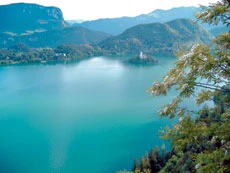
Finally, I got to see Bled, which is on the fringe of the Triglav National Park and is considered to be a real tourist paradise with numerous recreational possibilities, a conference hall, a casino and a golf course.
We were so lucky that the organizers had chosen Bled to be our residential area for studying, socializing as well as enjoying summer sports. I can talk forever about how beautiful and relaxing Bled is and how many different things one can do there. From water sports to horse riding, as well as hiking, cycling and visiting the tiny island with its famous “Wish Bell”. Not to mention paying a visit to Bled castle, where in addition to its unbelievable view of Lake Bled and the island, you can enjoy the local traditional dances and performance of the castle’s cast.
Igor Modic or Lake Bled, hosts a combination of natural wonders and unique culture and history attracts visitors. Among the most frequently visited locations, the Alpine Lake Bled area ranks first. The castle, dating back to 1111, and the “pletna” rowing-boats are two of the many attractions.
Another lifetime experience for me in Bled was when we went rafting in the wild river, something I never thought I would do. I guess it was peer pressure that helped to bring out the traveler and the explorer inside me. And there I was on a big inflatable boat with seven other women in addition to our guide rowing hard and holding on tightly as we traveled along the wild river.
Last but not least, we come to the capital, Ljubljana. With a mere 276,000 inhabitants, it is the city which suits everyone. It maintains the friendliness of a small town and at the same time possesses all the characteristics of a metropolis. Here, at the meeting point of the cultures of the east and west, the old of many theatres, museums and galleries and it also boasts one of the oldest Philharmonic academies. For the size of its population, Ljubljana has on the European scale, an above-average number of museums (22), galleries (53), theatres (10), and artistic and cultural events.
It is a city of concerts and diverse events, a scientific and university center, and a city of countless business meetings. In the warmer months of the year, numerous cafes and restaurants move outdoors to the banks of Ljubljana, river and the square of city center. Due to its central position, Ljubljana is a good starting point to discover Slovenia.
Ljubljana, was my final destination before leaving it back to London, we only had three hours to explore the city so there wasn’t much to do on a Sunday afternoon other than to go for a walk into town. I liked the old parts of the city, the unique architecture, the river that passes through as well as the momentums and statue of the famous poet Pre_eren.
One thing that I have noticed about this capital compared to other European countries that I have visited is that it was a European city that preserved its own identity to the extent to which we can hardly notice the effects of globalization and commercialization.
I really admired it for many things: different beautiful landscapes, rich history and culture, different available sports, its security and its ability to try and get the best of both the past and the present. And among all of this is the warmth and hospitality of its wonderful proud people and I can only say to them “Thank you” for this nice experience or as Slovenians say “Hvala”!