
WHEN my husband and I researched Malaysia as a tourist destination, we concluded that the country seemed like a charming fusion of three of Asia’s oldest civilizations -- Malay, Chinese and Indian. While that helped make good our decision to go to Malaysia on vacation, it was the image of stunning skyscrapers next to heritage buildings next to rainforests filled with a diversity of flora and fauna that was our go ahead.
Malaysia has an extensive network of trains, buses, air routes, taxis and ferries. Because the highways are well marked, even driving ourselves in a rental car was an enticing option. We opted out only because reaching places without having to read maps and signboards seemed like a timesaving decision.
As our taxi driver drove us to our hotel on Jalan Bukit Bintang in Kuala Lumpur, or “KL” for those in the know, he explained that the area was popularly known as the Golden Triangle. Bursting with cafes, restaurants, hotels and malls, the area is a nice hangout for tourists and locals alike. Inside KL’s Golden Triangle is a nocturnal Chinese bazaar where we struck some unimaginable bargains. And once we were done with shopping, we took our tired feet into one of the many reflexology centers for a relaxing foot massage that was both cheap and professional.
Most visitors to KL make their way to the imposing Petronas Twin Towers, the tallest twin towers of the world, as did we. Entrance to the famous sky-bridge on the 41st floor is open on a first-come-first-serve basis for around 500 people a day. It was the perfect place to get a magnificent view of the sprawling city beneath. Nearby was the Kuala Lumpur Convention Center’s Aquaria, where we had our closest encounter with sharks and other marine animals in the 90-meter underwater tunnel. Theme parks are sprawled all over the city, including bird, deer and butterfly parks, not to mention zoos that are home to some 200 species of animals. Admission is free to most places. If it were up to my nature-loving husband, we would have seen them all!
Time constraints prevented us from visiting Taman Negara, the oldest rainforest of the world that is a five-hour drive from KL. But we did find time to visit the Forest Research Institute of Malaysia in Kepong, a 45-minutes drive from KL before we set out for Langkawi and Penang.
The institute had the tranquility of an undisturbed tropical rainforest, and nature trails and herb gardens give visitors the chance to see nearly 15,000 species of plants. But the real appeal of the forest lay in the canopy walkway. Being suspended 30 meters above ground level felt like swinging in the shoots of bamboo trees. In all honesty, it was not a walkway for the weak-hearted!
Langkawi turned out to be so pristine that one could mistake it for a small fishing village rather than the international tropical island destination that it is. We saw water buffalo weltering lazily in vast paddy fields while farmers tended to their crops in traditional ways. In the backdrop were forested hills and small wooden houses. It truly did look like the “rice bowl” of the country.
Its cultural tapestry is shrouded in legends woven around places in Langkawi. True stories or mere myth, the local population believes this folklore and is quite articulate in the art of story telling. Island hopping seemed to be a favorite past time for tourists in Langkawi, possibly because it offers them virtual ownership of an island for the day.
For us, a boat journey upriver through the mangroves formed the most memorable part of our Langkawi sojourn. We rented out a boat at the rustic jetty at Sungai Kilim and made our way through gigantic trees half-sunk in water. Though there were sounds of all kinds of birds and insects, most were well camouflaged in the marshes. In the midst of the mangroves, our captain slowed the boat and threw out food into the water. As he stalled the boat nearby, we focused our cameras on the water, awaiting the arrival of fish. But what followed was a far more captivating sight. Several eagles appeared in the sky out of nowhere. Spreading their wings with all their might, they swooped down to pick their share of food from the water surface. Within a minute, about half a kilo of chicken was gone.
Our next stop was at a quaint fishing farm where my husband tried his hand at feeding some stingrays. Nearby was a restaurant whose chef offered to cook any seafood variety that we wanted. But recovering from a bout of food poisoning as we were, we decided not to try our stomachs.
Another interesting stopover was at the Gua Kelawar (“Bat Cave”). There our captain halted the boat and handed us a torch and some instructions, suggesting we walk through the tunnel. I was sure that crocodiles and poisonous insects awaited us, but my husband coaxed me in. Once inside, he flashed the torch on the cave’s walls, as instructed. We were awestruck to see thousands of bats clinging to the striking formations of stalactites and stalagmites. They weren’t the least bit bothered by our presence and let us explore the cave in peace. But the best bit of the journey came last. After our relatively serene expedition in the mangroves, we came out into the open sea for an exhilarating yet refreshing ride in the turquoise waters of the Andaman Sea. As our stomachs somersaulted with the waves we thanked God we hadn’t had lunch!
We took a ferry to Penang and arrived at the hotel hungry, exhausted and a little seasick. It took us nearly an hour to find our bearings, and then we chose two temples out of too many to visit.
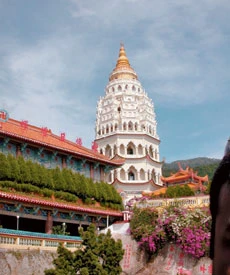
We began with Kek Lok Si Temple, one of the grandest Buddhist temples of Southeast Asia. Built in steps, it is home to the famous seven-story tall Pagoda of Ten Thousand Buddhas housed in the temple’s compound -- a reflection of the Chinese, Burmese and Thai cultures.
Another fascinating place was the Sri Mariamman Temple with a priceless statue of a Hindu deity decorated with gold, silver, diamonds and emeralds inside.
By then, my husband was suffering from “cultural fatigue”, as he put it. We set out to see the butterfly farm with about 50 species of colorful butterflies, frogs, scorpions and other insects. It was a delight to see so many colors whiz past us after having spent our lifetimes seeing just a few species.
At the nearby spice garden, we chose the “Ginger Walk” from a list of trails. Though we didn’t find too many spices, upon hearing strange noises we looked up to see small macaque monkeys sitting in attendance in the trees.
As the time approached sunset, we strolled into Batu Ferringhi, the neighborhood renowned for its golden beaches. Unfortunately, the 2005 tsunami that devastated much of South Asia did not leave its coastline unharmed and remnants of that disaster were quickly pointed out by locals.
As night fell, the Batu Ferringhi sidewalk was transformed into a bazaar with traders from all over the island setting up stalls under colorful canopies. Everything from clothing, watches, perfumes and souvenirs were available at dirt-cheap prices -- if you knew the art of bargaining that is.
We returned to KL by bus, starting off with crossing the Penang Bridge that linked Penang Island to the mainland. The breathtaking green expanses of mountains covered with clouds, and moderate to heavy showers now and then made the four-hour ride pleasurable. After having spent so many rain-starved years in the Middle East, it was absolute bliss to be riding in the clouds. We caught a late night flight from Kuala Lumpur’s international airport back home. As I settled down to update my Malaysia journal, it was with the realization that the delightful mix of cross-cultural influences that lured us to the country in the first place, was the force that made it so popular amongst most tourists. With its colorful traditions and a population so warm and tourist-friendly, it is no wonder that Malaysia has carved a niche for itself in the world of tourism.