
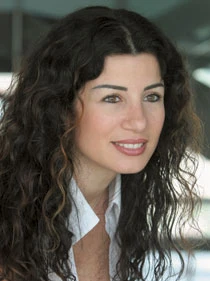
JOUMANA Haddad is understandably shaken. Two bridges were reduced to rubble by Israeli bombs just five minutes away from the poet’s home in Jounieh, Beirut, a few days ago.
She is one of four poets scheduled to tour the United Kingdom as part of the Banipal Live 2006 tour this week, but her participation depended on a lull in Israel’s relentless onslaught on Lebanon. Like most Lebanese people, she spends most of her time tuned into 24-hour news channels, watching the situation worsen in Lebanon.
“We are glued to the news. We are living in rage and fear. I’ve been dealing with this cancer called war for 31 years now, and I’ve had enough of it ruining my life and dreams,” said Haddad. “(Groceries) are starting to be difficult to get. Many items are missing. It’s also very hard to get gasoline.”
Last week, Haddad was holding onto the hope that the two warring sides would come to their senses so that lives would be spared and she would be able to represent her country at the Edinburgh International Book Festival performance-reading at the end of the tour.
“The Beirut airport is shut, and there is no safe way out of the country,” Haddad had said. “So, I’m basically counting on a miracle to help me participate in the tour.” This week she sounded resigned. The cease-fire came too late: “The airport is still shut and we are still besieged, no way out, no way in.”
The journalist and poet, who recently received an award for her writing in Dubai, dedicates editorials for Lebanese daily An Nahar to the discussion of politics but refuses to pollute her poetry with it.
It is difficult for the narrative of a traumatized people to remain free of tragic, bleak visions of the future: the Japanese anime shorts that the movie Matrix borrowed heavily from are full of post-apocalyptic images that reek of the Hiroshima tragedy. Similarly, South Asian artists find it difficult to shake the ghosts of partition from their works, while Middle Eastern authors cannot help but attempt to find method in the madness that is war by putting pen to paper.
The body of artwork that emerges from conflict is as invaluable as the documentation that bears witness to historical fact. The persecution is translated into a story that captivates generations to come. The danger is that the world around that group begins to see them only in terms of victims, incapable of hope and happiness, destined to wallow in suffering.
It is important for there to be a parallel narrative infused with buoyancy. It is this segment of the Arab literary scene from where Banipal, London’s leading literary magazines, invited four writers to tour the UK.
Masoura Ez-Eldin’s writing moves in masterful dream sequences, while the poetry pours out in confessional free-flow for Abed Ismael. Ala Hlehel’s writing prods the diurnal details that reveal the little truths that make up the sum of our existence and Haddad’s poetry unfolds like an endless bolt of textured silk that wraps the reader in her writing, yielding a range of sensations.
“”All around me, I see death and destruction. But I also see hope. I’m determined on seeing hope. Although I’ve been living with the ghost of war since I was four years old, I never let it invade my poetry, at least not directly,” she said. “It’s extremely important to protect art from politics.
I’m personally convinced that ideologies are the sworn enemy of poetry. Poetry should be gratuitous. Only then it can save us.”
Banipal is taking four poets and writers from Syria, Lebanon, Palestine and Egypt on tour across four cities from Aug. 14-20.
Syrian participant Abed Ismael agrees with Haddad’s insistence on preserving poetry in the realm of apolitical art. “I am always careful not to mix up politics with art. I try to keep politics away from metaphors and symbols. But the scenes of destruction affect my imagination,” He said.
“The death of innocent people has its own toll on my poetic vision. I often spend sleepless nights thinking of those who lost their homes, or those who were killed by random bombing, or those whose lives wasted waiting for salvation. But poems often fail to come to terms with such cruelty.”
For Ismael, the issue is that one’s political agenda may mutate the language that he likes to wield in the interests of creating beauty.
“I think politics often spoils literary texts, if writers do not know how to valorize the artistic aspect, and avoid taking language hostage to ideology,” he says acknowledging that poetry and politics have intersected purposefully on innumerable occasions.
“In world literatures, we have great political writers and poets. Or say poets who touched on certain political issues: (like) Pablo Neruda from Chili, Nazim Hikamt from Turkey, Luis Aragon from France, and, of course, Rudyard Kipling from England.”
Mansoura Ez-Eldin, from Egypt, has another take on the issue altogether: “The question is not whether to keep politics and art separate or not. It is how to deal with politics and make use of it to enrich your piece of work, without letting it turn your work into a boring political article. I prefer politics to be the servant of my work than let work be its servant.”
However, since the bombings began, the words that used to come so easily to the writer have recently refused to materialize.
“You won’t believe it, but since the beginning of the war against Lebanon, I can’t go on writing my second novel. I’ve no explanations, but I just can’t go on writing while the civilians and children are killed and maimed every day.
The whole situation is a nightmare.”
Haddad may prefer to keep politics from seeping into her poetry, which is sensual and textured exploration of her innermost desires, but she has no qualms about taking questions regarding politics in the region.
“In my opinion, others are waging a criminal war on our territories. Lebanon has always been a favorite arena. Tel Aviv insists on punishing the puppets instead of dealing with the true responsible parties. It insists on killing innocent Lebanese citizens and children. We are paying the price of a sin we did not commit, as well as the price of ongoing regional conflicts and compromises. It’s the culture of death versus the culture of life. We want to live and enjoy and celebrate life.”
And one way to do that is to separate an entity of grace and beauty from the sullying forces of political thought, just as these poets are doing.
Perhaps it is time to concentrate on an apolitical identity as Arabs. Maybe it is time to eschew politics as a subject for film, visual art and literature. The tour will showcase a valiant effort by these Arab voices to cull poetry from the hopeful tracts of their inner selves. But as long as bombs keep ripping into Middle Eastern soil, the shadow of politics will continue to encroach on the Arab soul.