
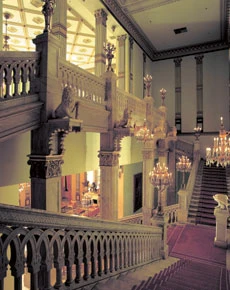
SEASONED travelers in Egypt are no longer concentrating solely on the pyramids and Islamic Cairo. Defying clichés, and mass tourism diktats, a distinctive class of tourists is now searching for what is truly original, unknown and authentic. In Cairo, the search is bringing people back to the city’s downtown, to Roda Island, Garden City and Zamalek: All areas linked to Egypt’s modern golden age. Mohamed Ali and his successors, who ruled Egypt from the early 19th century until the abdication of King Farouk in 1952, are credited with the creation of modern Egypt.
The cradle of civilization became a land of opportunities, luring bankers, industrialists, merchants, architects, painters, craftsmen, Egyptologists and of course simple adventurers in search of a new El Dorado.
In a lavishly illustrated book “Egyptian Palaces and Villas, 1808-1960,” the well-known author, Shirley Johnston, brings to life a particular architecture whose various styles she has come across while writing about architecture in Malta, Spain and on the Riviera.
“Many people whom I wrote about in previous books came to Egypt. I noticed a lot of crossovers. All these people were great travelers and they were all simultaneously building in the same style and décor.”
When Johnston first came to Egypt in 1992, her interests were focused, like most first-time tourists, on the country’s ancient treasures. She quickly discovered, however, an amazing number of architectural jewels.
She admits that she could have easily made her book 100 pages longer and that she even had enough material to write a book on the city of Alexandria alone and also another one dealing exclusively with the Manial Palace!
What was initially an easy project turned into a five-year labor of love requiring time and patience. The author’s toughest challenge stemmed from an acute lack of information.
Islamic and Pharaonic architecture is well-documented but accurate information concerning private houses and palaces from the 19th and 20th centuries is scarce. When Nasser came to power, many people left Egypt with their memories.
Johnston made a tremendous personal effort while searching for the missing facts. She was told amazing anecdotes while interviewing the owners of these outstanding villas and palaces. The success of her previous books is due largely to her inimitable style. “I write non-fiction using the techniques of fiction. I bring life to space,” she explained. And she does it with a touch of genius.
Her writing is full of humor and poetry, gracefully laced with historical facts. Her descriptions are compelling, brimming with detail and overflowing with color, sound and texture so we are led to see the place as if we were there.
“The central hall was a gentleman’s affair with leather couches for conversation and Turkish coffee. While there were a few European pictures, the prince’s true taste was to be found in his oriental hall.
“There, inlaid wooden doors, built-in-sofas, and Turkish and Persian carpets competed for attention with the finest medieval enameled-glass lamps, metalwork, and ceramics by the hundreds.
Vermillion reds and vibrant blues shone from seventeenth-century Iznik jugs, ewers, and bowls, alongside eighteenth-century polychrome Turkish qumqums, dishes, jugs and bottles.
“The seats were modern oriental-style divans that the prince had ordered custom-made from the Milan workshops of Carlo Bugatti, the designer of rich and exotic furniture and interiors, who had proven his skills in Khedive Abbas Hilmi’s palace in Istanbul.
“It was also here, around a fountain of colored marbles, amid medieval azulejos imported from Spain, that the prince hosted his famous evenings of oriental music and song,” wrote Johnston describing the Prince Youssef Kamal Hall built on the outskirts of Cairo which now houses the Desert Research Institute.
Along with the style, the alluring pictures, taken by the author with contributions from Sherif Sonbol, create an atmosphere of beauty and harmony.
Johnston composed all the shots. “I position the camera and I compose the image. When I go into a room, I know exactly I want.” She explained that she began with photography and then wrote the accompanying text.
It took her five years to collect all the photographs. In some cases, she spent several days in a single house.
“The families who opened their doors were patient but didn’t quite understand how one shot could sometimes take three hours! For each image, I take three exposures for the lighting. The way I work is basically — shoot to print. What you see is printed.”
Finding the palaces and villas, getting permission to photograph and then taking the photographs took a long time, much more than initial expectations, admitted Johnston.
She is especially proud to have included in the book ten houses from the provinces. “No one had gone to the provinces. That was a big discovery. I tried to include as many houses as I could from Qena, Luxor, Aswan, Alexandria, Maghagha in the province of Minya, Girga in the province of Sohag, Tanta in the province of Dakahliya and Robamiya in the province of Sharkiya,” she explained.
High on the list of outstanding houses are little known architectural jewels such as the Bindernagel Villa in Alexandria, one of the greatest neo-classical houses in the world.
There are also two private residences designed by the famous Egyptian architect Hassan Fathi. For his client Toussoun Abu Gabal, Fathi “devised a highly unconventional house for the time, one that was fresh, spirited and spontaneous in its modernism, but also imbued with the memory of Islamic decoration,” wrote Johnston.
Faced with more houses and palaces that she ever imagined, her final choices were not easy. Her criteria for selecting the homes were rigorous enough. She paid attention to the location, the house’s historical and cultural significance and made sure both exterior and interior were intact.
Johnston is known to provide views of a full room and not details only. Showing a room in its entirety lures the reader into the room to feel the atmosphere.
Despite all the problems plaguing the Arab world, she said, “The feedback from America and Europe has been fantastic. A lot of people who have read the book come up to me and tell me that they did not realize Egypt was like this and they now want to visit Egypt. I would love to see a translation of this book into Arabic,” she concluded.
— Egyptian Palaces And Villas, 1808-1960. The American University in Cairo Press, 207 pages.