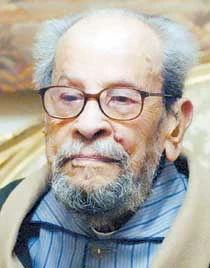
JEDDAH, 31 August 2006 — Naguib Mahfouz, the famous Egyptian novelist who was the only Arab to win the Nobel Prize in literature, passed away yesterday at one of Cairo’s hospitals at the age of 94.
He was admitted to the hospital more than a month ago after falling in his home and injuring his head. He died yesterday morning after a sharp decline, said Dr. Hossam Mowafi, head of a medical team supervising his treatment at the Police Hospital.
“His wife last night was whispering in his ears and he was smiling and nodding,” said Mowafi, as reported by The Associated Press. The prize, awarded in 1988, brought to notice a man who had already established himself as one of the Middle East’s finest and most beloved writers and a strong voice for moderation and religious tolerance.
Many Saudi writers expressed their deep grief at the loss of Mahfouz, whose Cairo trilogy introduced a character who became an icon in Egyptian culture: Si-Sayed, the domineering father who lords over his wives and daughters, but who also holds the family together. Saudi writer and board member of the Jeddah Literary Club Mohammed Diyab said that the Nobel Prize was a very far if not impossible dream for Arab novelists before Mahfouz.
“I don’t know how long will we have to wait until the Arab nation produces another talent like this,” said Diyab, pointing out that many of Mahfouz’s Arab critics became instant converts the morning it was announced that he won the Nobel Prize. Mahfouz was nearly killed in 1994 by an extremist, inspired by a sketchy fatwa issued by a self-proclaimed religious leader, that Mahfouz was a blasphemer. The man stabbed the 82-year-old author as he left his home. Mahfouz survived, but the attack damaged nerves leading to his right arm, seriously impairing his ability to write. A man who had once worked for hours at a time — writing in longhand — found it a struggle to “form legible words running in more or less straight lines,” he wrote in the aftermath.
Still, Mahfouz maintained a busy schedule well into his 90s. In his final years, he would go out six nights a week to meet friends at Cairo’s literary watering holes, trading jokes, ideas for stories and news of the day.
Across the span of 34 novels, hundreds of short stories and essays, dozens of movie scripts and five plays, Mahfouz depicted with startling realism of the Egyptian “Everyman” with a foot planted on each side of a widening fissure between tradition and the modern world. The crowded neighborhood of alleys and centuries-old mosques is the setting for his masterpiece Cairo trilogy. The trilogy — “Palace Walk,” “Palace of Desire” and “Sugar Street,” all of which appeared in the 1950s — details the adventures and misadventures of a Muslim merchant family not unlike Mahfouz’s own. “Definitely Mahfouz’s rich experience has had an influence on Saudi writers, especially in the art of short story writing,” said Saudi literary critic Khulud Al-Harithy. “His realist technique has affected many.”
Alkhobar-based British translator Anthony Calderbank, who translated one of Mahfouz’s novels, “Rhadopis”, for the American University in Cairo said the author clearly played a dominant role in making modern Arabic literature popular. He said that it’s time for a new generation of Arab writers to take inspiration from Mahfouz and move Arab literature forward.
“In the Arab literary world, the older generation continued to be on the spot for a long time after they did their business,” he said, comparing Mahfouz to Charles Dickens’ precision to scene descriptions and details.
A military funeral will be held for Mahfouz today at a Cairo mosque, with his coffin covered with an Egyptian flag and carried by caisson. Mahfouz is survived by his wife, Attiyatullah, and two daughters, Fatima and Umm Kulthoum.