
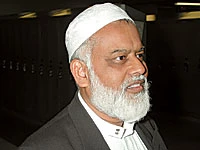
A graduate of Madinah Islamic University, McGill University and University of Toronto, Sheikh Ahmad Kutty is a well-known scholar. He has been actively engaged in Islamic research and propagation as well as promoting religious tolerance and understanding among the various communities in Canada for more than three decades. As a mufti (a Muslim legal expert who has the power to give rulings on religious and non-religious matters) for islamonline.net and islam.ca websites, he has answered thousands of questions from both Muslims and non-Muslims.
“I am really fascinated by my work as a mufti for islamonline.net because it gives me an opportunity to answer questions from people from all over the world,” Sheikh Kutty, who, with his family, was in the Kingdom to perform Umrah, told Arab News. A senior lecturer and resident scholar at the Islamic Institute of Toronto, he is presently working on two important research papers: “Shah Waliullah’s Concept of Harmony of Reason, Revelation and Intuition in the Light of Hujjat Allah Al-Balighah” and “Human Rights: The Western & Islamic Perspectives.”
The global war on terror, he says, is a new slogan coined by Bush and his team of neoconservatives. “They are using this campaign to eliminate threats against Israel. It is the duty of Muslims to stand united with a spiritual mission against this plan, rather than reacting to it erratically. We have to mobilize our intellectual and spiritual resources for a new world order. We have seen only one side of America. The other side is intellectual and scientific progress and excellent management. There is dignity and freedom for human individuals. These are Islamic values that we should apply first in our societies. We should think of one human family. The world has become a single village and we have to seize this opportunity to bring humanity together, instead of participating in any clash of civilizations. Islam has a formula for uniting humanity,” he pointed out.
He emphasized the need for a middle-of-the-road approach while giving Islamic rulings or fatwas. “Most muftis still deal with issues in old ways. They are not aware of modern issues facing Muslims, issues that are relevant to their lives. There should be changes in fatwas in accordance with time and place. It is not principle that changes but the way you relate to the condition of modern man who is faced by enormous challenges,” he explained.
Kutty spoke about the methodology he follows when answering questions on contemporary issues. “We respect the tradition followed by other scholars in the past. At the same time, when dealing with modern issues, we focus more on the maqasid — the higher objectives of the Shariah — rather than the texts. As for ibadat (matters related to worship), there is no need for us to offer any new rulings. But sometimes we have to reinterpret. We don’t add anything to the aqeeda or faith that is already clear from the Qur’an and Sunnah. But we will explain it in a way people can understand.”
According to Kutty, music remains a contentious issue among Islamic scholars. “There have been times when scholars gave a blanket ruling saying music was totally prohibited in Islam. These people did not ask the question ‘What is music?’ It is a melodious voice. How can Islam, being a complete way of life, reject it? A human being loves to hear music just as he loves the singing of birds and the sound of a breeze,” he said, adding that the Prophet Muhammad (peace be upon him) attended weddings at which girls sang.
“There are fatwas condemning all musical instruments, but reputable scholars such as Ibn Hazm and Al-Ghazzali have said there is not much evidence for them. In Shariah many things are prohibited because of the association. Prohibition can be lifted in the absence of such associations. The albums of Yousuf Islam are an example. There are now many good Islamic musicians,” he pointed out. At the same time, he cautioned Muslims to approach music with care as it can be used to uplift human spirit or to arouse less noble feelings and instincts. “Islam favors entertainment and Ali ibn Abu Taleb reportedly advised people to engage in some kinds of amusement now and then.”
Sheikh Kutty does not favor the unification of fatwas as, according to him, it would curb freethinking and go against the Prophet’s traditions. “We have heard these calls since the time of the Abbasid Caliph, Haroun Al-Rasheed (786-809). The Prophet and scholars such as Imam Malik encouraged people to think and come up with new ideas. At the time of the expedition against the Banu Quraida, the Prophet announced that nobody should pray the Asr prayer before meeting the tribe. The Prophet’s Companions (the Sahaba) heard the words from his mouth but nonetheless, there was confusion. Some wondered how they could delay Asr when the Qur’an instructs the faithful to perform their prayers on time and so they prayed before reaching the Banu Quraida. Another group did not and when the problem was submitted to the Prophet, he said both were correct. We should not be overly concerned about different views. Differences are bound to occur.”
Kutty strongly believes that Muslims must consider their problems as challenges and take effective steps to solve them. “We should establish independent think-tanks to brainstorm and come up with creative ideas and ways to improve our present condition.” According to him, Muslims are now wasting their time dwelling on problems. “What is facing us is a huge mountain. We can remove it by everybody chipping in. The Prophet taught us practical strategies. His solution was a win-win one. Exaggeration of problems will defeat us,” Kutty pointed out.
According to the sheikh, Muslims are not short of able people. “Our problem is that we don’t do our job properly. A free environment is required for intellectual exercise. Muslims can draw on their past but today they are withdrawing instead of looking globally and trying to integrate and unite everybody,” he said. “We have a challenge in communicating with other people so we must build bridges of understanding with Christians and Jews. Many people think that our fight is with the Jews. Our fight is against aggressors and all Jews are not aggressors.”
Kutty believes that an imam should use his Friday sermons to boost the spiritual strength of the Muslim faithful. “Blaming America or Israel will not help us,” he said. Spiritual empowerment is the duty of a khateeb (the man who delivers the sermon) rather than giving political analysis. There is no need for filling Muslim hearts with more cynicism and pessimism. America became a mighty nation because of the spirit of its people. We have to instill that same building spirit among Muslims. Nobody will be able to destroy the spirit. Muslims can come out of this trial with greater faith in Allah and the ability to deal with challenges positively with greater moral strength and courage,” he said.
“The time with Allah is not the same as time with human beings. There is a time for everything. This is the time of trial and it will pass,” he said.
Kutty advises his fellow Muslims to focus more on correcting their lives in accordance with the teachings of Islam. “Let’s become true Muslims. I am not concerned about military humiliation. Are we keeping the spiritual, ethical and moral values of our religion? Are we living Islam? We are not. Many of the problems we face are trials from Allah for not living up to the spiritual and ethical values within Islam. That is my big worry. Allah will take on Israel and America if we are on the correct path. They try to distort but are we doing enough to present the true image of Islam and Muslims by using our resources? What is preventing us from buying a newspaper in the US? We should allocate our resources to establishing strong media organizations in the West.”
Sheikh Kutty cautioned Muslims against playing the game of “us and them” and says that Muslims should work for human unity. “East and West belong to Allah. There are vested interests that try to pit one civilization against the other. Islam teaches us that we should look at humanity at large.” Decrying the Sunni-Shiite fighting in Iraq, he said it is a big lesson and proves that Muslims are susceptible to colonialist plans. “Malik ibn Nabi once said that to confront colonialists, we should not be susceptible to playing their games. It is sad to say that many Muslims are killed by Muslims. Why does Allah allow others to rule over us? To me, Allah is in charge — not Bush,” he concluded.