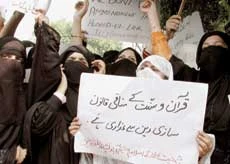
ISLAMABAD, 19 September 2006 — The Pakistani government deferred the presentation of the Women’s Empowerment Bill in the lower house of Parliament yesterday.
President of the ruling Pakistan Muslim League (Q) Chaudhry Shujaat Hussain told Arab News, “We sought suggestions and input from political parties including the Muttaheda Majlis-e-Amal (MMA) but there are certain things that need to be sorted out. We want to present the bill with consensus.”
He said, “We will keep our options open and continue to hold talks with other parties to reach a consensus.”
Hafiz Hussain Ahmad of the MMA said, “We refused to back the government because it wanted to pass a bill that would appease the United States especially because President Musharraf is scheduled to meet President George W. Bush.”
Hope for an agreement between the MMA and PML(Q) faded after their leaders failed to narrow down their differences last week. Now the ruling party has no option but to muster the support of the PPP and the MQM, which had extended their support to the bill earlier.
“The government made a tactical mistake by seeking MMA’s support,” PPP legislator Raja Pervez Ashraf told Arab News. “Originally it was a PPP-sponsored bill to empower women legally, socially and economically. This is in line with the PPP policy. But the government tried to drive a wedge between the opposition grouping, Alliance for the Restoration of Democracy and the MMA by engaging MMA in Talks. The government’s strategy has failed,” he said.
Meanwhile, senior officials said the government had decided to delay trying to pass the bill until President Pervez Musharraf returns from the United States at the end of the month.
The bill is seen both as a barometer of Musharraf’s commitment to his vision of “enlightened moderation,” and a major battle in the long struggle between progressive and conservative forces to set the country’s future course.
Shujaat said he was looking to delay submitting the bill for up to two weeks, although the final decision would be taken by the National Assembly.
“It could be delayed to evolve consensus. We are not backtracking,” he told Geo News television channel.
With the bill facing fierce resistance from the Islamist opposition, the National Assembly session was adjourned until the government was ready to reconvene.
The government had tried to duck a confrontation with the Islamist opposition over the bill to amend laws covering rape and adultery, but changes subsequently proposed by the religious parties proved unpalatable to the PML’s coalition partners.
Conservative sections of the PML had been fearful that it risked losing ground to the Islamists over the issue in elections due late next year, but according to a senior official the government had decided to take the risk.
Speaking on condition of anonymity, he said the bill that would be voted on, possibly in the first week of October, would be the original draft that placed the crime of rape under the civil criminal code and removed it from the parallel Islamic penal code, known as the Hudood Ordinance.
The official said the government also planned to introduce additional legislation to improve women’s status.
Political analysts, however, were skeptic of the government’s intentions, as the Hudood laws served the purpose of dividing the more secular mainstream and religious opposition.
“I can’t say this will never be amended or repealed, but I would say there is a lack of sincerity and it is being used for political reasons,” Shafqat Mehmood, a Lahore-based political analyst and former senator, remarked.
The original draft, framed by a parliamentary select committee and presented in mid-August, had been praised by reformers and rights groups, who have long pressed for repeal of the Hudood Ordinance introduced in 1979 by military dictator Mohammad Zia-ul-Haq. Under the law a rape victim might face prosecution for adultery if she cannot produce four male witnesses.
The Hudood Ordinance has drawn widespread criticism both at home and abroad.
Musharraf was lambasted over Pakistan’s poor record on women’s rights when he visited the United States a year ago, and Islamist politicians have accused him of trying to force through reforms to placate Washington.
Lacking the numbers to block the bill, the Islamists had instead threatened to resign from Parliament and the provincial assemblies in protest, raising fears of a political crisis in Balochistan and North West Frontier — the sensitive provinces neighboring Afghanistan.