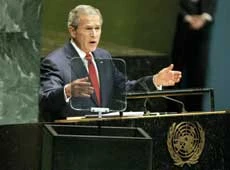
WASHINGTON, 20 September 2006 — US President George Bush pressed Iran to immediately begin negotiations on its nuclear program and warned Tehran that delay would bring consequences.
Speaking before the United Nations’ 61st General Assembly in New York yesterday, the president also emphasized the need to strengthen emerging democracies in the Middle East.
Bush’s 15-minutes speech aimed to persuade skeptical world leaders to embrace his vision of the Middle East, and reiterated to world leaders that the United States won’t leave Iraq until the country’s transformation to a peaceful democracy is complete.
The president also pledged to give diplomacy a chance to resolve the dispute with Iran over its nuclear development program.
Bush said the progress of democracy in the world, particularly the Middle East, is real and sometimes dramatic, even if it is gradual. “Some have argued that the democratic changes we are seeing in the Middle East are destabilizing the region,” Bush said. “The reality is that the stability we thought we saw in the Middle East was a mirage.”
He pledged to assist the emerging democracies in Afghanistan and Lebanon as well as Iraq.
Bush’s address drew a line between the moderate governments that want peace and extremists who want to spread terror and violence.
In his opening remarks, he tried to placate those who believe his administration is waging a war against Islam. “Today I’d like to speak directly to the people across the broader Middle East. My country desires peace. Extremists in your midst spread propaganda claiming that the West is engaged in a war against Islam. This propaganda is false, and its purpose is to confuse you and justify acts of terror.
“We respect Islam, but we will protect our people from those who pervert Islam to sow death and destruction. Our goal is to help you build a more tolerant and hopeful society that honors people of all faiths and promote the peace,” said Bush.
Bush also agreed to meet with Palestinian and Iraqi presidents while at the United Nations and during his speech spoke of the need for a two-state solution for Israel and Palestine. “I’m committed to a Palestinian state that has territorial integrity and will live peacefully with the Jewish state of Israel. This is the vision set forth in the road map — and helping the parties reach this goal is one of the great objectives of my presidency,” Bush said.
This year’s General Assembly meeting takes on added significance with negotiations on the sidelines to determine who will be the United Nations next secretary-general. Many observers believe South Korean Foreign Minister Ban Ki Moon is the likely candidate to replace Kofi Annan at the end of his term.
In his farewell address, Annan made an impassioned plea for Middle East peace and a spirited defense of the world body he has led for 10 years. He singled out the Israeli-Palestinian conflict as one of the most important security challenges facing the world community.
French President Jacques Chirac urged the United Nations to organize an international conference to revive moribund Mideast peace efforts.
“In this highly sensitive region where divides meet, the status quo has become unbearable,” Chirac said in his address.