
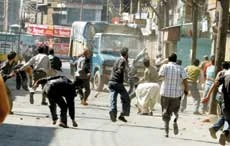
SRINAGAR, 28 September 2006 — Angry protests rocked Kashmir capital Srinagar yesterday after a court ordered the execution of a man convicted of helping mastermind an attack on Parliament.
Several hundred activists of pro-independence Jammu and Kashmir Liberation Front (JKLF) led by the group’s chairman, Mohammad Yasin Malik, staged protests in civil lines areas of Srinagar.
Another protest was staged by the women’s separatist group, Dukhtaran-e-Milat.
Police fired tear gas to disperse the protesters. The clashes erupted a day after an Indian judge told authorities to hang Mohammed Afzal, a Kashmiri, on Oct. 20 at New Delhi’s Tihar Jail over the 2001 attack that brought nuclear-armed India and Pakistan close to war.
Scores of protesters shouting “Afzal is innocent, release him” poured into the streets of Srinagar, summer capital of Indian Kashmir where a separatist insurgency has raged against New Delhi’s rule since 1989.
Police set up barricades and used batons to disperse the demonstrators who pelted stones at security forces, burned tires and forced shops to close. “Some 20 people including Yasin Malik, have been detained,” a police officer said
Earlier, police detained Malik along with a dozen supporters. “By hanging innocent Kashmiris India can’t suppress our freedom struggle,” Malik said before launching yesterday’s protests. Protesters held placards that read “Don’t repeat Maqbool Bhat, don’t hang Afzal”.
Mohammad Maqbool Bhat, the founder of JKLF, was hanged in 1984 for killing an Indian intelligence officer. Bhat is buried at New Delhi’s Tihar jail where Afzal is due to be executed.
Kashmiri lawyers protested the execution order by staying away from the courts in Srinagar, witnesses said.
In Afzal’s hometown of Sopore, 50 kilometers south of Srinagar, most shops and businesses were shut in protest, residents said. And the hard-line wing of the region’s main separatist alliance, the Hurriyat Conference, called for a one-day strike tomorrow over the judgment.
Last month, the Supreme Court upheld the death sentence against Afzal over the attack in which five heavily-armed attackers stormed Parliament on Dec. 13, 2001 and killed nine people before guards shot them dead.
The Supreme Court said there was no doubt of Afzal’s complicity in carrying out the terrorist act. India blamed the attack on Pakistan, a charge Islamabad rejected. Afzal can still seek clemency from India’s president, but his office has said no plea has yet been received.
However, the Hindustan Times newspaper quoted Afzal’s lawyers as saying he would file a mercy plea to the president.
In fresh violence yesterday, suspected militants shot dead one policeman and wounded another in Srinagar. Later, militants threw a grenade at a security bunker in the city, wounding five policemen and two civilians.
India’s Supreme Court rarely authorizes executions, and only for what it considers the most heinous crimes. They are regularly delayed indefinitely or commuted by the president to life in prison.
India’s last execution took place in the eastern city of Calcutta in 2004, when Dhananjay Chatterjee was hanged for raping and murdering a girl.
The last death penalty carried out at the Tihar prison was in 1998, when Satwant Singh and Kehar Singh were hanged for the 1984 assassination of then Prime Minister Indira Gandhi.

