
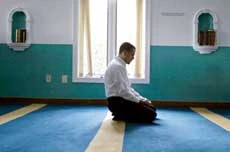
CHRIS Moore was an aspiring rock musician with earrings and a shaved head when he walked into a Northern Virginia mosque a dozen years ago and began asking questions about Islam.
A month later, the Christian-raised son of a US Navy man became a Muslim. His conversion initiated a spiritual odyssey that took him to several Muslim countries, including Saudi Arabia.
Moore’s faith journey ultimately brought the Annandale, Va., resident home, and today he is pursing a master’s degree at St. John’s College in Annapolis, Md., a university noted for its demanding curriculum based on reading classic works of Western civilization.
Like many other young Muslims in the United States, Moore is seeking to fashion an Islamic identity that flourishes in American society and influences it for the better. He feels a responsibility, he said, to contribute to a more harmonious relationship between Islam and the West — a task that is on his mind as he observes this year’s Islamic holy month of Ramadan, a period of daytime fasting and spiritual introspection that starts at sundown today.
“I’ll be doing a lot of reflecting on how I can make a difference in the state of affairs of Muslims — in the West, specifically,” said Moore, 31, who attends the Mustafa Center in Annandale.
Fluent in Arabic, Moore said he hopes to foster understanding between Muslims and non-Muslims by translating some of the “beautiful, deep wisdom that I’ve found in Arabic literature. ... There’s a lot in the Islamic tradition that people in this country ... would love.”
But first, he wants to better understand his own culture, which is why St. John’s was a logical choice. “What better way to understand the West,” he said, “than by going directly to the foundational texts and books and works that helped create that civilization?”
Ramadan, believed to be the period when God revealed the first verses of the Qur’an to the prophet Muhammad, is the most important month of the Islamic religious calendar. During this time, which is dedicated to spiritual growth, Muslims must refrain from eating, drinking and having sexual relations between dawn and sunset. It is also customary for Muslims to spend part of the days during Ramadan studying the Qur’an.
The daily fast is broken with an evening meal called the iftar, after which many Muslims attend special nightly prayers, known as taraweeh, at their mosques. Ramadan evenings are often festive, with visits among relatives and friends. The month ends with one of Islam’s major holidays, Eid Al-Fitr.
The arc of Moore’s personal journey from a very conservative to a more moderate expression of his faith echoes the spiritual path of many Muslim American converts. For Moore, the story began in 1994, a year after graduating from Annandale High School.
An only child, he became close friends with Aaron Sellars, another young aspiring musician. The two also shared a yearning for spiritual fulfillment, which led them to Dar Al Hijra Islamic Center in Falls Church. They walked in one day and began asking one of the members about Islam. Sellars converted that day; Moore, raised Catholic, did so shortly afterward.
He took to his new faith with an intensity typical of converts. He adopted the Arabic name Khalil, which means intimate friend, and gave up his beloved music, because a Saudi spiritual adviser convinced him that it was a sinful waste of time.
Moore also enrolled in the Saudi-run Institute of Islamic and Arabic Sciences in Fairfax to learn Arabic, because he wanted to read Islam’s scriptures in their original language.
When the Fairfax institute offered Moore a scholarship to study in Madinah, Saudi Arabia, he grabbed it — because to live in the town that Muhammad called home for several years is “the dream of every Muslim,” Moore said.
In 1999, he decided to study Islam elsewhere and traveled to Mauritania, Morocco, Yemen and Egypt. He worked at an Islamic educational center in Abu Dhabi for a while. During his travels, he returned in the summer to study English and religious studies at George Mason University, where obtained a bachelor’s degree in 2001.
To develop “a truly Muslim identity within the American context,” Moore said, Muslims in the United States need to combine what is best from their Islamic traditions and their American culture.
Moore, who no longer shuns music, is looking forward to the rigors of Ramadan. Although his current reading assignments from St. John’s include “King Lear” and “The Canterbury Tales,” he said he will strive to complete the traditional Ramadan practice of reading the Qur’an, a book of more than 6,000 verses, “from cover to cover” over the next 30 days.
He also, of course, will be fasting from dawn to sunset, a sacrifice that the Qur’an teaches is prescribed for Muslims “in order that you should become God-conscious,” Moore said.
“Ramadan is a very personal affair,” he added, noting that no one but God knows if you are truly fasting or sneaking a bite to eat. “Everyone can see that you’re praying,” he said. “But fasting — how can you tell?”